
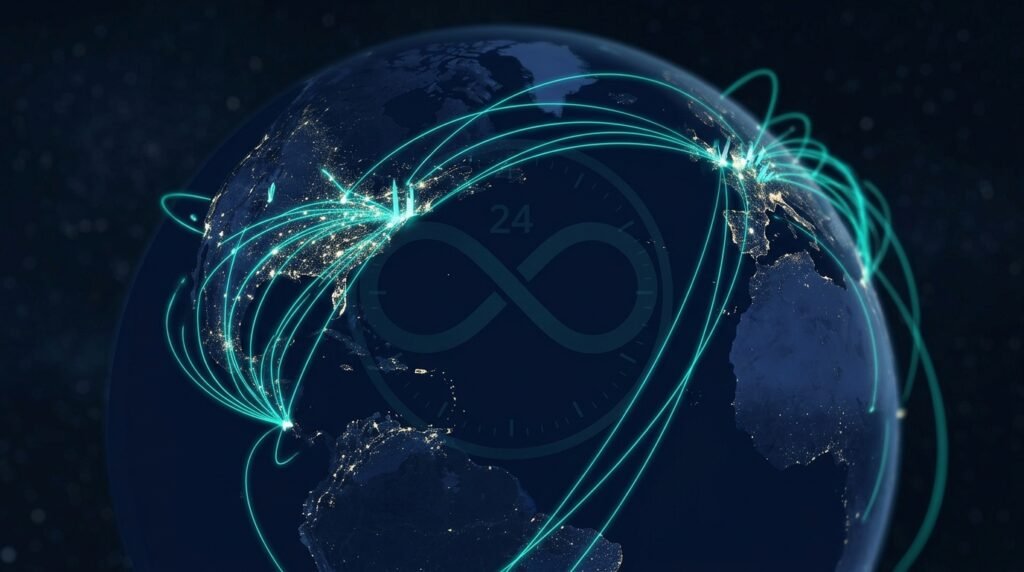
Partior and LSEG Team Up for ‘Always-On’ Cross-Border Settlement — Why It Matters for Asia
Singapore — 17 September 2026. Partior, the Singapore-founded blockchain-based
clearing and settlement network, and LSEG Digital Settlement House (DiSH) — part
of the London Stock Exchange Group — have announced a strategic collaboration to bring
round-the-clock settlement-bank liquidity to Partior’s global cross-border payments
network. Working with a group of banks, the two firms are building a Multi-Settlement
Bank (MSB) solution that pairs the reach of correspondent banking with the speed of
digital settlement.
The problem: money that can’t move after hours
Anyone who has waited days for an international transfer knows the pain. Behind the
scenes, that delay is often caused by the plumbing of correspondent banking — the
web of accounts banks hold with one another to move money across borders.
Two frictions dominate:
- Pre-funded nostro/vostro accounts. Banks must park cash in accounts held at
partner banks abroad (“nostro” = our account with you; “vostro” = your account with
us) just so payments can settle. That capital sits idle, tied up as a cost of doing
business. - Payment cut-off times. Traditional settlement rails run on business hours and
regional windows. Once the cut-off passes, money effectively stops moving until the
next day.
As Partior and LSEG put it, in a world moving toward near real-time, programmable
payments, “fragmented settlement is no longer simply inefficient — it is incompatible.”
The fix: shared rails, 24/7 liquidity
The MSB solution combines LSEG DiSH’s omnibus trust-account framework with
Partior’s multi-currency clearing and settlement network. In plain terms, it lets
participating banks move settlement liquidity across multiple banks and currencies
24/7 — without each bank having to open direct bilateral accounts with every
counterparty or plug into every proprietary digital network.
The target design promises:
- 24/7 liquidity management without opening nostro/vostro accounts
- A unified experience for corporate clients across participating banks
- Frictionless interbank settlement on shared infrastructure
- Foundations for intraday FX and intraday repo (PvP and DvP settlement)
Who’s involved
This is not a two-company science project. Some of the world’s largest banks are already
in testing, including J.P. Morgan’s Kinexys, Deutsche Bank, and Standard
Chartered — the last a founding shareholder of Partior.
“By adding our omnibus trust account option with Partior’s clearing scheme, we enable
participating banks to instantly manage settlement liquidity 24/7 without the need for
direct bilateral account and proprietary digital system integration.”
— Andrew Williams, CEO, Post Trade Solutions, LSEG“We eliminate legacy nostro friction and offer a proven, production-ready blueprint for
the rest of the global banking community to join.”
— Humphrey Valenbreder, CEO, Partior
Partior, LSEG and the participating banks are currently in industry testing, with
production go-live and commercial onboarding of additional settlement banks targeted
from Q1 2027. (The “always-on” availability is subject to scheduled maintenance and
downtime.)
Why it matters for Asia
For the region FinDeskAsia watches most closely, this is more than a back-office upgrade:
- A Singapore-born network goes global. Partior was spun out of a Singapore project
backed by DBS, J.P. Morgan and Temasek, with Standard Chartered as a founding
shareholder. Its expansion cements Singapore’s role as a hub for next-generation
settlement infrastructure. - Cheaper, faster corridors. For Asian corporates and financial institutions,
removing pre-funded nostro requirements frees up trapped capital and can lower the
cost of USD, SGD and regional-currency payments — the corridors that carry trade,
payroll and remittances across the region. - A template for the ringgit and beyond. As Bank Negara Malaysia and regional
regulators explore real-time and cross-border rails (from DuitNow’s cross-border QR
links to tokenised settlement), a bank-grade, interoperable “always-on” model offers a
blueprint for how commercial-bank money could settle 24/7 across ASEAN.
The direction of travel is clear: the industry is stitching together digital and legacy
systems so money can move whenever business needs it — not just when the settlement
window is open.
FinDeskAsia reports on the payments and financial infrastructure shaping Asia. This
article is based on the companies’ 17 September 2026 announcement and public statements.
