
Laos: China’s Digital Yuan Now Pays at 17 Lao Banks and Wallets, Settled in Kip
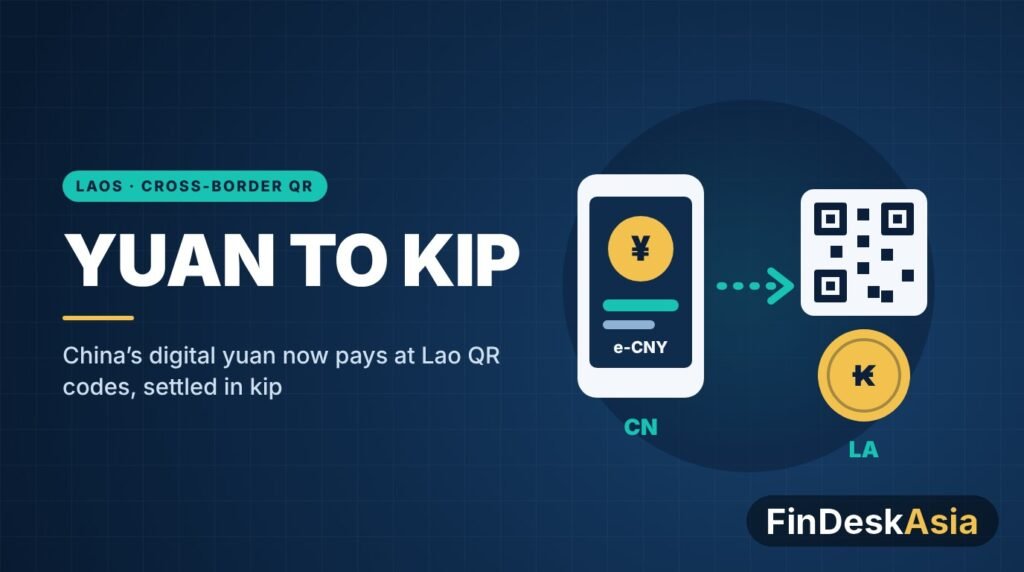
Chinese visitors in Laos can now pay local shops straight from China’s digital yuan wallet by scanning an ordinary Lao QR code, while the merchant is paid in Lao kip. A new note from AMRO, the ASEAN+3 economic watchdog, calls the link a new model for cross-border payments, because it plugs a central bank digital currency directly into another country’s national payment network.
Key facts
- The People’s Bank of China (PBOC) and the Bank of the Lao PDR (BOL), the Lao central bank, launched the China–Lao PDR Cross-Border Digital Payment Connect in Nanning on 18 September 2026.
- Users of e-CNY, China’s retail digital yuan, can scan QR codes from 17 members of LAPNet, Laos’ national payment network: 15 banks and two e-money providers.
- Merchants receive Lao kip through domestic channels, with settlement handled by a Lao-regulated financial institution.
- At launch the service only works one way: Chinese consumers paying Lao businesses.
- More than 1.16 million Chinese visitors travelled to Laos in 2025, and China is Laos’ largest foreign investor, with over US$18 billion invested.
How the link works
Most QR payment links in Asia, including the ones between ASEAN countries, connect bank accounts or e-wallet accounts on each side. This one is different. On the Chinese side, the money sits in an e-CNY wallet, a form of digital cash issued by the PBOC itself and handed out through approved operators such as large Chinese banks.
A Chinese tourist opens the e-CNY app, scans a Lao merchant’s QR code, checks the exchange rate and fees on screen, and confirms. The payment is routed through LAPNet, converted by regulated intermediaries, and the shop receives kip in near real time. Neither side needs new hardware: the merchant uses the same QR code it already shows local customers.
The technical work was done by China’s Digital Currency Institute and LAPNet. The project grew out of a memorandum of understanding on digital payments and central bank digital currencies that the two central banks signed in March 2024 and amended in June 2026. According to Chinese state media, some Lao banks have also joined CBETS, China’s cross-border e-CNY transfer service, to pilot payments for trade and investment.
Why it matters
For Laos, the link gives small shops, guesthouses and restaurants a way to take money from Chinese visitors without handling foreign cash or paying for card terminals. Because the merchant is paid in kip, the central bank keeps its own currency at the centre of domestic trade, a sensitive point in a country where the kip has been under pressure. Authorities also get a clearer view of cross-border spending than they have with cash or informal money changers.
For China, it is a test of whether the digital yuan can work abroad for everyday spending, not just for large bank-to-bank transfers. Adoption so far has been modest: AMRO notes that Hong Kong, which links e-CNY to its own instant payment system, had about 80,000 e-CNY wallets registered to Hong Kong phone numbers by the end of January 2026. Laos, linked to China by the China–Laos Railway, is a natural next market.
For the wider region, the model shows that a central bank digital currency and a conventional national payment network can talk to each other. AMRO, which monitors the 10 ASEAN economies plus China, Japan and South Korea, says lessons from the link could guide similar connections elsewhere.
AMRO also lists the risks. Wider use of the renminbi in Lao pricing or savings could weaken the kip’s role, a problem economists call currency substitution. Bigger flows raise anti-money-laundering and fraud risks, and users will need dependable refunds and dispute handling. AMRO urges both sides to keep exchange-rate conversion transparent and to publish basic statistics such as active users, success rates, fees and spreads.
What to watch
- Whether the link expands beyond tourist spending to remittances, person-to-person transfers and payments between businesses, which AMRO says should follow sandbox testing.
- Whether more e-CNY apps, Lao banks, e-wallets and merchants outside the main tourist areas join.
- Whether the PBOC and BOL publish usage data, and whether other ASEAN central banks look at similar links to the digital yuan.
Related on FinDeskAsia: China wants overseas banks to offer digital yuan accounts and ASEAN’s cross-border QR links.
Sources: AMRO (November 2026), TNGlobal (November 2026), Thailand Business News (November 2026), Global Times (September 2026).
