
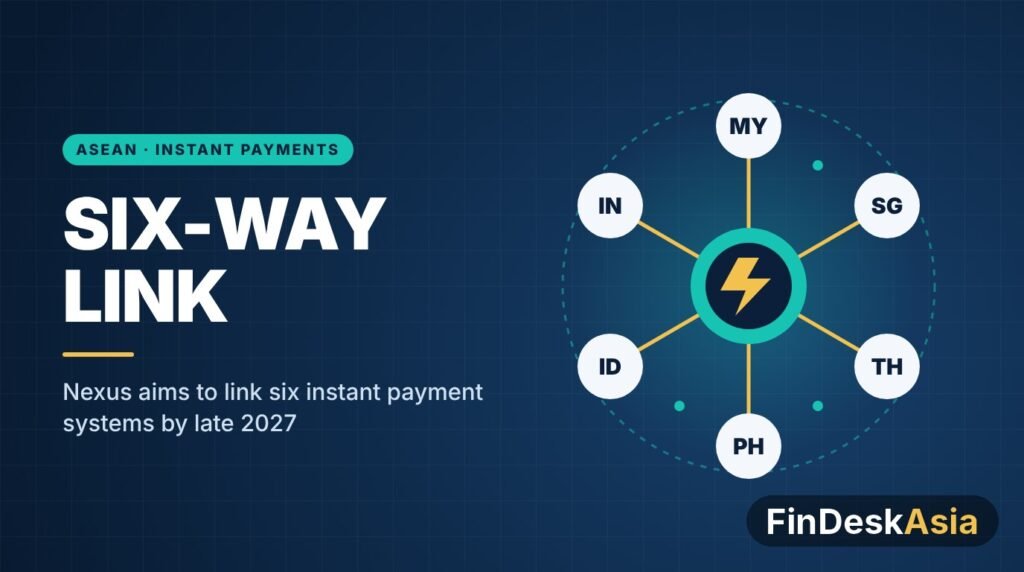
Nexus Targets Q4 2027 Launch to Link Instant Payments in Six Asian Countries
Nexus Global Payments, the body building a shared hub for Asia’s instant payment systems, is now aiming to go live in the fourth quarter of 2027. Its chief executive, Andrew McCormack, gave the target at a Bank of Korea payments conference in Seoul on 11 November. The network would let people in six countries send money across borders through the same fast-transfer systems they already use at home.
Key facts
- Six countries: Nexus links the national instant payment systems of India, Indonesia, Malaysia, the Philippines, Singapore and Thailand.
- Launch target: The fourth quarter of 2027, according to Mr McCormack’s presentation at the Bank of Korea conference.
- One hub, not many links: Each country’s system connects once to a common platform, so it does not need a separate bilateral link with every other country.
- Operator: A joint venture of Malaysia’s PayNet and Singapore’s NETS was appointed in February 2026 to build and run the network, with Amazon Web Services and Endava as technology partners.
- South Korea is not in it: The Bank of Korea hosted the talk but has not announced plans to join the live network.
What Nexus is
Most Asian countries now have an instant payment system: a national network that moves money between bank accounts and e-wallets in seconds, often using just a phone number or a QR code. Malaysia’s version is DuitNow, run by Payments Network Malaysia (PayNet). India’s is the Unified Payments Interface (UPI).
These systems work well at home but stop at the border. Countries have been joining them up in pairs, but each pair needs its own technical and legal arrangement. With six countries that can mean up to 15 separate links. Nexus, which grew out of a project at the Bank for International Settlements (BIS), the “central bank for central banks”, replaces that web with one shared hub.
The platform coordinates the transfer, but it does not hold the money. Banks and foreign exchange providers still convert the currency and settle the payment, as they do today.
Why it matters
The people who stand to gain most are those who send money abroad often: migrant workers sending wages home, travellers paying overseas, and small businesses paying foreign suppliers. Today many of these payments go through correspondent banks, a chain of banks that each take a fee and add delay.
Nexus is designed to match a G20 goal for cross-border payments: the money should arrive within 60 seconds, and the fee and exchange rate should be shown to the sender before they press “send”. That transparency matters as much as the speed, because hidden exchange-rate mark-ups are one of the biggest costs in remittances.
The firmer date also gives banks and e-wallets in the six markets a clear deadline to prepare their own systems. The PayNet–NETS joint venture began technical development in early 2026.
The Seoul conference showed how far the idea is spreading. The Bank of England described its plan to settle tokenised assets with central bank money by 2028, while Brazil’s central bank presented its Pix instant payment system. Korea’s absence from Nexus is notable, given how many Korean tourists and workers move around South-East Asia.
The Malaysia link
Malaysia has an unusually large role. It is one of the six countries, and PayNet, the operator of DuitNow, co-runs the technical operator with NETS. Once Nexus is live, a DuitNow user should be able to pay into an account in, say, the Philippines or India using the same app, with the fee and rate shown up front. That could help Malaysia’s large community of foreign workers, and Malaysian SMEs that buy from regional suppliers.
What to watch
- Whether the fourth-quarter 2027 date holds as the six national systems finish connecting and testing.
- Which banks and e-wallets sign up first in each country, and what fees they charge customers.
- Whether more central banks, including South Korea’s, decide to join after launch.
Related: How ASEAN’s cross-border QR links are growing and PayNet and the regulators.
Sources: Aju Press (November 2026); Seoul Economic Daily (November 2026); Fintech News Singapore (February 2026).
