
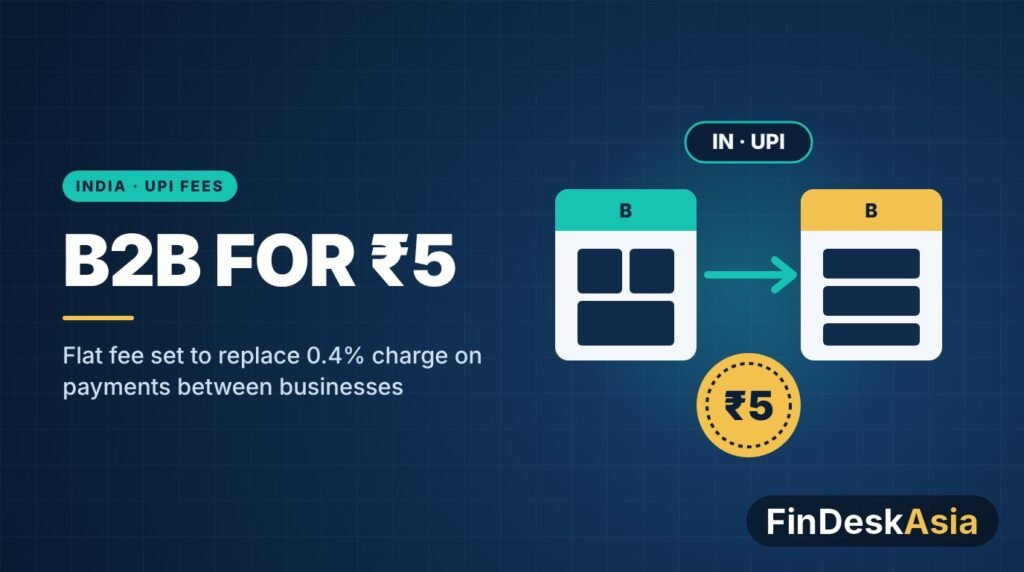
India: UPI Payments Between Businesses Set for Flat ₹5 Fee Instead of Up to ₹300
Businesses in India that pay each other through UPI (Unified Payments Interface), the country’s real-time payment network, look set to pay a flat ₹5 fee per transfer rather than a percentage of the amount. The decision, reported by Business Standard, would cap what many wholesalers, distributors and B2B platforms had feared could be charges of up to ₹300 a payment.
Key facts
- NPCI’s UPI and Services Steering Committee has reportedly approved a flat ₹5 merchant discount rate (MDR) for merchant-to-merchant (M2M) UPI payments, citing two people aware of the matter.
- The ₹5 fee would cover wholesaler-retailer payments, B2B marketplaces and B2B collections.
- Under the general 0.4% rate for merchant payments above ₹2,000, a typical ₹20,000 to ₹40,000 M2M transfer would have cost ₹80 to ₹160, and payments of ₹75,000 or more would hit the ₹300 cap.
- The wider fee framework was due to start on 15 October 2026 but was put off until after Diwali; no new start date has been announced.
What is changing
For most of its 10-year life, UPI has been free for both consumers and merchants. That is ending. In September, the National Payments Corporation of India (NPCI), which runs UPI under the oversight of the Reserve Bank of India (RBI), issued a framework that lets banks and payment firms charge merchants an MDR. The MDR is the small fee a shop pays its bank or payment provider each time it accepts a digital payment.
Under that framework, published with an FAQ by the Finance Ministry’s Department of Financial Services, person-to-merchant (P2M) payments of ₹2,000 or less stay free. Above ₹2,000, merchants pay 0.4%, up to a maximum of ₹300. Some sectors, including railways, telecom, insurance, fuel and utility bills, pay a flat ₹5 instead. Person-to-person transfers remain free, as do small vendors receiving up to ₹1 lakh (₹100,000) a month through UPI QR codes into their own accounts. Merchants are not allowed to pass the fee on to customers.
The September rules left one gap: they did not set a separate rate for payments between businesses. That is the gap the steering committee has now reportedly filled.
Why it matters
B2B payments behave very differently from a shopper buying coffee. According to the report, the average M2M ticket on UPI is about ₹20,000 to ₹40,000, so a percentage fee would bite hard on every restocking order. The All India Consumer Products Distributors Federation (AICPDF) says around 65% of consumer payments that retailers receive, and 40–45% of retailers’ payments to distributors against credit bills, are already settled on UPI. It warned that fees charged at both stages of the supply chain could squeeze members’ thin margins, and has asked Finance Minister Nirmala Sitharaman to exempt M2M payments altogether. A flat ₹5 falls short of that request but removes most of the cost.
For banks and payment companies, the fee framework is the first real revenue from UPI acceptance, which they have long said is expensive to run, especially in smaller towns. A low, flat M2M fee keeps businesses on UPI rather than pushing them back to cash or slower bank transfers, while still giving providers some income.
For the region, India is the largest test of moving a free national QR and instant-payment system to a paid model. Neighbouring central banks building their own real-time networks, many of which are now linking to UPI, will be watching how merchants respond once fees start.
What to watch
- An official NPCI circular confirming the ₹5 M2M rate, and the new start date for the whole MDR framework.
- Whether the government grants distributors’ request for a full M2M exemption, and how GST on MDR is handled; that question sits with the GST Council, not NPCI or the RBI.
- Signs that larger merchants shift payments to other channels once the 0.4% fee kicks in.
Related on FinDeskAsia: India’s UPI fees and street vendors · NPCI’s UPI Vyapaar Saksham scheme for small merchants
Sources: Business Standard (November 2026); Business Today (November 2026); Elets BFSI (November 2026); Department of Financial Services MDR FAQ (September 2026)
