
South Korea: Hyundai Card and J.P. Morgan Let AI Agents Run Cross-Border Transfers
Two pieces of software, one at a South Korean card company and one at a global bank, have moved money between each other without a person pressing “send”. Hyundai Card says it has completed a proof of concept with Kinexys, J.P. Morgan’s blockchain unit, in which AI agents handled cash management, currency conversion and transfers between overseas units on their own. The test used simulated transactions, but it is one of the clearest looks yet at how “agentic” payments could work inside large companies.
Key facts
- Who: Hyundai Card, the card and finance arm of Hyundai Motor Group, and Kinexys by J.P. Morgan, the bank’s permissioned blockchain platform (formerly known as Onyx).
- What: AI agents at the two firms talked to each other to manage cash, foreign exchange (FX) and fund transfers between two hypothetical overseas subsidiaries.
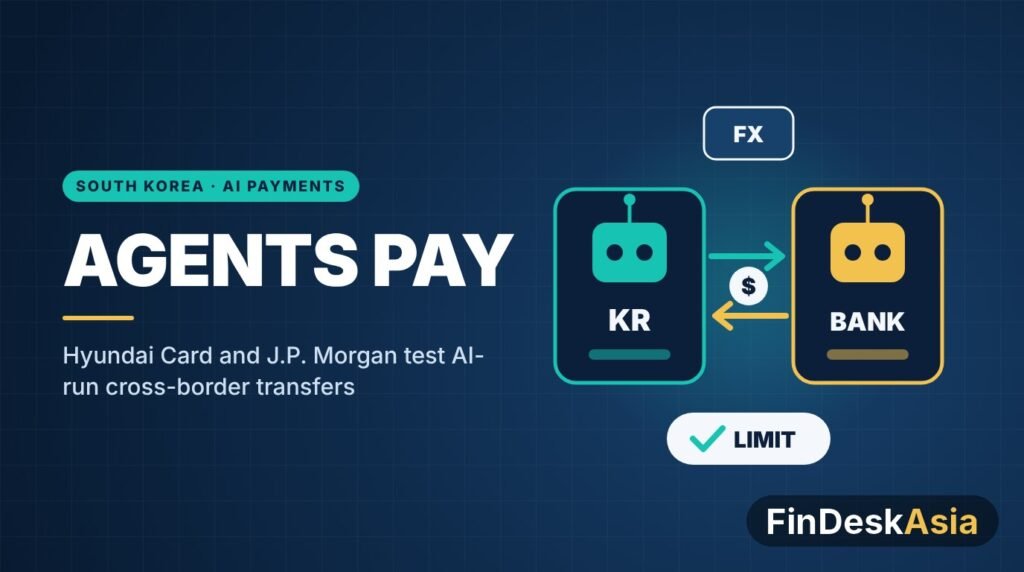
- How: When the receiving unit’s balance dropped below a set level, Hyundai Card’s agent compared FX quotes from several banks and told the Kinexys agent to convert and send the shortfall.
- Controls: Payments inside pre-approved limits went through automatically; anything outside them was sent to a human for approval or rejected.
- Next: A more complex trial with several AI agents is planned for the first half of next year, and the firms are looking at in-vehicle payments.
How the test worked
The set-up split the work clearly. Hyundai Card designed the scenario and wrote the rules on what each agent was allowed to do. Kinexys built the agents for both companies, plus the checks that sit around them: identity verification, authorisation and transaction controls.
In practice, the Hyundai Card agent acted like a treasury analyst. It watched the balances of both subsidiaries, shopped around for the best exchange rate and worked out how much money needed to move. It then sent an instruction to the Kinexys agent, which acted more like the bank’s payments desk. Before doing anything, the Kinexys agent confirmed that the request really came from an authorised Hyundai agent and that the amount was within the limits it had been given. Only then did it convert the currency and send the funds over the Kinexys network.
This “agent talks to agent” design matters. Most AI payment pilots so far have involved one assistant shopping or paying on behalf of a consumer. Here, two agents at separate institutions had to trust and check each other, which is closer to how real corporate banking works.
Why it matters
Big manufacturers such as Hyundai Motor Group run production and sales units around the world. Keeping each one funded in the right currency is a daily chore for treasury teams, and it is often slowed by bank cut-off times, time zones and manual sign-offs. According to Korean press reports, the companies see the model being used for group-wide cash management across affiliates such as Hyundai Motor and Kia, spotting funding gaps in real time and moving money outside normal banking hours.
The limits built into the test are the most important detail for regulators. Across Asia, central banks are asking how far AI should be trusted with money. Vietnam’s central bank, for example, has just labelled some AI-made payments as high-risk. A model where the agent can only act inside a pre-set “box”, with humans stepping in for anything larger, is likely to be the template that supervisors look for.
The pilot also builds on Hyundai Card’s earlier blockchain work. In July, it ran a live stablecoin test that moved funds between Hyundai units in the United States and Mexico using Tether’s USDT on the Avalanche blockchain. Together, the two trials show a South Korean conglomerate testing both new payment rails and new ways of deciding when to use them.
What to watch
- Whether the multi-agent trial planned for the first half of next year uses real money rather than simulated transactions.
- How South Korea’s Financial Services Commission and other Asian regulators set rules for AI agents that can move funds.
- Whether other Asian banks and conglomerates follow with similar agent-to-agent treasury pilots.
Related on FinDeskAsia: Vietnam’s new rules for AI payments and KakaoBank’s Apple Pay launch.
Sources: Fintech News Hong Kong (November 2026); CoinDesk (November 2026); Seoul Economic Daily (November 2026); Cointelegraph (July 2026).
