
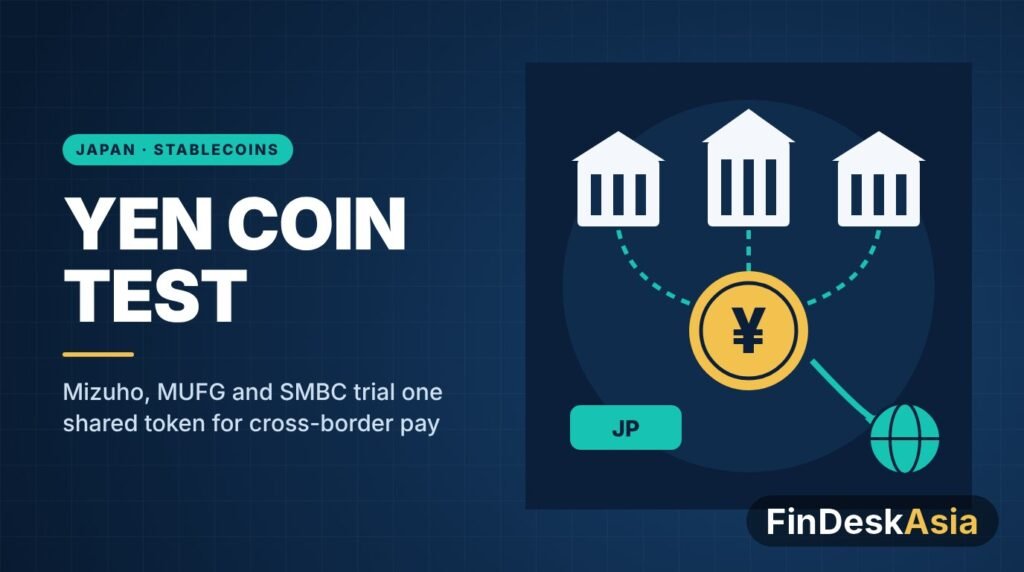
Japan’s Megabanks Complete Joint Yen Stablecoin Pilot for Cross-Border Payments
Japan’s three largest banks have finished testing a yen stablecoin that they issued together, and they used it to move money between a major trading house and its overseas offices. Mizuho, MUFG and SMBC announced the results on 16 October 2026 and said they are aiming for real commercial transactions before the end of March 2027.
A stablecoin is a digital token designed to hold a steady value, in this case one yen per token, backed by money held in the banking system. What makes this test unusual is that three rival banking groups issued a single shared token rather than each building their own.
Key facts
- Who: Mizuho Bank, MUFG Bank and Sumitomo Mitsui Banking Corporation (SMBC) acted as joint issuers, with Mitsubishi UFJ Trust and Banking as trustee and TISI Inc. as a technology partner.
- What was tested: the full life cycle of the token: issuing it, transferring it and redeeming it back into yen.
- Use case: cross-border settlement between Mitsubishi Corporation’s head office in Japan and its overseas offices.
- When: the pilot ran in July 2026; results were announced on 16 October 2026.
- Next step: live commercial transactions are targeted within Japan’s fiscal year 2026, which ends in March 2027.
How the yen token works
The coin was issued under Japan’s Payment Services Act, which was amended in 2023 to create a legal category for stablecoins, officially called “electronic payment instruments”. Under that law, only licensed banks, registered money transfer firms and trust companies may issue them, which keeps the market in the hands of regulated players.
The banks used a trust structure. The three megabanks act as joint “settlors”, meaning they put the backing funds into a trust, while a trust bank holds and manages those funds on behalf of token holders. In the test, tokens could only move between customers who had passed identity checks (known as KYC, or “know your customer”) at the participating banks, and anti-money laundering controls were part of what was tested.
The project has the backing of Japan’s Financial Services Agency (FSA), the country’s financial regulator. It was selected in November 2025 under the FSA’s Payment Innovation Project, part of its FinTech Proof-of-Concept Hub, a programme that has supported fintech experiments since 2017. In June 2026 the three banks set up a joint council to work out the governance and day-to-day operations needed for a real launch.
Why it matters
For corporate treasurers, moving money between a parent company and its foreign branches often means waiting on correspondent banks, cut-off times and several days of settlement. A bank-issued token that can be transferred and redeemed on demand promises faster, round-the-clock movement of funds, while keeping the money inside the regulated banking system.
The joint approach also matters. If each megabank issued its own coin, corporate clients would face three incompatible tokens. A single shared yen token, accepted across the three groups, is closer to how cash and bank transfers already work and could become a common standard for Japanese companies operating abroad.
Japan is not alone. Several yen stablecoins from other issuers have appeared since late 2025, and regulators across Asia are testing similar ideas. In Malaysia, Bank Negara Malaysia (BNM) has its own tokenisation roadmap and ringgit stablecoin pilots. Japan’s megabank model, where established banks issue a jointly backed token under clear rules, is one template that other markets in the region will be watching closely.
What to watch
- Whether the first live commercial transactions happen on schedule before the end of March 2027, and which corporate clients join beyond Mitsubishi Corporation.
- How the shared token connects with overseas banks and payment systems, which will decide how useful it is for cross-border trade in Asia.
- Any further FSA guidance on how bank-issued stablecoins sit alongside other yen tokens already on the market.
Related on FinDeskAsia: ASEAN cross-border QR payments hit a record and BNM’s tokenisation roadmap and ringgit stablecoin pilots.
Sources: BeInCrypto (October 2026), CoinTurk News (October 2026), The Defiant (October 2026), The Block (June 2026), Decrypt (June 2026).
