
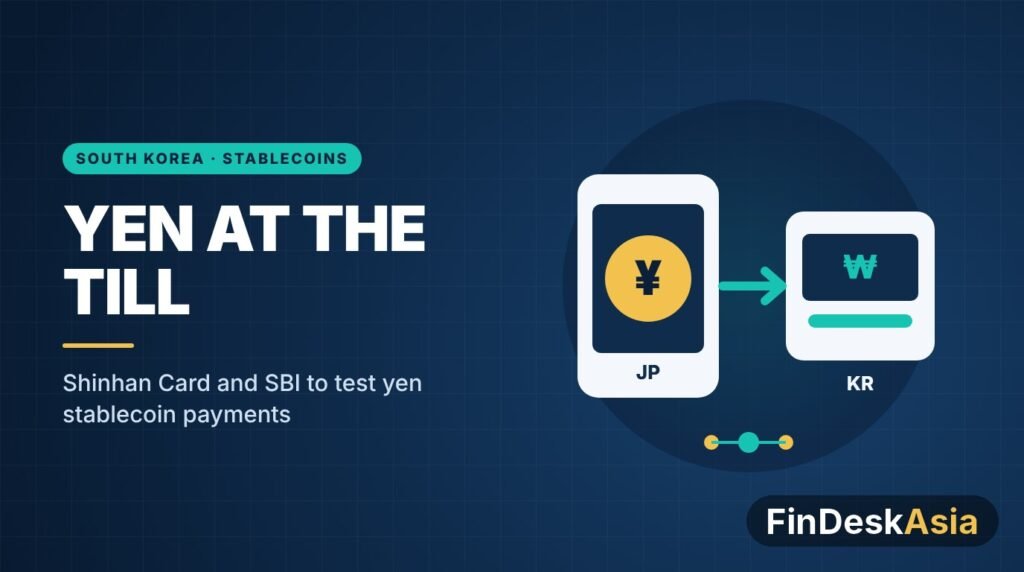
South Korea’s Shinhan Card and Japan’s SBI to Test Yen Stablecoin Payments for Travellers
South Korea’s Shinhan Card has teamed up with two units of Japan’s SBI Group to test whether travellers can pay in shops with a yen-backed stablecoin, a digital token designed to hold the same value as the Japanese yen. The memorandum of understanding (MOU), signed in Tokyo on 20 October 2026, also covers wallet-to-wallet transfers and settling trade payments between the two countries. It is an early-stage study, and no launch date has been set.
Key facts
- Who: Shinhan Card, one of South Korea’s largest card issuers, with SBI VC Trade, SBI’s licensed crypto exchange, and SBI XDC Network APAC, a blockchain venture SBI formed in December 2023.
- What: phased proof-of-concept tests on yen stablecoin card payments, wallet-to-wallet transfers and cross-border trade settlement, including links to existing remittance channels.
- Scale: Shinhan Card has about 20 million cardholders.
- Demand: Japan and South Korea logged more than 10 million visitor arrivals between them in the first eight months of 2026, including 7.42 million South Koreans visiting Japan and about 2.7 million Japanese visiting South Korea.
- Not yet decided: the partners have not named the stablecoin, the merchants or the test dates.
How the pilot would work
The idea is simple from the shopper’s side. A Japanese tourist in Seoul would hold yen stablecoins in a digital wallet and pay at the till through a card, with a checkout that feels like any normal card payment. Behind the scenes, the token would be converted and the Korean merchant would be paid in won. The partners say they will study the user experience, how transactions are processed and the technical and operational set-up in stages before judging whether a commercial service makes sense.
The tests will also look at anti-money-laundering (AML) checks and fraud detection, which regulators in both countries will expect before any stablecoin touches everyday retail payments. Shinhan Card and SBI XDC Network APAC will also explore infrastructure on the XDC Network, a blockchain used for trade finance, although neither side has committed to running a node on it.
Both sides bring some experience. SBI VC Trade registered in March 2025 as Japan’s first “electronic payment instruments exchange service provider”, a licence under Japanese law that allows it to handle regulated stablecoins such as Circle’s USDC. Shinhan Card completed an earlier proof of concept on stablecoin payments and overseas settlement in April 2026.
Why it matters
Travel between Japan and South Korea is one of the busiest tourist corridors in Asia, and South Korea was Japan’s largest source of foreign visitors in the first eight months of the year. Today, most of that spending runs through card networks or currency exchange counters, each adding fees and a delay before merchants are paid. A regulated yen stablecoin could, in theory, let a visitor pay directly from a digital wallet and let merchants settle faster.
The trade-settlement part of the deal may prove just as important. Companies that buy and sell across the Korea–Japan border still rely on correspondent banking, which can take days. Tokens that move on a blockchain around the clock could cut that time, provided the AML and conversion steps hold up.
The deal also fits a wider regional trend. Banks and card firms across Asia are moving from talking about stablecoins to testing them in narrow, supervised use cases, while governments write the rules. South Korea is still finalising its own digital asset legislation, including how won-backed stablecoins would be issued, so a pilot built on a yen token from a licensed Japanese player is a lower-risk way for Shinhan to learn.
What to watch
- Which yen stablecoin is chosen and who issues it. SBI has its own yen token project, but it has not been confirmed for this pilot.
- Test dates, the first merchants and whether real Shinhan cardholders take part.
- How South Korea’s pending digital asset rules treat foreign stablecoins used for local payments.
Related on FinDeskAsia: Japan’s Megabanks Complete Joint Yen Stablecoin Pilot for Cross-Border Payments and ASEAN Cross-Border QR Payment Network Hits a Record.
Sources: Cointelegraph (October 2026); crypto.news (October 2026); Unchained (October 2026).
