
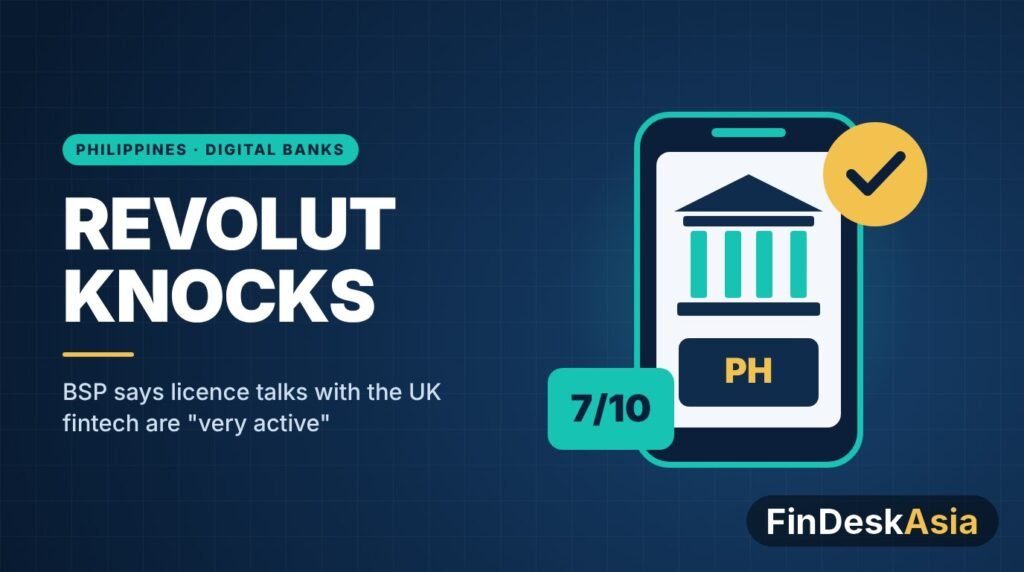
Philippines: BSP Says Revolut Digital Bank Licence Talks Are “Very Active”
The Bangko Sentral ng Pilipinas (BSP), the Philippine central bank, says its talks with British fintech Revolut about a digital banking licence are still “very active”. The comments, made on 25 October by a BSP deputy governor, are the clearest sign yet that Revolut wants to move beyond its Manila tech office and serve Filipino customers directly.
Key facts
- Talks confirmed: BSP Deputy Governor Lyn Javier, who heads the bank’s Financial Supervision Sector, said discussions with Revolut are ongoing and that the company remains interested.
- No shortcut: Revolut must still pass the BSP’s full assessment, including the rules for a foreign bank setting up locally. Timing depends on how quickly it can comply.
- Two licences in view: According to the Department of Trade and Industry (DTI), Revolut is studying a wholly owned Philippine company that could hold both a digital bank licence and an electronic money issuer (EMI) licence.
- Crowded but capped market: The Philippines has seven licensed digital banks. MariBank became the seventh in July 2026, and the BSP allows a maximum of 10.
How Revolut got here
Revolut already has people on the ground. It opened a global technology hub in Manila in July 2025 that supports its teams in the UK, Europe, Asia-Pacific and the Americas. It has also named Albert Tinio, a former co-chief executive of GoTyme Bank, as its Manila-based CEO-designate.
In early October, Trade Secretary Cristina Roque met Revolut’s global head of government affairs, Adam Gagen, at the company’s London headquarters. The DTI said Revolut was weighing which regulatory route and company structure to use, and offered to help it talk to the relevant agencies.
The licence question is where it gets harder. A digital bank in the Philippines is a full bank that operates mainly online, with no branch network. An EMI is a lighter licence that lets a company hold e-money for customers and use it for payments and transfers, but not run a full lending and deposit business. Revolut appears to want the option of both.
Why it matters
The BSP paused new digital bank licences for three years before reopening applications in January 2025 with four new slots. Applications closed at the end of November 2025 and are still being processed. The BSP has said a European bank applied, but it has not named it, and it is not clear whether that was Revolut.
For Filipino consumers, another well-funded digital bank would mean more competition on savings rates, cards and especially overseas transfers, one of Revolut’s core products in other markets. Remittances matter a great deal in the Philippines, where millions of families rely on money sent home by relatives working abroad.
For incumbents, the timing is awkward. Local players such as GoTyme, Maya, Tonik, UnionDigital and MariBank are already fighting for the same young, mobile-first customers, and e-wallet giant GCash dominates everyday payments. A global brand with a multi-currency app would raise the bar on fees and user experience.
The story also echoes debates across the region. Several ASEAN regulators, including Bank Negara Malaysia, have chosen to license only a small number of digital banks at a time, so they can watch risks closely before opening the door wider.
What to watch
- Whether the BSP’s Monetary Board fills the remaining digital bank slots, and whether Revolut is among the winners.
- Whether Revolut applies for an EMI licence first, which could let it launch payments and transfers sooner.
- The BSP’s separate plan to let existing thrift, rural and cooperative banks convert into digital banks, which could add more rivals.
Related on FinDeskAsia: GCash parent Mynt lists after a record IPO and ASEAN’s cross-border QR record.
Sources: BusinessWorld (October 2026); Crowdfund Insider (October 2026); The Philippine Star (October 2026); Fintech News Philippines (October 2026).
