
Singapore: Grab, Wise and Liquid Group First to Adopt Payments Code on Hidden Fees
Grab, Wise and Liquid Group are the first payment companies to publicly back a new industry code in Singapore that targets hidden foreign-exchange mark-ups, misleading “zero fee” claims and weak fraud controls. The voluntary code was launched in August by the Singapore FinTech Association (SFA), and these early adopters give it its first real test with customers.
Key facts
- Grab, Wise and Liquid Group are the first three providers to declare adherence to the SFA Payments Industry Code of Conduct, according to reports published on 27 October 2026.
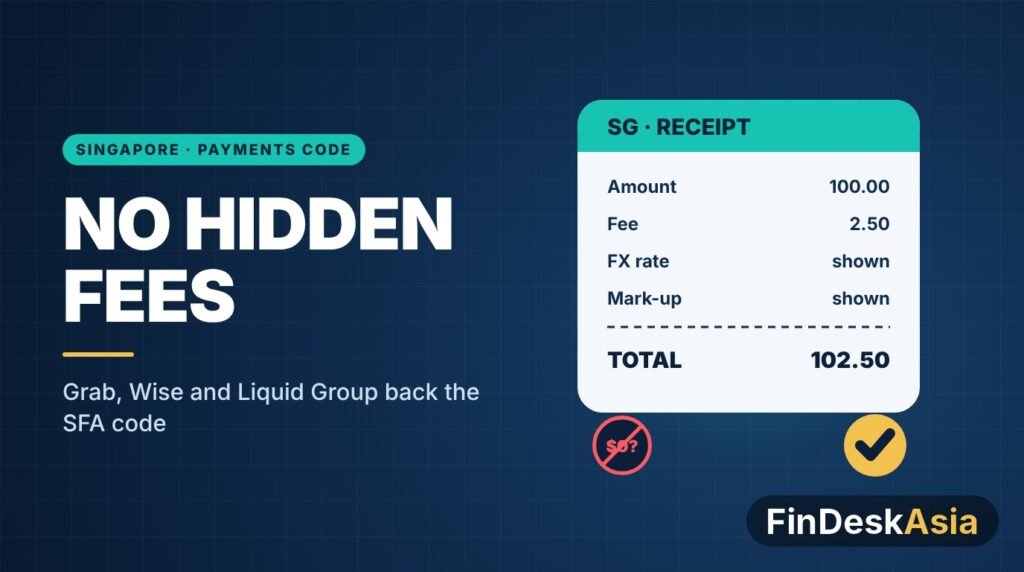
- The code asks providers to show the full cost before a customer commits: the amount sent, transaction fees, the exchange rate, any mark-up and the final amount.
- It bans “drip pricing” (adding compulsory charges partway through a payment) and calling a service “free” when an undisclosed mark-up or exchange-rate spread is built in.
- Joining is voluntary and based on self-assessment; a declaration is valid for one year and must then be renewed.
- The code sits on top of the Payment Services Act 2019 and the rules of the Monetary Authority of Singapore (MAS), the central bank and financial regulator. It does not replace them.
What the code asks providers to do
The code covers firms licensed under Singapore’s Payment Services Act, including major payment institutions, standard payment institutions and money-changers, as well as exempt providers. It applies only to ordinary currency (fiat) payment services, so crypto or “digital payment token” services are left out.
Beyond pricing, the code sets out several other standards:
- Fair advertising: ads must not give a false picture of cost, and comparisons with rivals must be accurate and backed up. A provider cannot highlight a competitor’s fees while leaving out its own.
- Fraud prevention: each adherent needs a written fraud framework with regular risk checks, transaction monitoring, clear escalation steps and ongoing scam education for users.
- Card protection: for card services, customer liability for unauthorised transactions should follow the limits in the Association of Banks in Singapore’s code of practice.
- Data breaches: affected users and Singapore’s Personal Data Protection Commission must be told as soon as practicable, and within three calendar days of the firm assessing a notifiable breach.
- Resilience: critical systems such as wallet ledgers, payment gateways, customer-facing APIs and log-in services must be identified and stress-tested.
Once a firm has checked its own policies and systems against these standards, it can call itself a “Code Adherent”. It must state the year of its self-assessment and must not overstate its compliance.
Why it matters
Hidden costs are a long-running complaint in money transfers and currency exchange. A service can advertise no fees while quietly using an exchange rate worse than the market rate, so the customer pays through the spread. By asking for the mark-up and final amount to be shown up front, the code makes it easier for users in Singapore to compare a wallet, a remittance app and a bank on the same basis.
The choice of early adopters is notable. Grab runs one of Southeast Asia’s biggest consumer apps and helped shape the code before it launched. Wise is a cross-border transfer specialist that has long campaigned against hidden FX fees, and Liquid Group operates a regional QR payment network. Leaders from Wise and Liquid Group have co-chaired the SFA’s payments subcommittee that worked on the code.
Because the code is voluntary, its impact depends on how many other providers sign up. Grab has said it hopes more payment firms will follow. For the wider region, the code offers a template for industry-led consumer standards in markets where e-wallets and remittance apps are growing faster than rules on pricing disclosure.
What to watch
- Whether other large e-wallet, remittance and merchant-payment providers in Singapore declare adherence over the coming months.
- How the SFA checks self-assessments in practice, and how it handles firms that claim adherence without meeting the standards.
- Whether MAS or regulators elsewhere in ASEAN point to the code when they review rules on fee disclosure and scam prevention.
Related on FinDeskAsia: how ASEAN’s cross-border QR links keep growing and Bank Negara joins Singapore-led BLOOM.
Sources: Fintech News Singapore (October 2026); IBS Intelligence (October 2026); Singapore FinTech Association (August 2026); TNGlobal (August 2026).
