
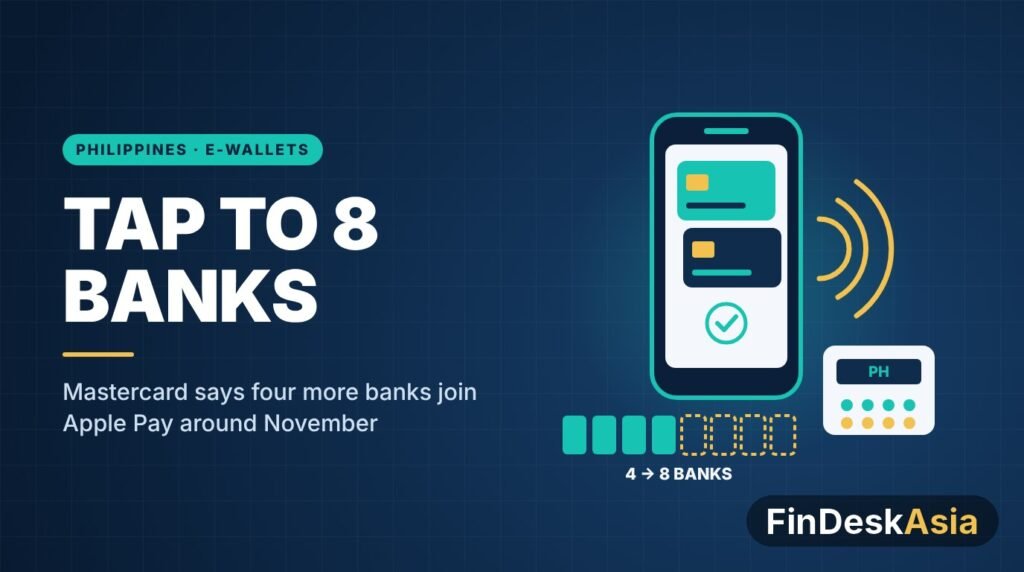
Philippines: Apple Pay to Reach Eight Banks by November, Mastercard Says
Apple Pay is set to double its bank line-up in the Philippines. Mastercard’s country manager says four more local banks should switch on the iPhone wallet around November, bringing the total to eight before the end of 2026, with another group expected in early 2027.
The update comes less than three months after Apple Pay first went live in the country, and as the Bangko Sentral ng Pilipinas (BSP), the Philippine central bank, reports that most retail payments are now made digitally.
Key facts
- Apple Pay launched in the Philippines in August 2026 with four partner banks: Chinabank, GoTyme Bank, Metrobank and UnionBank.
- Jason Crasto, Mastercard’s Country Manager for the Philippines, expects four more banks to go live around November 2026, taking the total to eight. He did not name them.
- A further batch of banks is expected in the first quarter of 2027.
- BSP data show digital payments made up 64.7% of retail payment volume in 2025, up from 57.4% in 2024, inside the central bank’s 60% to 70% target for 2028.
- Mastercard has also signed a memorandum of understanding with the Department of Trade and Industry’s E-commerce Bureau to help small businesses go digital.
A slow, bank-by-bank rollout
Apple Pay is a tokenised mobile wallet. Instead of handing over the real card number, the phone sends a one-time digital code, and the shopper confirms the payment with Face ID, Touch ID or a passcode. It works at any contactless card terminal, and inside apps and websites that accept it.
The catch is that each card-issuing bank must sign up and connect its systems before its customers can add a card. That is why the Philippine rollout is happening in waves. Cardholders at the first four banks have been able to use eligible Visa and Mastercard cards since August. Customers of other banks still have to wait, and Mastercard has kept the names of the next four under wraps.
Crasto has not shared transaction numbers, saying it is still early to judge adoption. He described the response at the banks already live as encouraging and expects usage to pick up in 2027 as more lenders join.
Why it matters
The Philippines has moved quickly away from cash, but much of that shift has run through local e-wallets such as GCash and Maya, which rely on QR codes and the national InstaPay and PESONet transfer rails. Card-based phone wallets have been a smaller part of the picture.
More banks on Apple Pay gives more iPhone users a tap-to-pay option that also works abroad. For merchants, it adds volume to contactless card terminals they may already own, without the need for a new QR set-up.
It also matters for the BSP. Digital payments crossed into its target range for the first time in 2025, and the central bank wants that share to keep rising under the Philippine Development Plan. A wider choice of wallets, cards and QR options helps keep consumers away from cash.
For card networks such as Mastercard, the timing is useful. The company is pairing the wallet push with work on the merchant side: the agreement with the trade ministry’s E-commerce Bureau aims to give micro, small and medium enterprises (MSMEs) training and access to digital payment tools. More shops able to take digital payments means more places to use a phone wallet.
What to watch
- Which banks join next. Large card issuers that are not yet live would make the biggest difference to how many Filipinos can use Apple Pay.
- Usage data. Whether Mastercard, Visa or the banks share the first adoption figures as the wallet heads into the busy Christmas shopping season.
- The 2027 wave. How many more banks join in the first quarter, and whether e-wallet players respond with new tap-to-pay features of their own.
Related on FinDeskAsia: Philippines: GCash parent Mynt lists after record 53 billion peso IPO and BSP says Revolut digital bank licence talks are “very active”.
Sources: BusinessWorld, October 2026; Fintech News Philippines, October 2026; Technobaboy, October 2026.
