
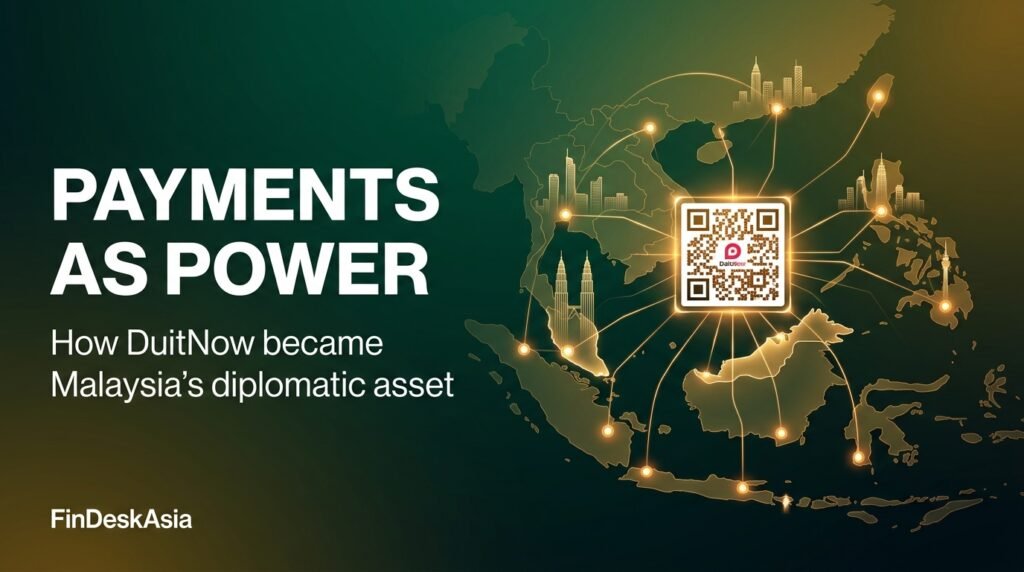
How DuitNow Quietly Became Malaysia’s Most Powerful Diplomatic Tool
When people talk about Malaysia’s foreign policy this week, the headline is BRICS — and Prime Minister Anwar Ibrahim’s stated goal of weaning the country “off overreliance on traditional Western markets.” But the most concrete tool Malaysia already holds in that game isn’t oil, palm, or semiconductors.
It’s the QR code in your phone.
Payments are the new diplomacy
A recurring theme in the current debate — including a widely-read 17 September opinion piece — is that BRICS gives Malaysia “room to manoeuvre” by widening its trade, finance and technology options. And of all those levers, payments infrastructure is the one Malaysia has actually built out.
By the end of 2025, Malaysia had established 29 cross-border payment linkages with regional partners. That’s not a pilot or a memorandum — it’s live rails moving real money.
What DuitNow can already do abroad
The national QR standard, operated by PayNet, has quietly gone regional:
- Live QR corridors connecting Malaysia with Singapore, Thailand (PromptPay), Indonesia (QRIS), Cambodia, and China (via Alipay+ / UnionPay).
- A partnership between PayNet and Ant International that extends DuitNow QR acceptance to over 100 million Alipay+ merchants worldwide — meaning a Malaysian wallet can increasingly pay overseas the same way it pays at the mamak.
- Participation in Project Nexus, the multilateral effort to plug national instant-payment systems into one another.
For a mid-sized economy, that reach is disproportionate. It means Malaysian tourists spend more easily abroad, inbound visitors pay more easily here, and — crucially — settlement can increasingly happen outside the traditional correspondent-banking channels that run through a handful of Western financial centres.
Why this matters for the BRICS conversation
The appeal of BRICS-style arrangements, for a country like Malaysia, is optionality: shorter settlement times, lower conversion costs, and less exposure to decisions made in Washington. Malaysia’s existing DuitNow linkages are a working proof of concept for exactly that — bilateral, interoperable, low-cost rails that don’t require anyone’s permission to switch on.
That doesn’t make DuitNow a geopolitical weapon. The system is built for consumers and merchants, not statecraft. But it does give Malaysia something most of its neighbours are still trying to build: a credible, exportable piece of financial infrastructure it can bring to the table.
The takeaway
Trade deals and summits grab the headlines. But the quiet story is that Malaysia has spent the last few years turning its national payment rail into a regional network — and that network is now one of its more valuable diplomatic and economic assets.
The next time you scan DuitNow QR at a hawker stall in Bangkok or a shop in Shenzhen, you’re not just paying for lunch. You’re using a piece of Malaysia’s foreign policy.
FinDeskAsia tracks the payments and fintech infrastructure shaping Malaysia and the region. This article is analysis based on publicly reported figures from BNM, PayNet and industry sources.
