
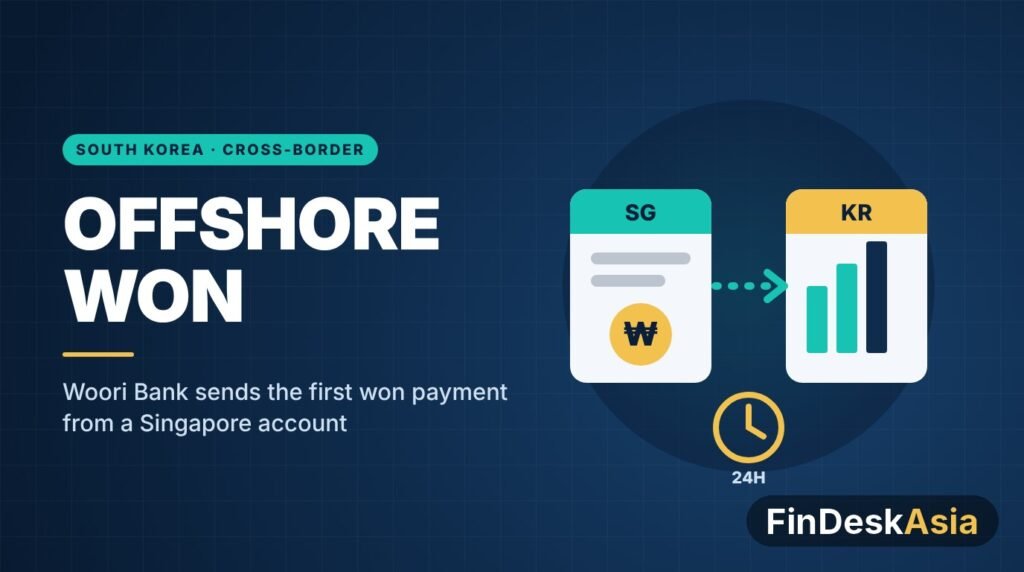
South Korea: Woori Bank Completes First Offshore Won Payment via Singapore Branch
A foreign institution has, for the first time, opened a South Korean won account outside Korea and used it to invest in a Korean product. Woori Bank said the deal, run through its Singapore branch on 29 October, is the first by a Korean bank under the government’s push to let the won be used offshore. It is a small but symbolic step for a currency that has long been tightly kept at home.
Key facts
- On 29 October 2026, Woori Bank’s Singapore branch opened a won account for an unnamed overseas investment institution.
- The client sent won through the Bank of Korea’s won settlement network to a Korean securities firm to buy a won-denominated product, without holding an account in Korea.
- Woori says it is the first such transaction by any bank, and the first real use of the government’s offshore won liberalisation, part of a won internationalisation roadmap announced in July 2026.
- In September, Woori’s Singapore, Tokyo and London branches and its China subsidiary were registered with the Ministry of Economy and Finance as overseas won-handling institutions, known as RFI-K.
- Foreign exchange rules were eased, so the deal did not need the usual advance report of a capital transaction. The transaction size was not disclosed.
How the new route works
Until now, a foreign investor who wanted to put money into Korea in won generally had to open an account with a Korean financial institution and send payment orders during Korean business hours. That added paperwork and time-zone friction for funds in Europe or other parts of Asia.
Under the RFI-K model, the investor opens a won account with an approved institution abroad, such as Woori’s Singapore branch. That institution keeps a pooled won account with a participant in the Bank of Korea’s settlement network and makes payments on the client’s behalf. Because the network now runs around the clock on business days (weekends and public holidays excluded), won payments can be sent during the investor’s own working hours.
A Woori executive, Na Ji-young, said the deal matters because it shows won remittances actually happening offshore now that the won-dollar foreign exchange market is open 24 hours.
Why it matters
South Korea is one of Asia’s largest economies, but the won has stayed a largely onshore currency. Foreign investors have typically had to work through Korean accounts or use dollar-settled instruments. Letting the won move through overseas bank accounts is meant to make Korean assets easier to buy and hold, and to give the won a bigger role in international trade and investment.
For the region, the choice of Singapore is telling. The city-state is already a hub for foreign exchange, wealth management and treasury operations across Southeast Asia, so it is a natural first port of call for an offshore won market. If more banks win RFI-K status, Asian asset managers, corporates and family offices could eventually settle won deals locally rather than routing everything through Seoul.
The step also fits a wider trend in Asia of central banks and governments building direct currency and payment links, from local-currency settlement schemes to cross-border QR payments, to reduce dependence on the US dollar for regional flows.
What to watch
- Whether other Korean banks and foreign banks register as RFI-K institutions and complete similar deals in Singapore, Tokyo, London and beyond.
- Whether volumes are disclosed, which will show if offshore won accounts move from pilot to regular use.
- Further steps in Korea’s won internationalisation roadmap, including how far foreign exchange reporting rules are relaxed.
Read more: ASEAN’s cross-border QR record and our earlier story on how a national payment system works.
Sources: Businesskorea (Nov 2026), The Korea Economic Daily / Hankyung (Nov 2026), Newsway (Nov 2026), Financial News (Nov 2026).
