How Malaysia’s Payment System Works: A Plain-English Guide
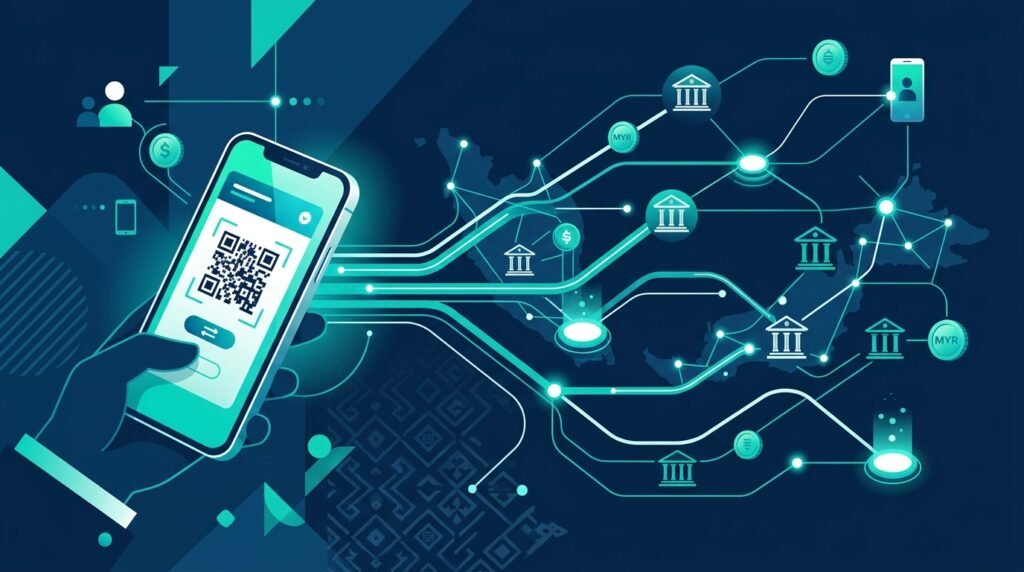
Every time you scan a DuitNow QR at a mamak, transfer money to a friend by phone number, or pay a bill through your banking app, you’re riding on a set of national payment “rails” most Malaysians never see. Here’s how the whole thing actually fits together.
The two names that run everything
Malaysia’s payment system has two anchors:
- Bank Negara Malaysia (BNM) — the central bank and regulator. It sets the rules, licenses the players, and guards the security and stability of the whole system.
- Payments Network Malaysia (PayNet) — the national payments network. It builds and operates the actual infrastructure that moves money between banks and e-wallets.
Think of BNM as the government that writes traffic laws, and PayNet as the company that builds and runs the highways.
The RPP: the highway everything runs on
At the centre sits the Real-time Retail Payments Platform (RPP) — the backbone that allows money to move instantly, 24/7, between any two banks or e-wallets in the country. It’s built on the modern ISO 20022 messaging standard, the same global language increasingly used by payment systems worldwide.
Before the RPP, an interbank transfer could take hours or a day. Now it settles in seconds, any time of day, weekends and public holidays included.
DuitNow: the brand you actually see
DuitNow, launched in December 2018, is the consumer-facing service that rides on the RPP. It comes in a few flavours:
- DuitNow Transfer — send money using just a mobile number, NRIC, passport, or business registration number, instead of a long account number.
- DuitNow QR — the single, national QR standard. One QR code works across all banks and e-wallets, so a merchant no longer needs a wall of different QR stickers.
- DuitNow AutoDebit — set up recurring payments (subscriptions, bills, instalments) with a one-time consent.
DuitNow QR has become the default way Malaysians pay in person. By the end of 2025 there were almost 3 million registered QR touchpoints nationwide, and QR transaction volumes more than doubled to around 3 billion in a single year.
The rest of the plumbing
PayNet also runs the less glamorous but essential systems:
- FPX (Financial Process Exchange) — the “pay via online banking” option you see at e-commerce checkouts.
- JomPAY — standardised bill payments (that Biller Code and Ref-1 you type in).
- MyDebit — the national debit card scheme.
- Interbank GIRO (IBG) — lower-cost, batch bank transfers.
Together these handle everything from your Astro bill to your Shopee checkout.
How big is it?
The numbers show just how cashless Malaysia has become:
- PayNet processed 8.44 billion digital payment transactions in 2025.
- Total e-payment transactions hit roughly 18.4 billion in 2025, up about 25% year-on-year.
- That works out to the average Malaysian making over 500 electronic payments a year.
Where it’s heading
BNM’s Financial Sector Blueprint 2022–2026 set targets to push digital payments to the majority of retail transactions and reach near-universal digital payment acceptance among registered businesses. Recent moves point the same direction:
- Cross-border QR linkages with Singapore, Thailand, Indonesia, China, Cambodia and more — so you can scan and pay in local currency while travelling.
- RENTAS+, introduced in October 2025, bringing 24/7 interbank settlement to large-value payments.
- A National Fraud Portal being enhanced with predictive analytics to fight scams.
The takeaway
Malaysia’s payment system is a layered stack: BNM regulates, PayNet operates, the RPP moves money in real time, and DuitNow is the friendly face you interact with. Everything else — e-wallets, payment gateways, cross-border scan-and-pay — plugs into this national foundation.
Understand these rails, and every fintech headline in Malaysia suddenly makes a lot more sense.
FinDeskAsia — explaining the money behind Asia’s fintech.
