
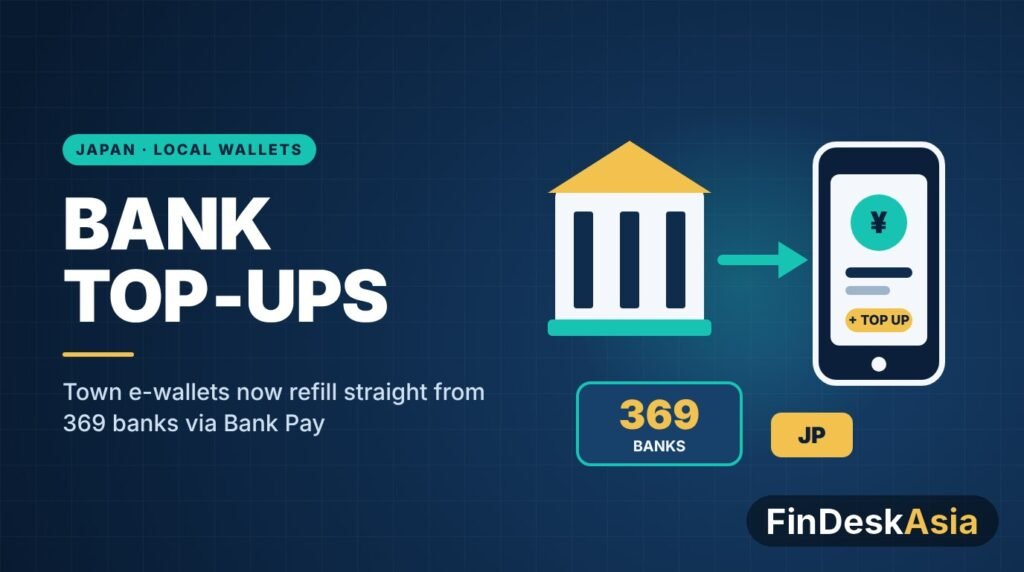
Japan: Town E-Wallets on TOPPAN’s Regional Pay Can Now Be Topped Up From 369 Banks
Residents of Kihoku, a small town in Japan’s Ehime Prefecture, can now load money into their local digital currency straight from a bank account. Since 1 November, the town’s KIHOCA app accepts top-ups through Bank Pay, a national account-to-account payment network, after printing and digital services group TOPPAN linked its municipal payments platform with fintech firm Infcurion’s top-up service.
Key facts
- TOPPAN’s cashless platform for local governments, Regional Pay (Chiiki Pay), now supports bank account top-ups through Infcurion’s charging platform, CharG.
- The first town to use it is Kihoku Town, Ehime Prefecture, for its digital local currency KIHOCA, with the service live from 1 November 2026.
- Users can top up from accounts at 369 financial institutions at launch via Bank Pay, run by the Japan Electronic Payment Promotion Organization, with more banks to be added.
- KIHOCA started in 2023 as transport support for elderly residents and, since September 2024, also works at local shops and for the town’s points scheme.
- TOPPAN aims to bring Regional Pay to 170 local governments by the end of Japan’s fiscal year 2026.
How the new top-up works
Many Japanese towns and cities run their own digital vouchers or “local currencies”. These are prepaid balances, held in an app, that can only be spent at shops in the area. Councils use them to keep spending local, to hand out subsidies and to reward residents for things like health check-ups or volunteering.
The weak spot has often been loading money in. Topping up a local wallet can mean visiting a counter, using cash at a kiosk or linking a card. With the new link, a KIHOCA user who has downloaded the app and registered as a member can move money directly from a bank account inside the app. Bank Pay handles the debit from the user’s bank, while CharG connects that payment to the town’s prepaid balance.
Infcurion takes on the heavy lifting behind the scenes. It manages the contracts with banks, security audits and connection testing, so a local government can add bank top-ups without rebuilding its existing Regional Pay system. Only Bank Pay member institutions that support this specific service are included, which is why coverage is described as 369 institutions “at launch”.
Why it matters
Japan is still more cash-heavy than many of its Asian neighbours, and older residents in rural areas are often the slowest to switch. Kihoku’s case is a useful test: a currency first built to help elderly people pay for transport now has to be easy enough to refill without a trip to town. Removing that friction could make local digital currencies more practical across the country.
The deal also shows how account-to-account payments are spreading in Japan. Bank Pay lets people pay directly from their bank balance instead of through a card network, which usually means lower costs for whoever accepts the payment. Plugging it into municipal wallets gives the network a new, everyday use beyond shop checkouts.
For the wider region, the model is familiar. Across Southeast Asia, governments and central banks have pushed bank-linked QR and instant transfer systems so that small payments can move cheaply between accounts and wallets. Japan’s approach is more fragmented, with many local schemes, but the direction is similar: tie public-sector payments to the banking system so that money flows without cash.
What to watch
- Whether other towns on Regional Pay switch on bank top-ups, and how quickly TOPPAN gets close to its 170-municipality target.
- How many more banks join the Bank Pay top-up service beyond the first 369.
- Uptake among older users in Kihoku, which will show whether easier top-ups really change how rural residents pay.
Related on FinDeskAsia: Japan: Tourists Pay Tax First and Claim Card or App Refunds From 1 November and Vietnam: JCB to Bring Tap-to-Pay Fares to Hanoi Metro Gates.
Sources: Infcurion and TOPPAN press release (October 2026); IT Business Today (October 2026); Japan FinTech Observer (November 2026).
