
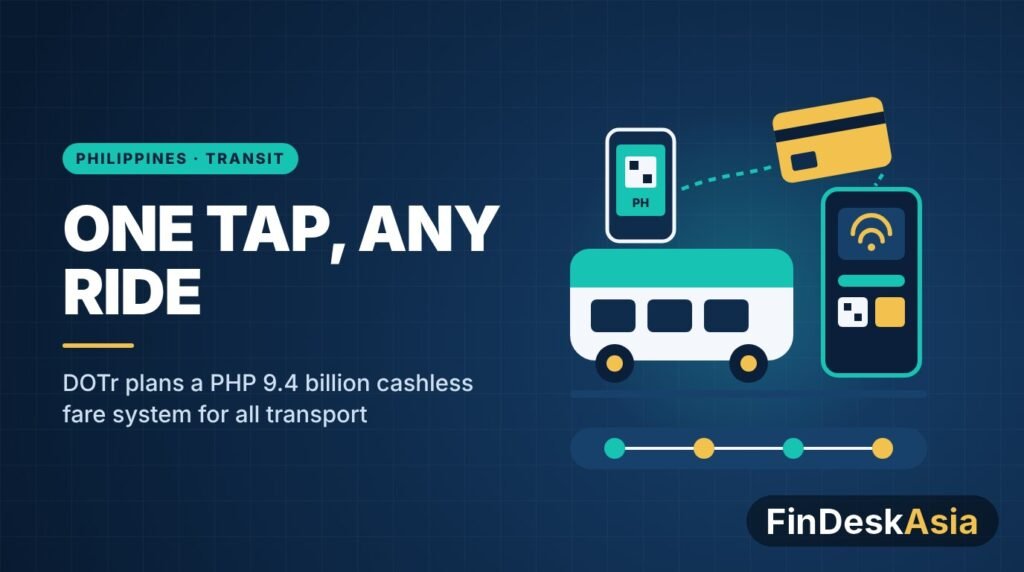
Philippines: DOTr Pushes PHP 9.4 Billion Cashless Fare System for All Public Transport
The Philippines wants commuters to pay for every bus, jeepney and train ride with one tap or scan. The Department of Transportation (DOTr) is pushing a nationwide automated fare system worth about PHP 9.4 billion that would accept e-wallets, QR codes, bank cards and phones across all public transport.
Key facts
- The project, called the Philippine Automated Fare Collection System, is costed at about PHP 9.37 billion and will be run as a hybrid public-private partnership (PPP).
- It still needs government approval before bidding can start. The winning bidder will build and operate the system, then hand it back to the DOTr when the concession ends.
- The system will accept e-wallets, QR codes, debit and credit cards, and other near-field communication (NFC) devices such as phones and watches.
- More than 50 local and international firms joined a market-sounding exercise in May. GCash, Visa and Mastercard are among the companies that have shown interest.
- It will replace the current Beep card concession held by AF Payments, which expires in December 2027.
What the DOTr is building
Today, paying for transport in the Philippines is fragmented. The Beep stored-value card works on Metro Manila’s rail lines, while most buses and jeepneys still run largely on cash. Commuters who switch between modes often queue several times and pay in different ways.
The new system aims to fix this with one shared payment backbone. At its heart is a Central Transit Acquirer System, which will process payments from different wallets, banks and card networks and settle them across the whole transport network. In payments terms, an “acquirer” is the party that accepts and processes a payment on behalf of the merchant, here the transport operator. Having one central acquirer means any approved payment method should work at any gate or bus reader.
This is an “open” model. Transportation Undersecretary Timothy John Batan said earlier this year that any card issuer would be able to take part, unlike the current setup where Beep is tied mainly to the railways. The Asian Development Bank (ADB) is advising the government on the project.
The cost has moved slightly. In May, the DOTr gave a preliminary estimate of PHP 9.5 billion, pending approval by the Investment Coordination Committee, the inter-agency body that reviews major public projects. The latest figure is about PHP 9.37 billion.
Why it matters
For commuters, the DOTr says the main gains are shorter queues at terminals, smoother transfers between modes and possibly lower travel costs. One idea is a single boarding fee for trips that use more than one mode, instead of paying a fresh flag-down fare at each change.
For the payments industry, transport is one of the biggest sources of everyday small-value transactions. Opening fare gates to e-wallets and cards could push millions of daily rides away from cash and give wallets such as GCash and card networks a regular, high-frequency use case. That explains the strong turnout: Batan has described the interest from bidders as “huge”.
The project also fits a wider push. The DOTr wants automated fare collection along the entire EDSA Busway, Metro Manila’s main bus corridor, before the end of 2026. Transportation Secretary Giovanni Lopez has said the busway system must accept several payment platforms rather than a single provider, calling interoperability “the key”. The department has also said cashless fares should not raise fares or add convenience fees.
For the wider region, a single national system that covers buses and jeepneys as well as trains would be an ambitious test of open, interoperable fare payments in Southeast Asia, and a useful case study for other cities weighing card and wallet payments at the gate.
What to watch
- Approval and bidding: whether the government signs off on the PPP soon enough for bidding to begin, given the Beep concession ends in December 2027.
- Who wins: whether a local wallet player, a global card network or a transport-tech specialist leads the winning consortium.
- Jeepneys and provincial buses: how quickly smaller operators outside Metro Manila install readers, which will decide whether the system is truly nationwide.
Related on FinDeskAsia: ASEAN’s cross-border QR payments hit a record · Inside Malaysia’s e-wallet war
Sources: Fintech News Philippines (Nov 2026) · BusinessWorld (May 2026) · Fintech News Philippines (Apr 2026) · Daily Tribune (Oct 2026)
