
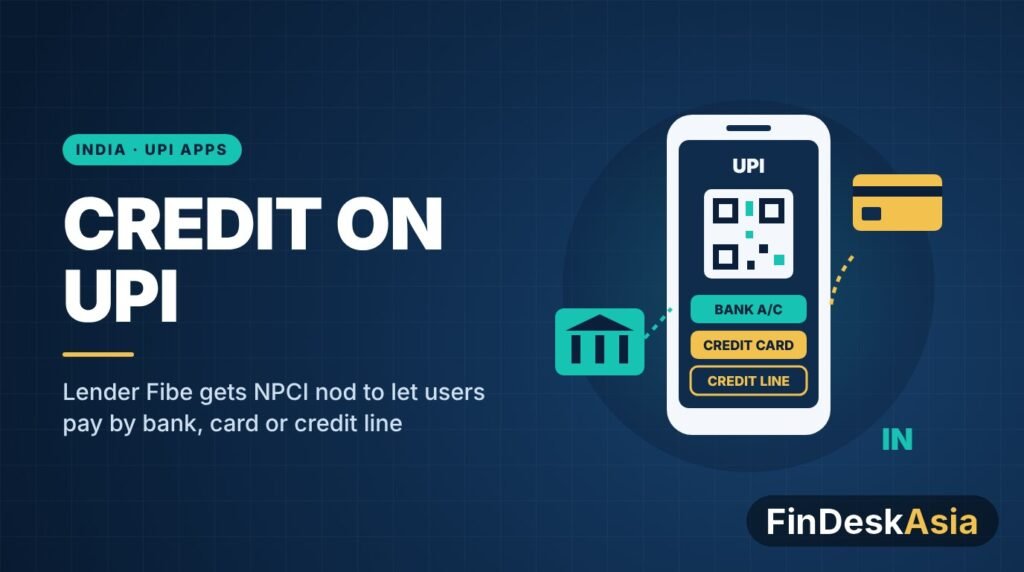
India: Lender Fibe Gets NPCI Nod to Run UPI Payments From Bank, Card or Credit Line
Fibe, a Pune-based digital lender best known for short-term personal loans, has switched on UPI payments inside its app. The move follows approval from the National Payments Corporation of India (NPCI), which runs UPI, India’s real-time payment system, and it turns a borrowing app into one that customers could open every day to pay.
What sets the launch apart is choice of funding source. Users can pay from a bank account, a RuPay credit card or an eligible pre-approved credit line, so the same QR scan can draw on savings or on credit.
Key facts
- NPCI has approved Fibe as a Third-Party Application Provider (TPAP), the licence category used by UPI apps that are not banks. The company announced the launch on 2 November 2026.
- Users can pay by UPI from bank accounts, RuPay credit cards and UPI-linked credit lines. The service is open to all users in India, not only Fibe borrowers.
- Fibe was founded in 2015 as EarlySalary. Its lending runs through an NBFC (non-bank finance company) subsidiary.
- The company is preparing a stock market listing. India’s market regulator, SEBI, issued its final observations on 15 September 2026, and the planned IPO includes a ₹750 crore fresh issue of shares.
- The launch lands as UPI hit a record 25.47 billion transactions in October 2026, according to NPCI data.
How a TPAP works
A TPAP is the app layer of UPI. It provides the screen where people scan QR codes, send money and check payments, while partner banks hold the underlying accounts and handle settlement. PhonePe, Google Pay and Paytm all work this way, and together they handle the large majority of UPI payments.
For Fibe, the licence means its customers no longer need to leave the app to pay a shop or a friend. Its existing products already include a numberless RuPay credit card issued with Axis Bank in 2023, plus fixed deposits sold on behalf of partners, loans against mutual funds and financing for healthcare, education and rooftop solar.
The credit-line option relies on rules from the Reserve Bank of India (RBI), the central bank. Since 2023, the RBI has allowed pre-sanctioned bank credit lines to be used through UPI. The lending bank sets the limit, the credit period and the interest rate, while the UPI app simply offers it as a way to pay.
Why it matters
Lenders in India are moving into payments because payments bring daily engagement. A loan app might be opened a few times a year; a payment app can be opened several times a day. Each payment also tells the provider more about how a customer spends, which can help it price credit.
Fibe is not the first lender to try this. ZET entered UPI in January 2026 after securing TPAP status, and other fintechs are pushing credit cards and credit lines onto UPI to win a share of a market dominated by a few large apps.
For India’s payment system, credit on UPI marks a shift. UPI began as a way to move money between bank accounts. Linking RuPay credit cards and credit lines turns it into a channel for borrowing too, which could widen access to small-ticket credit for people without a traditional card. It also raises questions about debt build-up if credit becomes as easy to spend as cash.
For the wider region, India is a model that others study closely. Central banks in Southeast Asia are linking their own QR systems with UPI and with each other, and the question of whether credit should flow through national QR rails is one that other markets are likely to face.
What to watch
- Whether Fibe can turn its existing borrowers into regular UPI users in a market where a handful of apps hold most of the traffic.
- How the UPI launch features in Fibe’s IPO story, and whether payments data improves its lending decisions.
- Any further RBI or NPCI moves on credit lines and credit cards on UPI, including rules on merchant fees.
Related on FinDeskAsia: India: UPI Hits Record 25.47 Billion Payments in October, Tops ₹1 Trillion a Day and India: Pine Labs Profit Jumps Sixfold as Online and UPI Payments Grow.
Sources: Indian Startup News (November 2026); Elets BFSI (November 2026); Whalesbook (November 2026).
