
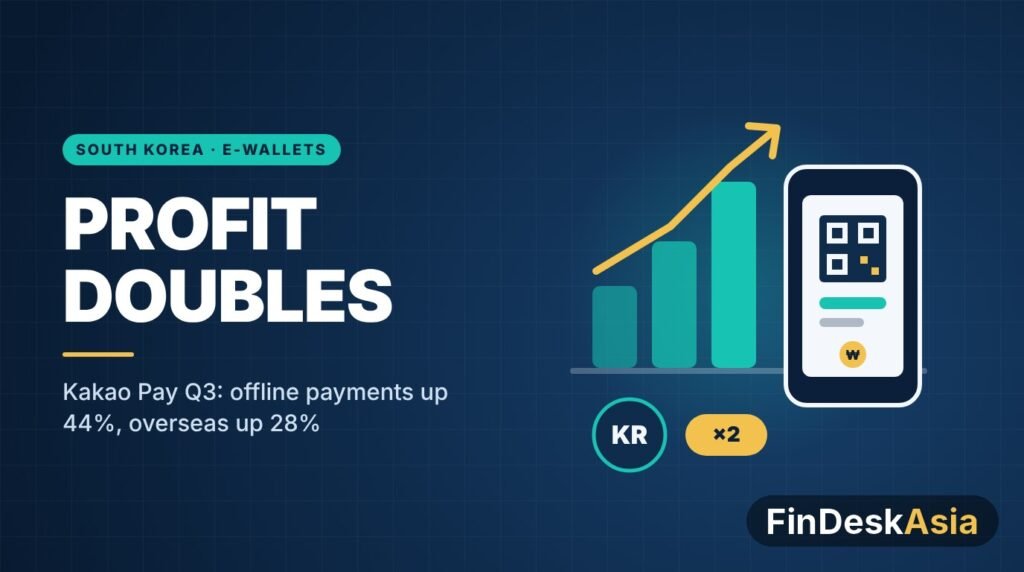
South Korea: Kakao Pay Doubles Q3 Profit as In-Store Payments Jump 44%
Kakao Pay, the payments and finance app built into South Korea’s KakaoTalk messenger, says its operating profit more than doubled in the July–September quarter. Faster growth in in-store and overseas payments, plus a busy quarter for its brokerage and insurance arms, pushed the company to its strongest results yet.
Key facts
- Operating profit rose 105% year on year to 32.5 billion won (South Korea’s currency) in the third quarter of 2026, on revenue of 302.1 billion won, up 27%.
- Net profit climbed 72% to 32.9 billion won, giving an operating margin of 10.7%.
- Total transaction volume reached 53.7 trillion won, up 14%, while payment volume alone grew 25%.
- Offline (in-store) payment volume jumped 44% and overseas payment volume rose 28%.
- Daily active users passed 7 million for the first time, according to the company’s results released on 3 November.
Where the growth came from
Kakao Pay splits its business into three parts. Payment services, which covers checkout, money transfers and its stored-value wallet, brought in 154.7 billion won, up 19%. Within that, online payment volume grew 18%, but the faster gains came from physical shops and from Koreans paying with the app abroad. Remittance volume, the money users send to each other, grew a slower 11%.
Financial services grew faster, with revenue up 41% to 133.4 billion won. Investment revenue rose 32% as stock trading picked up, insurance revenue rose 80% and lending revenue, earned by matching users with loans from partner lenders, rose 18%. A smaller platform services unit, mainly advertising, was slightly down at 13.9 billion won.
The subsidiaries did much of the heavy lifting. Kakao Pay Securities, the brokerage arm, earned 74.6 billion won in revenue and 15.7 billion won in operating profit. Its quarterly stock trading volume rose 139% to 81.6 trillion won and monthly trading customers grew 62% to 1.67 million. Kakao Pay’s general insurance unit posted revenue of 32.2 billion won, up 93%, helped by new mobile phone and health insurance policies.
Kakao Pay on its own, excluding subsidiaries, passed 200 billion won in quarterly revenue for the first time, reaching 204.9 billion won, while its standalone operating profit rose 160% to 24.9 billion won.
Why it matters
South Korea is one of Asia’s most crowded mobile payment markets, with big tech apps, card companies and phone makers all competing for the same shoppers. Kakao Pay’s results suggest the winning formula is not payments alone. Payments bring users in, but financial products such as brokerage, insurance and loan comparison earn more per customer. The company said average revenue per user rose 23% to 12,388 won, and each user made 87 transactions on average, up 15%.
The strong showing at the tills and overseas also matters. In-store use has long been the hardest part for app-based wallets to win, because shoppers already carry cards. A 44% jump in offline volume shows the app is gaining ground at the point of sale while the 28% rise in overseas payment volume shows more Korean users relying on the app when they spend outside the country.
The company is also preparing for digital assets. It said it is building infrastructure around a “Kakao Super Wallet” and working with partners including Circle, the issuer of the USDC stablecoin, digital asset security firm Fireblocks, Grab and Thailand’s SCBx. Chief executive Shin Won-keun said the quarter showed the company’s underlying earnings power and that it would keep pursuing quality growth through closer links with the wider Kakao group.
What to watch
- How Kakao Pay’s Super Wallet work with Circle and Fireblocks turns into real stablecoin or digital asset payment products, and how fast South Korea’s regulators allow it.
- If offline and overseas payment growth can hold up as competition from card firms and rival wallets intensifies.
- How much of the profit jump depends on stock market trading, which can fall quickly when markets cool.
Related on FinDeskAsia: ASEAN cross-border QR payments hit a record and how Malaysia’s e-wallet war compares.
Sources: Seoul Economic Daily (November 2026); Newsworks (November 2026); The Herald Business (November 2026).
