
China: Central Bank Wants Overseas Banks to Offer Digital Yuan Accounts
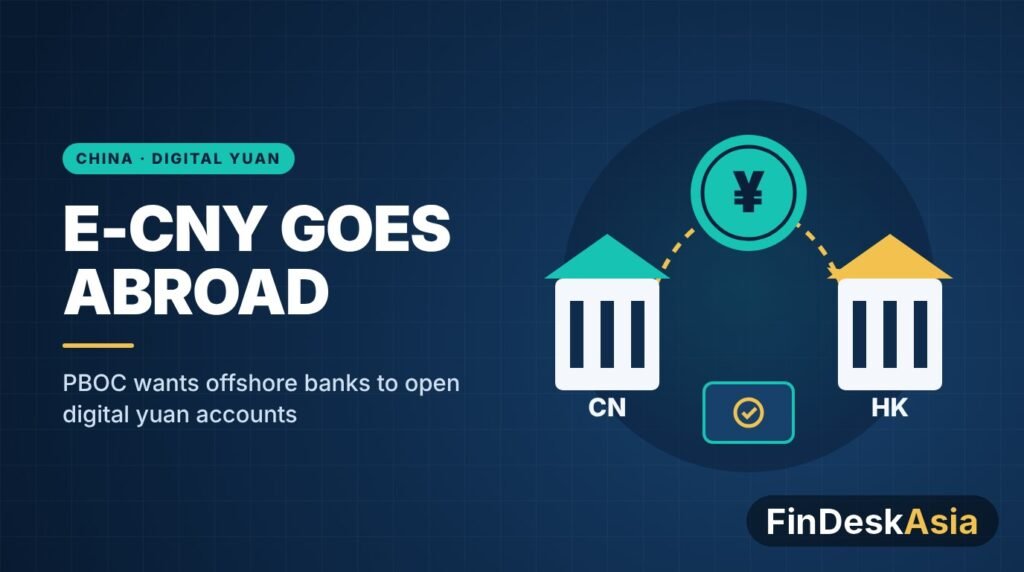
China’s central bank wants banks outside the mainland to start offering its digital currency. A senior official at the People’s Bank of China (PBOC) told Hong Kong FinTech Week that the next step for the e-CNY, the digital form of the yuan, is to give offshore banks, including their Hong Kong branches, the same operating role that 30 mainland banks hold today.
Key facts
- Lu Yuan, deputy head of the PBOC’s Digital Currency Research Institute, said 30 domestic banks now act as e-CNY operators and the work ahead is to extend that capability to offshore banks.
- He said he hopes overseas branches, including those in Hong Kong, can soon open e-CNY accounts for both companies and individuals. No date was given.
- The operator list reached 30 in August 2026, after the PBOC added eight banks, including Ping An Bank and Bank of Shanghai, to a roster that stood at 22.
- In June, 26 financial institutions, among them Standard Chartered Bank (China), signed up as direct participants in the PBOC’s cross-border e-CNY transfer service, known as CBETS.
What is changing
Today, only licensed mainland banks can act as e-CNY operators. These are the banks that open digital yuan wallets for customers, load them with money and handle redemptions. Users outside China have mostly reached the e-CNY through pilots, such as Hong Kong’s scheme that lets residents open wallets via mainland banks and top them up through the city’s Faster Payment System.
The new plan would let overseas banks do this work themselves. A Hong Kong branch of a Chinese bank, for example, could open an e-CNY account for a local trading company or a resident directly, instead of routing that customer through the mainland. Industrial and Commercial Bank of China (ICBC), one of the core operators, has encouraged its overseas offices to explore local e-CNY wallets for business customers.
The push builds on CBETS, which began commercial operation in mid-2026. It is designed so that banks abroad can send and receive digital yuan around the clock without rebuilding their core IT systems. An ICBC executive said the service remains free to use. The e-CNY also became more attractive to hold this year, after the PBOC allowed balances kept with banks to earn interest, much like a normal deposit.
Why it matters
For Beijing, the goal is wider use of the yuan in trade and cross-border payments. Letting foreign-based banks hand out digital yuan accounts would bring the currency closer to the companies that actually trade with China, from exporters in Hong Kong to suppliers across Asia.
For Hong Kong, the plan supports its role as the main offshore yuan centre. A report from the city’s Financial Services Development Council, released the same week, called for stronger payment infrastructure and for Hong Kong to strengthen its position as a multi-currency payment hub.
For banks across the region, it raises a practical question: whether to offer the e-CNY next to existing tools such as cross-border QR links and correspondent banking. Global lenders are already testing demand. HSBC said it has introduced retail and wholesale e-CNY services in mainland China and is seeing strong client interest in cross-border yuan settlement.
There are limits. The official gave no timeline, did not name which offshore banks would go first, and local regulators outside China would need to agree on how such accounts are supervised.
What to watch
- Whether the PBOC and the Hong Kong Monetary Authority (HKMA) announce the first Hong Kong branches approved to open e-CNY accounts.
- How many more foreign banks join CBETS as direct participants, and whether volumes grow beyond trade settlement.
- Whether other Asian financial centres are invited to host offshore e-CNY operators.
Read more: How cross-border QR payments are linking Asia and how Malaysia’s payment system works.
Sources: South China Morning Post (November 2026); KuCoin News / NS3 (November 2026); CoinGeek (August 2026); The Paypers (June 2026); Caixin Global (March 2026).
