
Tesla Unveils Next-Gen Roadster: Aerospace Tech Meets High-Margin Hypercar
In a move that blurs the boundary between automotive manufacturing and aerospace engineering, Elon Musk officially unveiled the second-generation Tesla Roadster today at SpaceX’s McGregor, Texas test facility. The vehicle represents Tesla’s aggressive push into the ultra-luxury hypercar segment, packing unprecedented performance metrics while simultaneously acting as a massive early-capital generator for the automaker.
Aerospace Integration & Market-Defeating Specs
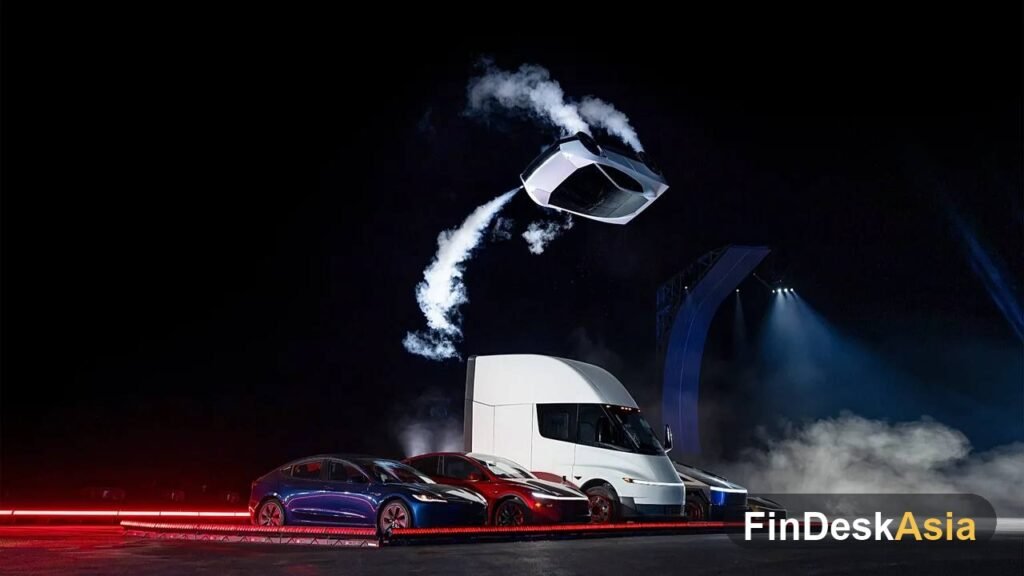
The Roadster’s most disruptive feature is its direct technology transfer from SpaceX: high-pressure cold-gas air thrusters. During the launch event, a prototype demonstrated this capability by launching off a ramp and executing mid-air maneuvers before landing securely.
On the ground, the specifications challenge the limits of modern physics. Tesla’s telemetry displayed a 0-to-60 mph (0-96 km/h) acceleration time of just 0.81 seconds. The vehicle is targeted to reach top speeds exceeding 230 mph (370 km/h) with an estimated driving range of 300 miles.
Tesla plans to offer the Roadster in three distinct variants:
* Performance: Equipped with active aerodynamics and a multimode suction fan system for extreme downforce.
* Thrust: Incorporates the rear-mounted SpaceX thrusters for short aerial capabilities and maximum boost.
* Rocket: A highly exclusive, invitation-only, single-seat variant featuring a comprehensive 10-thruster flight system.
The Financial Angle: A Strategic Capital Engine
While the Roadster serves as a halo product for Tesla’s engineering prowess, its financial structure is equally notable. Production is not slated until 2028, yet Tesla has already opened the order books with exceptionally high barriers to entry.
Securing a reservation requires a $50,000 deposit for the Performance tier and a staggering $250,000 for the Thrust variant (pricing for the Rocket variant remains undisclosed). This reservation model allows Tesla to secure millions in interest-free capital years ahead of actual delivery—a strategy that highlights the immense pricing power and brand loyalty Musk commands in the premium EV market.
A Pivot from Autonomy
In a notable departure from Tesla’s broader corporate focus on Full Self-Driving (FSD) and robotaxis, Musk emphasized that the Roadster is built for the driving enthusiast. It features a driver-focused, two-seater interior and is intended to be the only vehicle in Tesla’s lineup that remains manually driven for the longest period, prioritizing human engagement over automation.
For investors and industry analysts, the second-generation Roadster is more than just a speed record-breaker. It is a high-margin flagship designed to dominate the automotive news cycle, flex Tesla’s R&D capabilities, and lock in affluent early adopters well ahead of the competition.
