
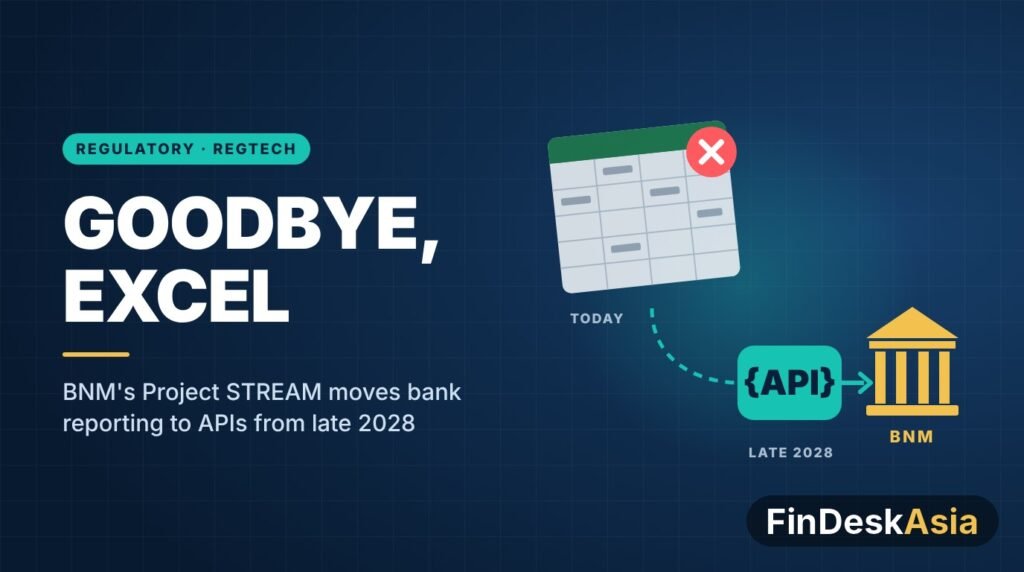
Goodbye, Excel: BNM’s Project STREAM Will Move Bank Reporting to APIs From 2028
Bank Negara Malaysia (BNM) is getting ready for its biggest change to bank reporting in more than a decade. Under Project STREAM, short for Statistical Reporting Modernisation, banks, insurers, takaful operators and payment system providers will stop filling in templates by hand. Instead, they will send automated, machine-readable data to the central bank through APIs.
BNM laid out the plan in its Quarterly Bulletin for 2Q 2026. Collection under the first phase is expected to start in late 2028.
What’s wrong with the current set-up
Since 2012, financial institutions have reported to BNM through its Integrated Statistical System (ISS). Much of that reporting still runs on web forms and Excel templates. The bulletin points to three problems:
- Duplication: institutions often submit the same information several times, in different datasets.
- Manual effort: preparing and checking submissions takes a lot of staff time.
- Lag and lumpiness: data mostly arrives in aggregated form at fixed intervals, so BNM’s view of the system is less timely and less detailed than it could be.
What STREAM changes
The idea is simple: collect data once and use it for many purposes. BNM wants granular data, built on standard data models, to become the single source of truth. That should cut down the ad hoc data requests institutions get today. BNM says this will bring:
- Cleaner data with consistent definitions across institutions
- Faster and more detailed public data releases from BNM
- Better peer benchmarking and analytics for the reporting institutions themselves
- Groundwork for future data-sharing initiatives, including Open Finance, and what BNM calls a “data-driven, AI-ready” financial sector
The rollout, phase by phase
- Phase 1 (from late 2028): deposits, payments and derivatives. Entity profiles have also been flagged as a priority.
- Later phases: cash balance of payments, credit and compliance reporting.
Each phase includes a review to harmonise data definitions. Output specifications for Phases 2 and 3 have not been released yet.
Industry is on board, with caveats
BNM is designing the system with an Industry Working Group of reporting institutions and industry associations. Its fourth meeting drew about 60 representatives from financial institutions. Consultations suggest the industry broadly supports the direction. Institutions have raised three concerns, though:
- the operational impact of upgrading infrastructure
- whether their staff have the skills needed for automated reporting
- whether the proposed timeline is realistic
Vendors are already moving. Local payments technology firm Finexus has launched AIRStream, a hosted service that takes data from a bank’s existing systems and converts it into the required reporting formats, so the bank doesn’t have to overhaul its core banking platform. Even so, Finexus says banks may still need to update front-end systems to capture details such as payment purpose codes and unique customer identifiers.
Why it matters for payments
Payments data is in the first wave. That makes STREAM especially relevant for payment system providers and the banks behind DuitNow, FPX and card rails. Granular, API-fed data could give BNM a much sharper, near-real-time picture of how Malaysians pay. That is useful for spotting risk early, and it lays the foundation for Open Finance services that would let customers share their own financial data securely with other providers.
What to watch
- Publication of the Phase 2 and Phase 3 data specifications
- Whether the late-2028 start holds as institutions assess their readiness
- How STREAM ties into BNM’s wider Open Finance plans
New to who runs Malaysia’s payment plumbing? Read PayNet & the Regulators and How Malaysia’s Payment System Works.
Sources: Bank Negara Malaysia Quarterly Bulletin 2Q 2026; The Edge Malaysia; Fintech News Malaysia (October 2026).
