
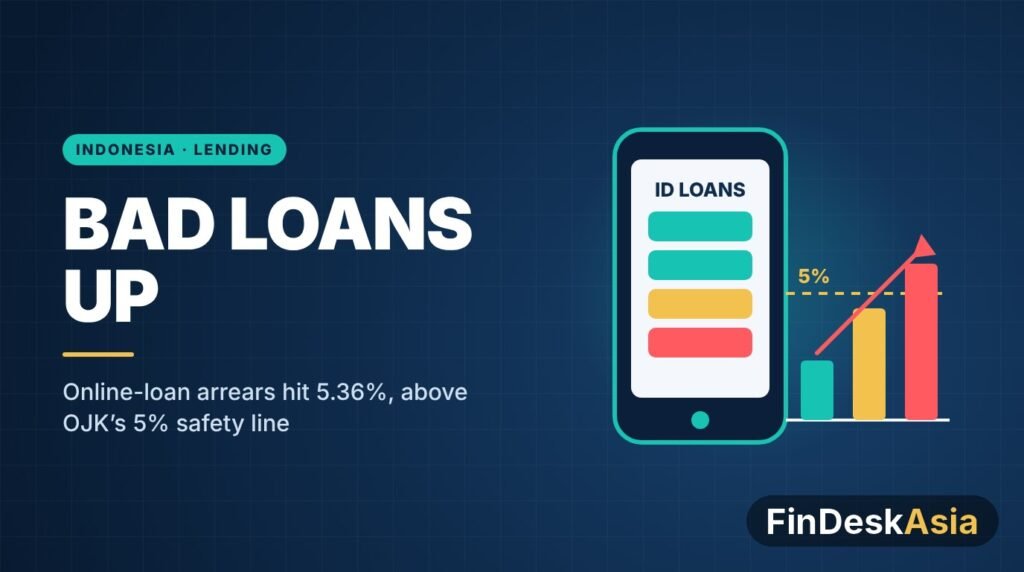
Indonesia: Bad Loans on Online Lending Apps Hit 5.36%, Above OJK’s 5% Safety Limit
More borrowers in Indonesia are falling behind on loans taken through online lending apps. Data from the country’s financial regulator, the Otoritas Jasa Keuangan (OJK), shows that the share of peer-to-peer (P2P) loans more than 90 days overdue climbed to 5.36% in September 2026, above the 5% level the regulator treats as the safe limit.
The jump comes as loan growth in the sector is also slowing, a sign that lenders and their users are under more pressure than a year ago.
Key facts
- The industry-wide bad-loan ratio, known in Indonesia as TWP90, rose to 5.36% in September 2026, up from 4.73% in August.
- A year earlier, in September 2025, the ratio stood at just 2.82%, so it has nearly doubled in 12 months.
- Outstanding P2P loans reached Rp106.48 trillion (about US$5.87 billion) at the end of September.
- Loan growth slowed to 17.02% year on year in September, from 22.07% in August.
- Lending to micro, small and medium enterprises (MSMEs) grew 12.49% year on year.
What happened
The figures were released at OJK’s monthly board press conference on Thursday, 5 November. OJK supervises banks, insurers, capital markets and non-bank lenders in Indonesia, while the central bank, Bank Indonesia, oversees payment systems such as the national QR standard, QRIS.
P2P lending platforms, now officially called pindar (short for pinjaman daring, or online loans), connect people and small businesses who need money with lenders who fund those loans through an app. They are popular with Indonesians who find it hard to borrow from banks, but they can be costly and risky when borrowers take on more than they can repay.
TWP90 measures the portion of outstanding loans on which repayments are at least 90 days late. OJK uses 5% as its safety threshold for the industry. Crossing that line does not by itself trigger penalties, but it shows that credit quality across the sector has worsened.
Agusman, the OJK executive who oversees financing companies, venture capital firms, microfinance and other non-bank lenders, said the regulator would keep monitoring the quality of the industry. He said OJK wants growth that is “healthy, inclusive and sustainable”, with priority on financing quality, stronger risk management and consumer protection. No specific new measures were announced.
Why it matters
Indonesia has a large and fast-growing digital lending market, and online loans play a big role in reaching people and small firms that banks do not serve. A rising bad-loan ratio puts that model under strain.
- For borrowers: lenders facing more defaults usually tighten approvals, which could make it harder for first-time and lower-income users to get credit.
- For platforms: higher arrears hurt the returns of the lenders who fund loans on these apps, which can reduce the money available to lend.
- For small businesses: MSME lending is still growing, but slower overall growth suggests funding may become more selective.
- For the region: regulators across ASEAN are watching how fast-growing digital credit, including buy now, pay later (BNPL), performs once the easy growth phase ends. Indonesia’s numbers are an early warning sign.
The trend is also notable because the ratio rose sharply in a single month, from 4.73% to 5.36%, after staying below the threshold in August.
What to watch
- Whether OJK’s October data, due at its next monthly briefing, shows the ratio easing or rising further above 5%.
- Any move by OJK to tighten rules for platforms, such as stricter credit checks or limits on how much borrowers can take across several apps.
- Whether loan growth keeps slowing as platforms become more careful about who they lend to.
Related on FinDeskAsia: Indonesia: Tax Office Says No New Tax on Transfers as Minister Keeps QRIS Question Open · ASEAN cross-border QR payments hit a record
Sources: The Jakarta Post (November 2026) · Kontan (November 2026) · Kontan (November 2026)
