
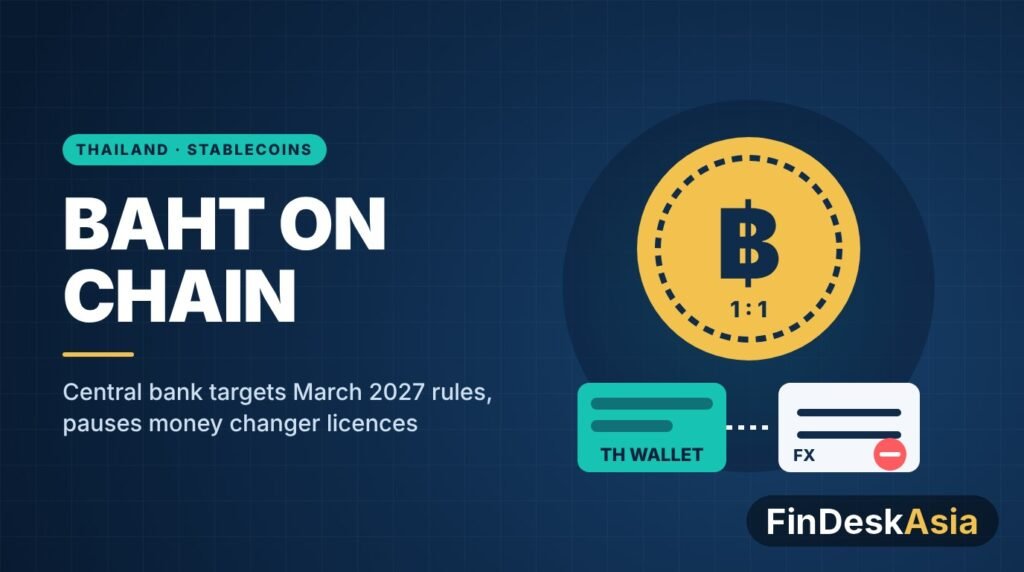
Thailand Eyes March 2027 for Baht Stablecoin Rules, Freezes New Money Changer Licences
Thailand’s central bank has put a date on its plan for a baht-backed stablecoin. The Bank of Thailand (BOT) now aims to issue the final rules around March 2027, and in the same week it said it will stop taking new money changer licence applications for all of 2027 while it raises standards for the industry.
Both moves come from a regulator that wants more digital payment options on one side and tighter control of so-called “grey money” on the other.
Key facts
- The BOT plans to issue rules for a stablecoin pegged one-to-one to the Thai baht around March 2027, according to Governor Vitai Ratanakorn.
- Under the proposal, issuers must hold bank deposits covering 100% of coins in circulation, let holders redeem within one business day, and pay no interest.
- Stablecoin wallet providers would have to verify every user and would be barred from connecting to offshore digital asset platforms.
- No new money changer licence applications will be accepted in 2027; firms that want to open next year must apply under current rules between 1 and 30 December.
- Licensing under stricter, risk-based rules starts in 2028, with two application windows a year, in March and September.
How the baht stablecoin would work
A stablecoin is a digital token on a blockchain that is designed to hold a steady value, usually by being backed by cash or similar safe assets. Thailand’s version would be worth exactly one baht and fully backed by deposits at commercial banks. In the first phase, reserves would be limited to bank deposits spread across several banks; short-term government bonds may be allowed later.
The BOT has said it may cap the number of licensed issuers, and early reports suggest only a small number will be approved at first, an approach that echoes Hong Kong and Singapore. Issuers would also need to publish how many coins are in circulation and how much money backs them, and be able to freeze or destroy coins linked to illegal activity.
The governor has described one early use: Thai crypto investors who sell Bitcoin or Ether could keep their money on-chain in baht, instead of moving it back to a bank account or holding foreign-currency coins such as USDT. Later uses could include payments, transfers between systems and programmable payments, where money moves automatically once agreed conditions are met, such as in an escrow deal. The coin is not meant to replace PromptPay, Thailand’s national instant payment system, for everyday shopping.
The public hearing on the principle paper was extended from 10 to 30 days at the industry’s request, and another round of consultation is planned once the detailed rules are drafted.
Why it matters
Thailand keeps tight foreign exchange controls, and the stablecoin design reflects that. By keeping wallets KYC-checked (know-your-customer identity checks) and walled off from offshore exchanges, the BOT wants a digital baht that cannot easily be used to move money out of the country. Foreign visitors could only hold the coin in a verified Thai wallet.
The money changer pause is part of a wider clean-up. The BOT says money changers will face standards matched to each firm’s risk level so they cannot be used to support illegal activity. It has already told banks to run extra checks on cash deposits of 5 million baht or more since 1 November, and the governor has put Thailand’s informal economy at about 48% of GDP. He has stressed that the stablecoin is a payments project, separate from the crackdown.
For the region, Thailand joins a growing list of Asian markets writing stablecoin rules that keep issuance tightly controlled. Malaysia is on a similar path: Bank Negara Malaysia (BNM) and the industry have several ringgit stablecoin and tokenised deposit initiatives underway, so Malaysian banks and fintechs will be watching how Thailand balances innovation and control.
What to watch
- Which firms, banks or non-banks, apply to issue the first baht stablecoins, and how many the BOT licenses.
- Whether the draft rules widen reserve assets beyond bank deposits or allow any cross-border use.
- How many money changers apply before the 30 December cut-off, and how strict the 2028 standards turn out to be.
Related on FinDeskAsia: ASEAN’s cross-border QR payments record and how Malaysia’s payment system works.
Sources: The Thaiger (November 2026); Xinhua (November 2026); Ledger Insights (November 2026); Retail News Asia (October 2026); FinTech Global (November 2026); Fintech News Malaysia (October 2026).
