
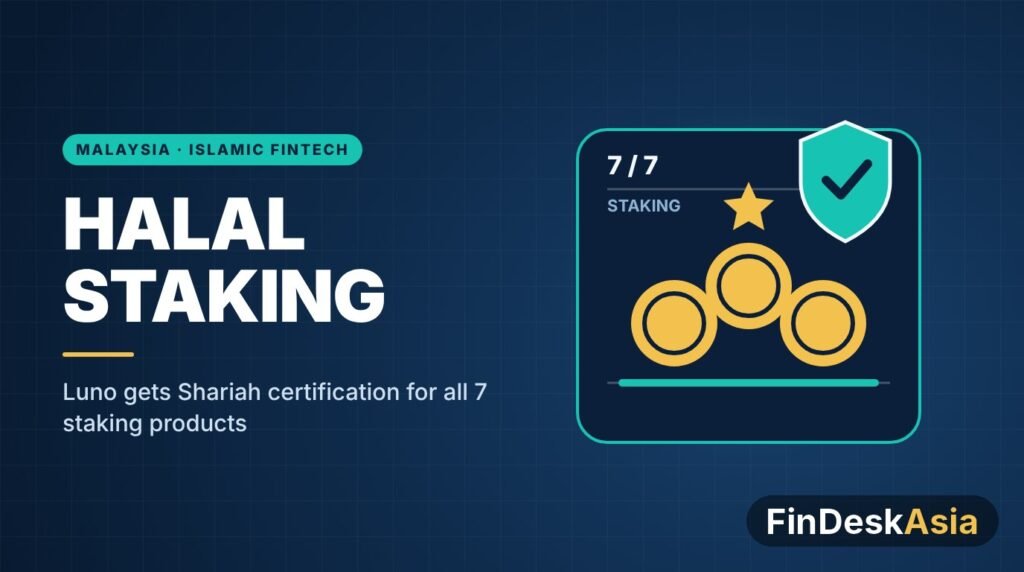
Luno Wins Shariah Certification for All 7 Crypto Staking Products in Malaysia
Luno, the cryptocurrency exchange regulated by the Securities Commission Malaysia (SC), says every staking product it offers in Malaysia now carries Shariah certification. The review also covers its Large Cap Bundle, a ready-made basket of the biggest cryptocurrencies. The company says it is the first regulated digital asset exchange in the country to reach full Shariah coverage across these “passive growth” products.
Key facts
- Who certified it: Sharlife Sdn Bhd, a Shariah advisory firm registered with the SC, carried out an independent review announced on 10 November 2026.
- Four new coins: staking for Polkadot (DOT), Avalanche (AVAX), Cosmos (ATOM) and NEAR Protocol (NEAR) was newly certified.
- Seven in total: they join Ethereum (ETH), certified in December 2024, and Solana (SOL) and Cardano (ADA), certified in October 2025.
- The bundle: the Large Cap Bundle tracks the CoinDesk 5 Index, holds up to five of the largest cryptocurrencies by market value and rebalances automatically.
- Customer base: Luno says it has more than one million customers in Malaysia.
What was reviewed
Staking means locking up coins to help a blockchain network check and record transactions, and earning a share of the network’s rewards in return. For a Muslim investor, the question is whether that arrangement is fair and free of elements Islamic finance forbids, such as interest (riba) or excessive uncertainty (gharar).
According to the announcement, Sharlife looked at the contracts behind Luno’s staking service, how the service works day to day, how transactions are validated and how rewards are paid out. For the Large Cap Bundle, it examined how the investment is structured, how coins are selected, how the basket is rebalanced and how the Shariah screening is done. Within that scope, Sharlife found the products consistent with the relevant Shariah principles.
Luno lists indicative yearly staking rewards ranging from up to 3% for Cardano to up to 11% for Cosmos. These rates are not guaranteed and change with network conditions.
Scarlett Chai, Luno’s country manager for Malaysia, said the firm had promised to widen its Shariah-compliant range after certifying Ethereum staking in 2024, and would keep working with its advisers on more assets. Sharlife founder and chief executive Mohamad Zulhaikal Mat Zukri said reviewing the whole range, rather than one product, set a standard other platforms in the region should follow.
What it means for Malaysians
- For Muslim investors: people who avoided crypto on religious grounds now have a wider set of certified options on a locally regulated platform, instead of turning to unlicensed offshore apps. Certification covers only the specific products reviewed, not every coin listed on Luno.
- The risk does not change: a Shariah stamp is a religious opinion, not a safety rating. Crypto prices can swing sharply and investors can lose money, so certified products still carry full market risk.
- For the industry: other SC-regulated exchanges may face pressure to certify their own products. That fits Malaysia’s long-running role as a hub for Islamic finance, which Bank Negara Malaysia (BNM), the central bank, has said will get a bigger role in its next Financial Sector Blueprint.
- For regulators: the certifier is registered with the SC, so investors can check who signed off on the products.
What to watch
- Whether rival regulated exchanges in Malaysia seek Shariah certification for their own staking or index products.
- How Bank Negara’s new blueprint and the SC’s digital asset rules treat Islamic fintech and crypto products in the coming years.
- Whether Luno extends certification to new assets it adds, as it has promised.
Related on FinDeskAsia: PayNet and the regulators · How Malaysia’s payment system works
Sources: Fintech News Malaysia (Nov 2026) · Ohsem.me (Nov 2026) · DagangNews (Nov 2026) · The Sun (Nov 2026)
