
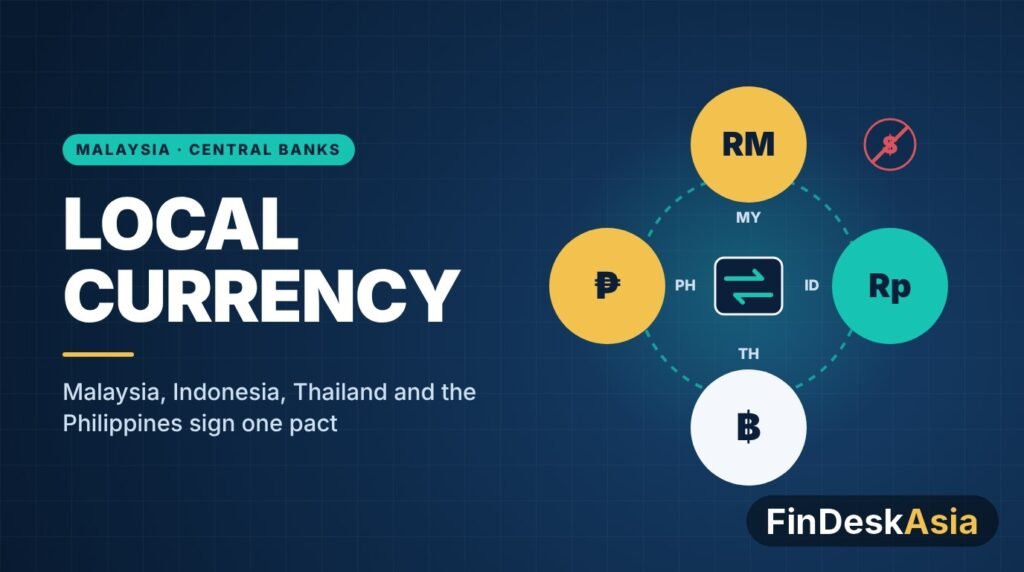
Malaysia, Indonesia, Thailand and Philippines Sign Pact to Settle Trade in Local Currencies
Bank Negara Malaysia (BNM) and the central banks of Indonesia, Thailand and the Philippines signed a memorandum of understanding (MoU) on Friday, 13 November, to promote the use of their own currencies when settling trade and investment between the four countries. The deal brings the Philippines into a local currency arrangement that until now linked only Malaysia, Indonesia and Thailand.
Key facts
- Who signed: BNM, Bank Indonesia (BI), the Bank of Thailand (BOT) and Bangko Sentral ng Pilipinas (BSP), the Philippine central bank.
- What it covers: cooperation under the Local Currency Transaction (LCT) Framework, so that bilateral trade, investment and other eligible deals can be settled directly in ringgit, rupiah, baht or peso.
- What it replaces: the separate bilateral MoUs that BNM, BI and BOT signed in August 2023.
- Stated aims: faster and cheaper cross-border settlement, fewer currency conversions, and more flexibility for businesses to manage foreign exchange risk.
From three countries to four
Most trade in Southeast Asia is still priced and paid in US dollars. A Malaysian exporter selling to a buyer in Manila, for example, often has to convert pesos into dollars and then dollars into ringgit. Each conversion adds a spread and a fee, and the business carries the risk that the dollar moves in between.
The LCT Framework is designed to cut out that middle step. Under it, appointed commercial banks quote direct exchange rates between pairs of regional currencies, and companies can invoice and settle in those currencies. Malaysia, Indonesia and Thailand have been building this network for several years. In February 2025 the three central banks harmonised their operating guidelines and widened the scope beyond trade in goods and services and direct investment to also cover portfolio investment. A few months later they appointed more banks as dealers to improve access to local currency liquidity.
The new four-way MoU puts all of this under a single agreement and adds the Philippines as the fourth member. BNM said the participating central banks would keep working together on developing and putting the framework into practice, and that the initiative is expected to grow local currency transactions gradually.
What it means for Malaysians
- Exporters and importers: SMEs that trade with the Philippines may in time be able to invoice in ringgit or peso instead of dollars, which can reduce conversion costs and make pricing more predictable.
- Banks: Malaysian banks active in regional trade finance could gain a new currency pair to quote and settle, adding to the ringgit-rupiah and ringgit-baht business they already handle.
- Investors: because the framework already covers investment flows between Malaysia, Indonesia and Thailand, a wider network gives companies more options when funding regional subsidiaries or projects.
- Consumers: the MoU is aimed at business and investment flows, not everyday card or QR payments. Malaysians already pay by QR in Indonesia, Thailand and other markets through separate links run by PayNet and its partners.
The move also fits a wider regional push to rely less on the US dollar for intra-ASEAN trade, reducing exposure when dollar rates swing sharply.
What to watch
- Which banks in Malaysia and the Philippines are appointed to quote and settle the ringgit-peso pair, and when settlements can actually begin.
- Whether the operating rules for the Philippines match the harmonised guidelines already used by the other three countries.
- Whether other ASEAN members, such as Vietnam or Singapore, join the same multilateral arrangement.
Related on FinDeskAsia: ASEAN’s cross-border QR payments hit a record and How Malaysia’s payment system works.
Sources: Bernama (November 2026); The Edge Malaysia (November 2026); The Star (November 2026).
