
ASEAN Signs DEFA, Its First Digital Economy Pact Covering E-Payments and Digital ID
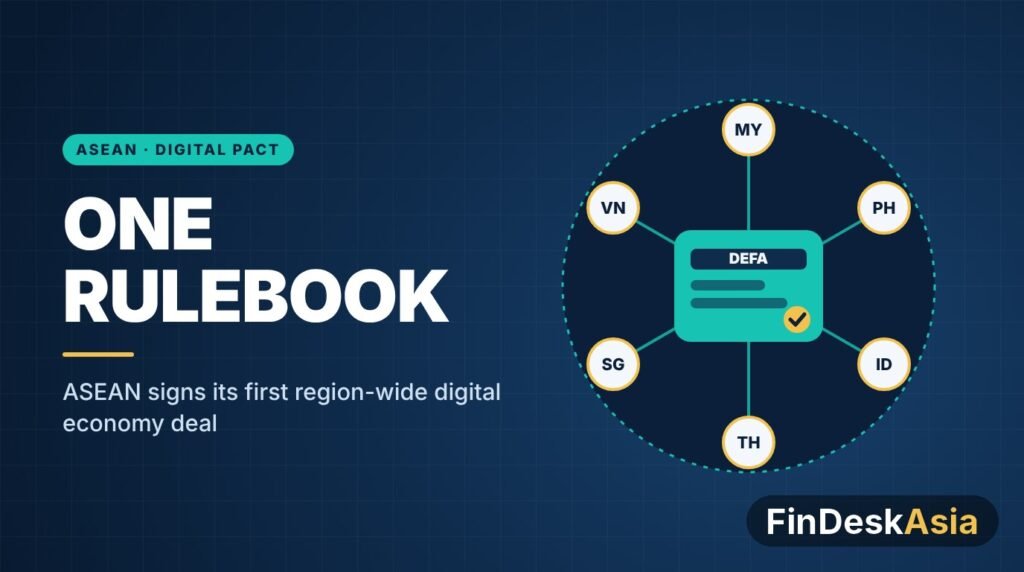
Southeast Asia’s 11 governments are signing the ASEAN Digital Economy Framework Agreement (DEFA) at the 49th ASEAN Summit in Manila. It is the bloc’s first region-wide rulebook for the digital economy. Electronic payments, digital identity and cross-border data are all in it. The aim is to make selling and paying online across borders as simple as doing it at home.
Key facts
- DEFA is being signed in Manila at the 49th ASEAN Summit. Indonesia’s government says its minister will sign on 14 November 2026.
- Officials finished negotiating the text at the second meeting of the 57th ASEAN Senior Economic Officials Meeting, held in Manila on 27–29 May 2026.
- The agreement covers nine areas, including electronic payments, cross-border e-commerce, digital identity, data governance and privacy, and cybersecurity.
- Studies cited by ASEAN officials say the region’s digital economy could grow to as much as US$2 trillion by 2030 if the pact is fully put into practice.
What the pact actually does
ASEAN, the Association of Southeast Asian Nations, now has 11 members, with Timor-Leste the newest. Each member has its own rules for e-commerce, data and payments. A small online seller who wants customers in three neighbouring countries can face three sets of paperwork and three payment set-ups. DEFA is meant to replace that patchwork with common regional rules.
The Philippines’ trade department says those rules will cover cross-border e-commerce, paperless trading and electronic payments, plus online consumer protection and data privacy. Indonesia’s economy ministry adds that the pact will push for interoperability between national payment systems. In plain terms, a wallet or bank app from one country should work smoothly with the payment rails of another. It also aims for trusted cross-border data flows and stronger cybersecurity rules.
The agreement goes beyond older ASEAN e-commerce deals. It adds commitments on digital identity, competition policy, artificial intelligence and the movement of digital talent. Business groups see it as a way to cut the cost of trading across the region, especially for micro, small and medium enterprises (MSMEs).
Why it matters
Payments are where many cross-border digital deals break down. Over the past few years ASEAN central banks have joined their QR code and instant payment systems one link at a time. DEFA gives that work a legal frame at the level of trade ministers. It sets shared rules on things like consumer protection, data handling and electronic transactions. That should make new payment links easier to agree and to run.
For merchants, the main benefit is predictability. If the rules on data, e-signatures and online payments are broadly the same across members, a business can plan one regional set-up instead of eleven. For consumers, the goal is safer and cheaper cross-border shopping, with clearer protection when something goes wrong.
There is a real Malaysia link. Malaysia chaired ASEAN in 2025, and talks were declared substantially concluded at the ASEAN Economic Community Council meeting in Kuala Lumpur that October. Malaysia’s DuitNow QR, run by Payments Network Malaysia (PayNet), already links with several neighbours. Bank Negara Malaysia (BNM), the central bank, is also part of Project Nexus, which aims to connect instant payment systems across Asia. Common regional rules on data and e-payments should help these links grow.
What to watch
- Ratification: each member must turn DEFA into national law, which may mean new rules or changes to existing ones before it takes full effect.
- Payments detail: how far the final rules on financial services and electronic payments go, and whether central banks use them to speed up new QR and instant-payment links.
- Data rules: how “trusted” cross-border data flows are defined, since payment firms need clear rules to move transaction data across borders.
Related on FinDeskAsia: ASEAN’s cross-border QR payments record and Nexus targets Q4 2027 launch to link instant payments in six Asian countries.
Sources: ANTARA News (November 2026); Daily Tribune (May 2026); SunStar (September 2026); Philippine News Agency (October 2026); US-ASEAN Business Council (2026).
