
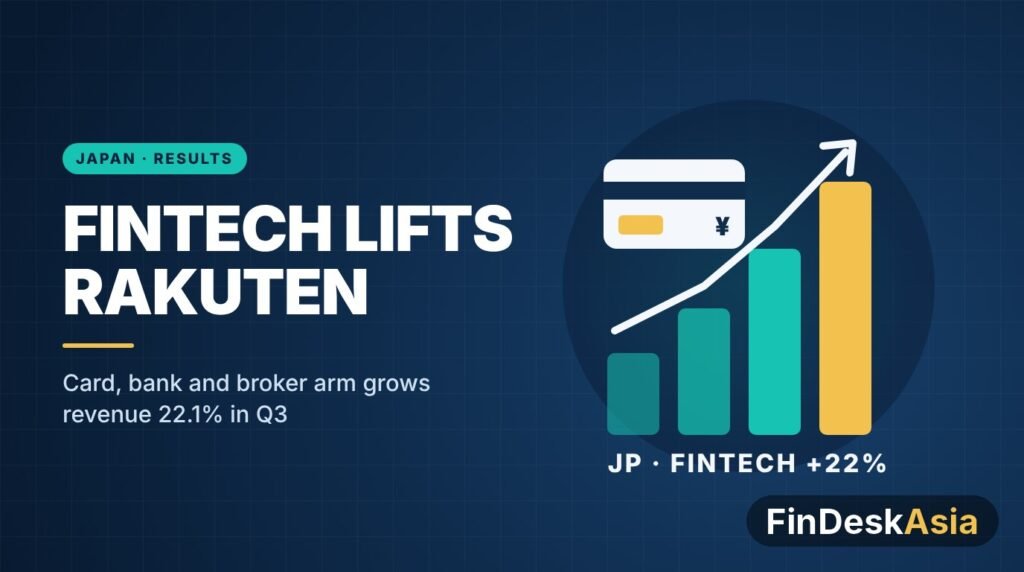
Japan: Rakuten’s Fintech Revenue Jumps 22.1% as Bank and Broker Accounts Grow
Japan’s Rakuten Group says its financial services arm was again the main engine of growth in the July–September quarter. Revenue from its FinTech segment, which covers Rakuten Card, Rakuten Bank, Rakuten Securities and its payment services, rose 22.1% from a year earlier to 306.0 billion yen, roughly double the pace of the group as a whole.
Key facts
- Group revenue for the third quarter of fiscal 2026 rose 10.9% to 697.1 billion yen, according to results released on 13 November.
- FinTech segment revenue grew 22.1% to 306.0 billion yen, while its Non-GAAP operating income (an adjusted profit measure) rose 23.7% to 68.0 billion yen.
- Rakuten Bank, an online-only bank, had 18.81 million accounts at the end of September, up 8.5%, with deposits up 11.2% to 13.6 trillion yen.
- Rakuten Securities reached 14.83 million accounts, up 15.3%, including 8.27 million NISA accounts, up 23.0%.
- The group’s adjusted operating income rose 25.9% to 48.6 billion yen, although it came in below analyst forecasts.
Where the money is coming from
Rakuten is best known for its online marketplace, but the numbers show how much the company now leans on finance. In the quarter, the FinTech segment earned 68.0 billion yen in adjusted operating income. That is more than the whole group’s adjusted figure of 48.6 billion yen, because losses in the mobile business still pull the total down.
The bank is a key part of that. Rakuten Bank grew its accounts by 8.5% and its deposits by 11.2% over the year. Like other banks in Japan, it is benefiting from the end of the Bank of Japan’s ultra-low interest rate era, which lets lenders earn more on the money customers keep with them. Its deposit base of 13.6 trillion yen gives it a large pool of funds to work with.
The brokerage is growing even faster, with accounts up 15.3% and NISA accounts up 23.0%. Much of that growth is linked to NISA, Japan’s tax-free individual savings scheme for stocks and funds, which the government has expanded to encourage households to move money out of cash and into investments.
Why it matters
Rakuten’s model is an “ecosystem”: shoppers earn Rakuten Points on its marketplace, pay with Rakuten Card or Rakuten Pay, keep savings at Rakuten Bank and invest through Rakuten Securities. Each service feeds the others, and the results suggest that the finance end of that loop is now the most profitable part of the business.
That matters well beyond Japan. Across Asia, super-apps and e-commerce groups, from Grab and Sea in Southeast Asia to Ant Group in China, are trying to turn large user bases into banking and payments revenue. Rakuten shows one version of how that can work at scale: a card business and a digital bank that win everyday payments and deposits, then a broker that captures savings.
It also shows the limits. Strong finance profits are still subsidising Rakuten Mobile, whose segment loss narrowed by 10 billion yen to 28.7 billion yen but has not disappeared. The group’s adjusted profit also came in below analyst forecasts, a reminder that a fast-growing finance arm does not cover every weakness.
There is a small Malaysian link. Rakuten Securities is a partner in Rakuten Trade, an online stockbroker in Malaysia, so the group’s approach to winning retail investors through apps and loyalty points is already familiar to some Malaysian users.
What to watch
- Whether rising interest rates in Japan keep lifting Rakuten Bank’s income, and how the bank uses its growing deposit base.
- Whether NISA-driven account growth at Rakuten Securities continues into the new year.
- Whether profits from finance are enough to carry Rakuten Mobile towards break-even.
Related on FinDeskAsia: Malaysia’s e-wallet war and how Malaysia’s payment system works.
Sources: Asia Business Outlook (November 2026); Investing.com, results slides (November 2026); Investing.com, earnings report (November 2026); Rakuten Group (November 2026).
