
India: RBI Gives Paytm Unit In-Principle Nod to Bring Back Its Digital Wallet
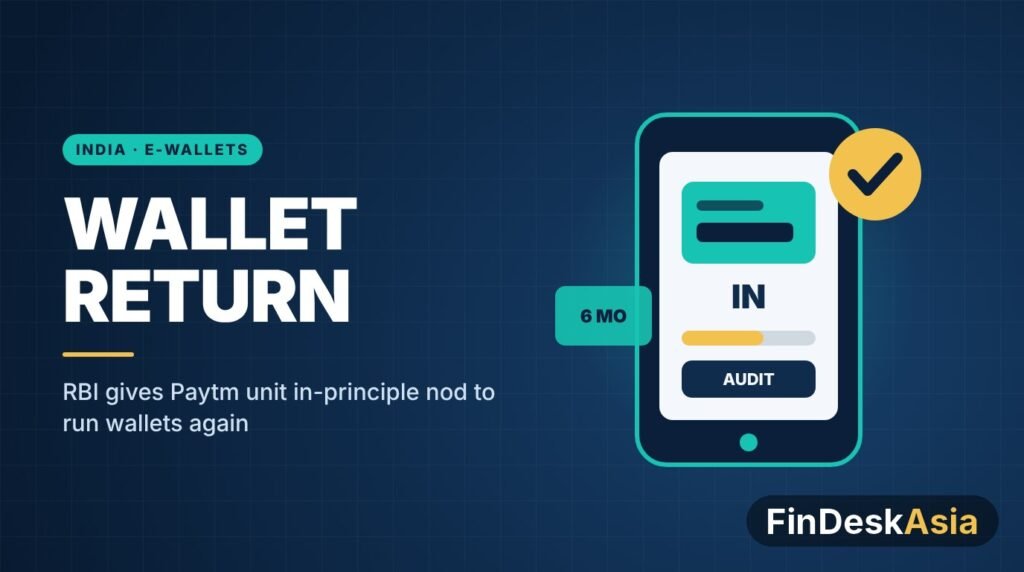
India’s Paytm has taken a first, conditional step towards bringing back its digital wallet. On 13 November 2026, the Reserve Bank of India (RBI), the country’s central bank and payments regulator, gave Paytm Payments Services Ltd (PPSL) in-principle approval to issue and run prepaid payment instruments, the official term for stored-value products such as e-wallets. The wallet cannot go live yet: PPSL first has to pass a technology and cybersecurity audit and win a final licence.
Key facts
- PPSL, a wholly owned subsidiary of Paytm owner One 97 Communications, received in-principle authorisation from the RBI on 13 November 2026 under the Payment and Settlement Systems Act, 2007.
- The approval covers issuing and operating prepaid payment instruments (PPIs), including digital wallets, under the RBI’s Master Directions on PPIs.
- PPSL must complete a system audit, including a cybersecurity audit, and submit the report to the RBI within six months, or the in-principle approval lapses automatically.
- Wallet services can start only after the RBI issues a final Certificate of Authorisation.
- Paytm’s original wallet was tied to Paytm Payments Bank, which the RBI barred from taking new deposits and wallet top-ups in 2024; that bank’s licence was cancelled in April 2026.
How Paytm got here
For years, the Paytm wallet was one of India’s best-known ways to pay online and at shops. It sat inside Paytm Payments Bank, a separate company that held customer money. In early 2024 the RBI stopped that bank from accepting fresh deposits, credits and top-ups, including into wallets. Customers could still spend or withdraw what they already had, but they could no longer add money, which in practice froze the product.
Paytm’s answer was to start again through a different company. Instead of relying on the payments bank, it applied for a fresh PPI licence through PPSL, the unit that already runs its business as a payment aggregator, the middleman that helps merchants accept digital payments. This week’s decision means the regulator is willing, in principle, to let that unit issue wallets. It is not yet a full green light.
The RBI has also told PPSL to get its prior approval for any change in shareholding or ownership, in line with its rules on changes in control of non-bank payment operators.
Why it matters
India’s payments market is dominated by UPI, the Unified Payments Interface, the real-time system run by the National Payments Corporation of India (NPCI) that moves money directly between bank accounts. Wallets are a smaller part of the picture, but they still matter for small-value spending, cashback offers and users who prefer not to link a bank account to every app.
For Paytm, a wallet would mainly help keep users inside its app more often. Indian business media expect the company to link a revived wallet with its other consumer products, such as Paytm Postpaid, its credit-on-UPI offering, as well as personal loans and investment services. The wallet on its own is not expected to be a major source of revenue.
The decision also shows how the RBI now deals with large fintech groups. Rather than reviving the old structure, it is asking for a clean, separately licensed entity with audited technology and cybersecurity, and it keeps a firm deadline: miss the six-month audit window and the approval simply expires.
For the wider region, it is a reminder that regulators across Asia, from India to Malaysia, increasingly treat e-wallet licences as something earned through governance and security checks, not a one-off permission.
What to watch
- Whether PPSL files its system and cybersecurity audit within the six-month window, and how fast the RBI issues the final Certificate of Authorisation.
- When and how the wallet relaunches, and whether it is bundled with Paytm Postpaid and other credit products.
- How rivals such as PhonePe, Google Pay and Amazon Pay respond if Paytm returns to the wallet market.
Related on FinDeskAsia: Malaysia’s e-wallet war explained and India: NPCI to Pay Banks ₹300 per QR Code to Bring UPI to Small-Town Shops.
Sources: Inc42 (November 2026), Business Standard (November 2026), Entrackr (November 2026).
