
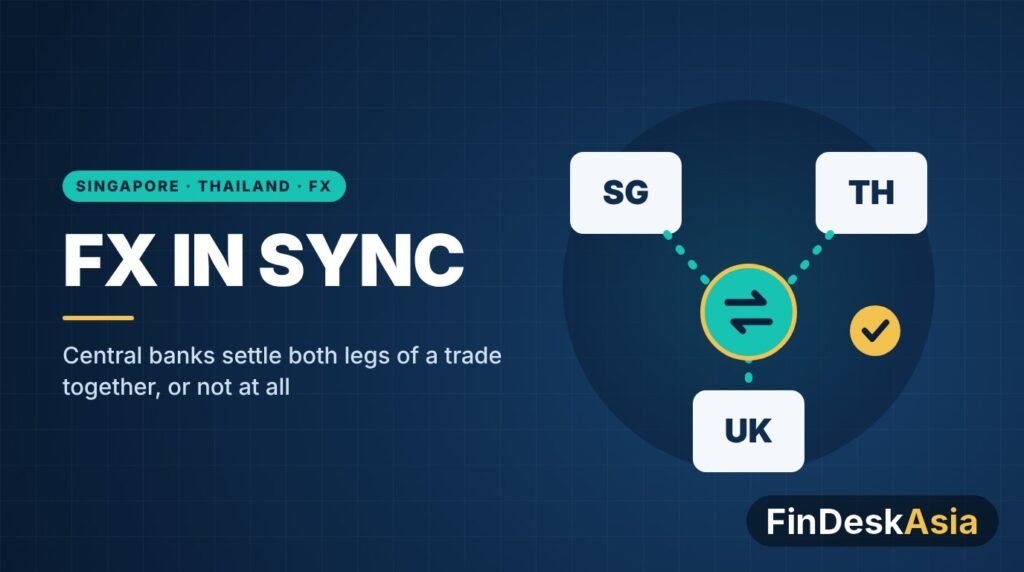
Singapore and Thailand Central Banks Show FX Trades Can Settle in Sync Across Systems
Central banks in Singapore, Thailand and the United Kingdom say they have shown that a currency trade can be settled in two different payment systems at the same moment, even when those systems are built on very different technology. The results of the trial, called Project Meridian FX APAC, were published on 13 November 2026 by the Monetary Authority of Singapore (MAS), the Bank of Thailand (BoT) and the Bank of England (BoE).
Key facts
- The trial tested payment-versus-payment (PvP) settlement, where both sides of a foreign exchange (FX) deal settle together or not at all, plus multilateral net settlement across three central bank test environments.
- The environments mixed traditional real-time gross settlement (RTGS) systems and distributed ledger technology (DLT), or blockchain-style, settlement systems.
- Singapore-based Partior built, connected and tested a prototype “synchronisation operator” that coordinates the linked payments.
- The Reserve Bank of Australia and the Philippines’ Bangko Sentral ng Pilipinas joined as observers for the policy work.
- According to the Bank for International Settlements (BIS), more than US$1.4 trillion, about 10% of average daily FX settlement in April 2025, was still fully exposed to settlement risk.
What the trial actually did
When a bank swaps Singapore dollars for Thai baht, each currency moves through its own national payment system. If one leg settles and the other fails, one party can be left out of pocket. This is known as settlement risk, and it is one reason cross-border payments remain slow and costly.
Project Meridian FX APAC placed a coordination layer, the synchronisation operator, between the three central bank systems. It matches instructions, checks that funds are reserved on both sides and only then tells each system to settle. The prototype was tested with problems such as insufficient funds, wrong account details and temporary outages; in each case the deal was either completed in full or fully reversed.
The trial also showed multilateral netting, in which offsetting trades between many banks are added up so that only the net amounts move. That can cut the amount of cash banks must keep ready, while still keeping the all-or-nothing safeguard.
Importantly, the three systems did not need to share one design. Where a system lacked a feature, the operator used adapters or other workarounds. In Singapore’s environment, for example, a dedicated escrow account was used to hold funds aside.
Why it matters
For Asia, the test is a sign that central banks can link legacy payment rails and newer tokenised platforms without first agreeing on one shared technology. Singapore and Thailand are both active in cross-border payment links in ASEAN, and safer FX settlement is a building block for cheaper transfers between currencies in the region.
The banks were also clear about the limits. This was a non-live proof of concept with simulated participants and a limited set of transactions. It assumed that all systems were open at the same time, so different operating hours, time-zone gaps and long outages were not tested. The central banks also flagged that “technical” all-or-nothing settlement is not the same as legal finality, which each country’s law defines in its own way. No existing rulebook fully covers an operator that coordinates settlement across borders.
The Bank of England said the findings will feed into its plan to launch a live synchronisation service in 2028. MAS and the Bank of Thailand stressed that taking part does not commit them to a similar rollout.
What to watch
- Whether more Asian central banks, including the two observers, join a next phase with more currencies and real market participants.
- How regulators handle legal settlement finality and oversight of a cross-border synchronisation operator.
- Further design details from the Bank of England, expected in early 2027, ahead of its 2028 launch.
Related on FinDeskAsia: ASEAN cross-border QR payments and PayNet and the regulators.
Sources: Monetary Authority of Singapore (November 2026), Financial News (November 2026), The Paypers (November 2026), Securities.io (November 2026).
