
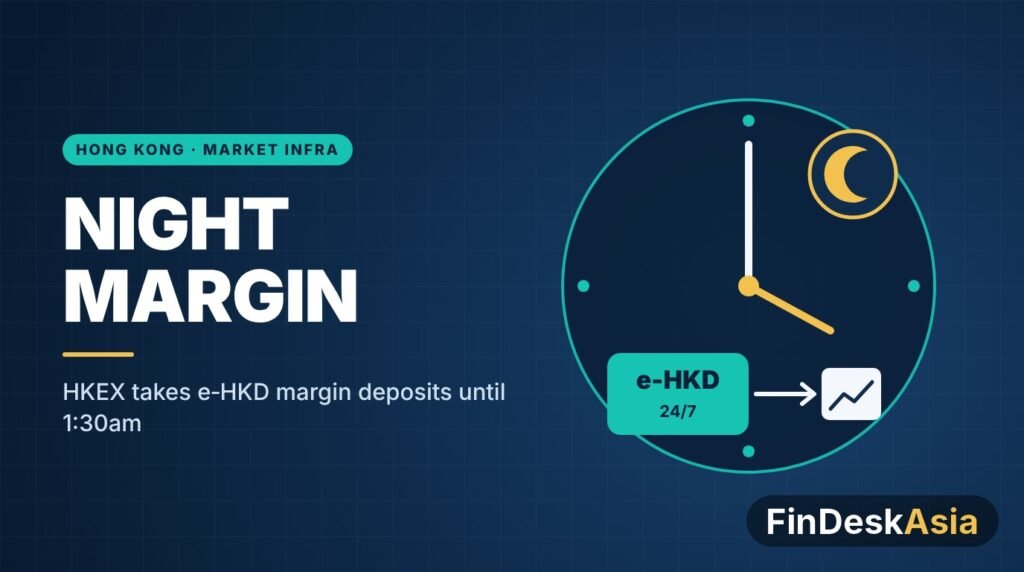
Hong Kong: HKEX to Take e-HKD Margin Deposits Until 1:30am From 14 December
Hong Kong’s stock exchange operator will let brokers top up their derivatives margin late into the night using the e-HKD, a digital form of the Hong Kong dollar issued for use between financial institutions. From 14 December 2026, eligible clearing members can send advance margin deposits between 5pm and 1:30am, instead of having to get the money in by mid-afternoon.
The move takes a central bank digital currency out of the lab and into a live market, and it shows how around-the-clock settlement money can fix a very practical problem for trading firms.
Key facts
- Hong Kong Exchanges and Clearing (HKEX) said the new payment option goes live on 14 December 2026 for its derivatives After-Hours Trading (AHT) session.
- Eligible Clearing Participants of HKFE Clearing Corporation (HKCC), the clearing house for Hong Kong’s futures and options market, can submit advance margin deposit requests from 5pm to 1:30am.
- The payments run on e-HKD, a wholesale central bank digital currency (CBDC) that operates 24/7. HKEX and the Hong Kong Monetary Authority (HKMA), the city’s central bank, first announced the pilot in June 2026.
- Before launch, HKEX ran real-value trial transactions with the HKMA, settlement banks and clearing participants to test readiness.
- The option sits alongside existing payment methods and complements HKEX’s plan to extend after-hours trading hours from March 2027.
The problem it solves
In a futures market, every trading firm has to post margin, a cash deposit that acts as a safety buffer in case its positions lose money. In Hong Kong, the amount a firm can trade is also tied to its capital and deposits through what HKEX calls the Capital Based Position Limit. If a firm wants more room to trade in the evening session, it has to put more money down first.
Until now, that was hard to do after office hours. According to the HKMA’s June announcement, clearing participants had to submit advance margin deposit requests to HKCC by 3pm for the money to count towards that night’s after-hours session. A firm that saw demand pick up in the evening, perhaps because of news from Europe or the United States, could not easily add funds once banks’ normal payment cut-offs had passed.
Because e-HKD settles around the clock, the money can move at night and be recognised straight away. HKEX said this gives firms more flexibility to manage how much of their position limit they are using outside regular banking hours.
Why it matters
Most CBDC projects in Asia are still trials or sandboxes. This is one of the first cases where a wholesale CBDC is being used for a routine, recurring job in a major live market. When the pilot was announced, HKMA Deputy Chief Executive Howard Lee described it as a wholesale use of CBDC “in a live market environment”.
The timing also matters for volumes. HKEX reported a record average of 1.66 million derivatives contracts a day in 2025, rising to more than 1.78 million a day in the first five months of 2026. As more of that activity moves into the evening, and as trading hours stretch further from March 2027, the old afternoon cut-off becomes a bigger bottleneck.
For the region, the project adds to a clear trend: central banks and market operators are testing digital money, tokenised deposits and faster payment rails to settle trades outside the traditional 9-to-5 banking day. Hong Kong is positioning itself as a place where this infrastructure is used for real business, not just showcased in proofs of concept.
What to watch
- How many clearing participants sign up after 14 December, and whether HKEX publishes take-up figures.
- Whether e-HKD use widens to other payments, such as intraday margin calls or the cash market, once after-hours trading is extended in March 2027.
- Whether other Asian exchanges and central banks follow with similar 24/7 settlement links for their own derivatives markets.
Related on FinDeskAsia: Hong Kong: HKMA and SFC want 24/7 tokenised deposits to settle tokenised fund trades
Sources: The Standard (November 2026); FX News Group (November 2026); HKSAR Government / HKMA press release (June 2026)
