
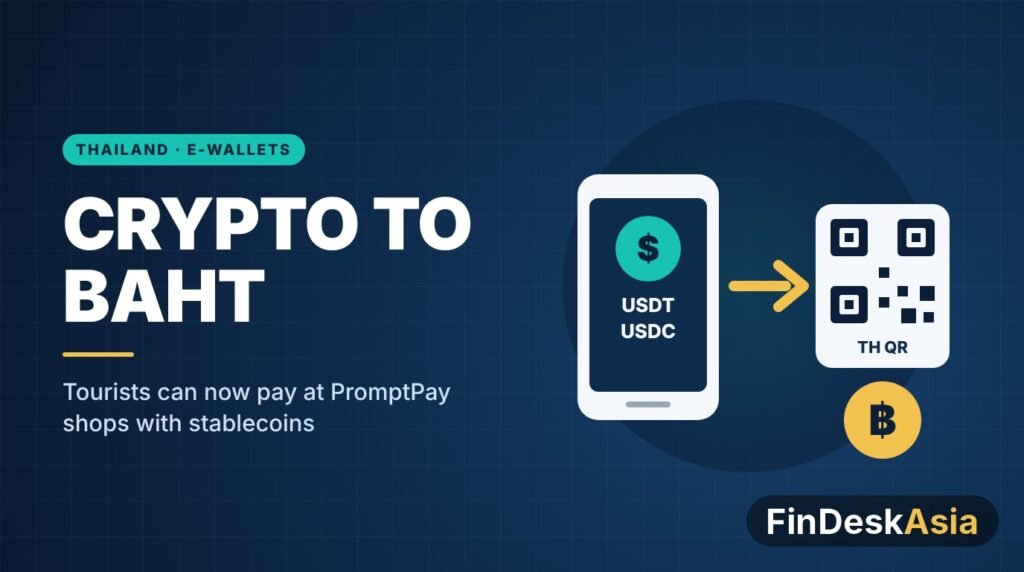
Thailand: Tourists Can Now Pay at PromptPay Shops With Stablecoins via WORPT App
Foreign visitors to Thailand can now turn stablecoins into Thai baht inside a phone app and pay at ordinary shops by scanning the country’s PromptPay QR codes. The app, called WORPT, officially launched on 13 November as the first service under a government-backed test scheme, and the shop being paid never touches crypto at all.
Key facts
- WORPT is run by Waan Exchange (Waanx), a digital asset exchange licensed by Thailand’s Securities and Exchange Commission (SEC), and Wipay, an e-money provider regulated by the Bank of Thailand (BOT).
- Tourists deposit USDT or USDC, two US dollar-linked stablecoins, convert them to baht and pay through Thai QR PromptPay, the national instant payment system. No Thai bank account is needed.
- The SEC approved Waanx’s place in the TouristDigiPay sandbox on 25 September for 18 months.
- The operators expect about 15 billion baht (roughly US$440 million) of digital assets to be converted and spent during the trial.
- Partners include Tether, the issuer of USDT, retailer The Mall Group and Visa, which is backing a prepaid card linked to the same baht balance.
How the app works
The design keeps crypto and everyday payments in separate boxes. A tourist downloads WORPT from the App Store or Google Play, completes identity checks with both the exchange and the e-money provider, and sends stablecoins into the app. Waanx sells them for baht, and the baht lands in a Wipay e-wallet that must be in the tourist’s own name.
From there, paying looks like any other Thai QR payment. The tourist scans the merchant’s PromptPay code and the shop receives baht through the normal banking system. Merchants do not need a crypto wallet, do not see a coin price and do not carry any crypto risk.
A physical Visa prepaid card is planned for around mid-November, with a virtual card to follow in early 2027. Both will draw on the same baht balance as the QR payments, so places that take cards but not PromptPay are also covered. Only two stablecoins are supported for now; the company says it plans to add more digital assets later.
The sandbox comes with conditions. The payment service has to be kept apart from investment trading, and the platform must run transaction monitoring and anti-money laundering checks. A sandbox is a controlled trial in which a regulator lets a firm test a new service under close watch before deciding on permanent rules.
Why it matters
Thailand’s tourism industry, a big source of jobs and income, has been losing momentum, with foreign arrivals heading for a second straight yearly drop. The Finance Ministry, which first unveiled TouristDigiPay in August 2025, has said the aim is to unlock extra spending from visitors, not to promote crypto as money. WORPT is targeting crypto holders from South Korea, Japan, the Middle East and Southeast Asia, who may hold savings in stablecoins rather than in cards that work well abroad.
The model is also a template other regulators are watching. Rather than letting shops price goods in crypto, Thailand routes everything through a licensed exchange and a licensed e-money firm, and then into existing rails. The central bank keeps control of the payment side, the SEC watches the exchange side, and the baht remains the only money that changes hands at the till. Bhutan introduced a similar crypto payment option for tourists in 2025.
For Malaysians, there is no change: the scheme is for foreign tourists holding stablecoins, and Malaysian visitors can already pay at PromptPay shops through the DuitNow QR link between the two countries. Bank Negara Malaysia (BNM) does not recognise crypto as legal tender, so a similar service at home would need a clear policy decision first.
What to watch
- Whether real take-up comes close to the 15 billion baht projection, and which visitor markets use it most.
- The rollout of the Visa prepaid card, and whether more licensed exchanges and e-money firms join the sandbox.
- How the SEC’s wider stablecoin rules, including proposed daily limits, shape the scheme after the 18-month trial.
Related on FinDeskAsia: Thailand: SEC Drafts 5 Million Baht Daily Cap on Stablecoin Deposits and Withdrawals and ASEAN’s cross-border QR payments.
Sources: VnExpress International / Bloomberg (November 2026); WORPT launch statement via Thailand Tourist (November 2026); BigGo Finance (November 2026); Thailand Business News (October 2026).
