
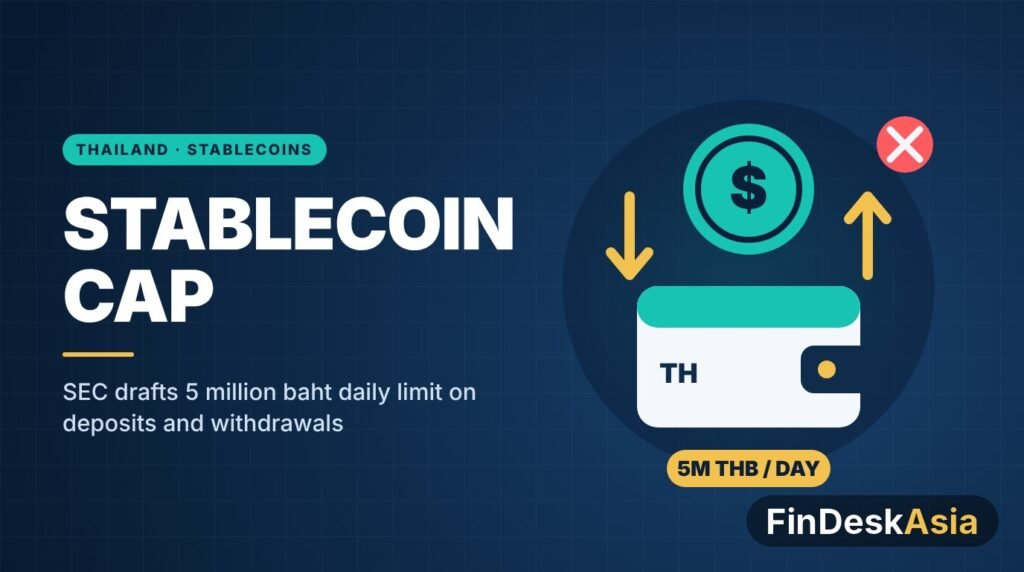
Thailand: SEC Drafts 5 Million Baht Daily Cap on Stablecoin Deposits and Withdrawals
Thailand’s Securities and Exchange Commission (SEC), which supervises crypto exchanges and brokers in the country, has published draft rules that would cap how much stablecoin a customer can move in and out of a licensed crypto platform each day. The limit would be 5 million baht (about US$148,000) for deposits and another 5 million baht for withdrawals.
The draft also bars transfers to and from wallets that belong to someone else. It is the latest step in a wider push by Thai authorities to stop dollar-linked tokens from being used to dodge money transfer controls.
Key facts
- Daily caps: 5 million baht a day for stablecoin deposits and a separate 5 million baht a day for withdrawals, per customer, at each licensed operator.
- Own wallets only: customers could move stablecoins only to and from accounts or wallets that operators have verified as their own. Third-party wallets would be off-limits.
- More checks for platforms: operators would have to follow the “Travel Rule”, which means passing sender and receiver details along with each transfer, and use blockchain analytics to spot wallets linked to suspicious activity.
- Trading rules: certain off-platform trades by brokers and dealers would face a minimum size of 3 million baht.
- Stated aim: the SEC says the measures target money laundering, cybercrime and attempts to get around the rules on sending money across borders.
What the rules would change
A stablecoin is a digital token designed to hold a steady value, usually one US dollar. In Thailand, licensed exchanges can list them, and many users treat them as a quick way to move value between a local platform and the wider crypto world.
That convenience is exactly what worries regulators. Moving baht abroad through a bank or a licensed remittance firm comes with identity checks, reporting and limits. A stablecoin sent from a Thai exchange to an overseas wallet can skip many of those steps. By capping daily flows and banning transfers to wallets owned by other people, the SEC wants each transfer to be traceable to a known customer and to stay within a size it can monitor.
The caps are counted per operator, so a customer with accounts at more than one platform would have a separate limit at each. The draft builds on an earlier SEC consultation held in September, which first floated per-customer transfer limits and tighter oversight of crypto firms.
Why it matters
For most retail users in Thailand, 5 million baht a day is far above normal activity, so everyday trading should not be affected. The rules bite hardest on large traders, over-the-counter desks and anyone who has been using stablecoins as an informal channel for cross-border payments.
For licensed exchanges, the bigger impact is on operations. Verifying wallet ownership, applying the Travel Rule to every transfer and screening wallets with analytics tools all add cost and can slow withdrawals. Smaller platforms may find this harder to absorb than the large local players.
For the region, Thailand is drawing a clear line: stablecoins can trade on regulated venues, but they should not become a shadow remittance rail. The move sits alongside the Bank of Thailand’s own work on stablecoin rules and money changers, and it shows how Southeast Asian regulators are trying to welcome tokenised money without losing control of capital flows. Other markets weighing their own stablecoin regimes are likely to watch how Thai platforms and users respond.
What to watch
- Feedback from Thai exchanges during the public consultation, and whether the 5 million baht caps or the third-party wallet ban are softened.
- When the SEC sets an effective date, and how long platforms get to build wallet checks and Travel Rule systems.
- Whether large stablecoin flows shift to unlicensed channels or offshore platforms once the caps apply.
Related on FinDeskAsia: Thailand Eyes March 2027 for Baht Stablecoin Rules, Freezes New Money Changer Licences and Japan: Digital Garage Adds Circle’s Arc so Payment Firms Can Offer USDC Without New Code.
Sources: Cointelegraph (November 2026), BigGo Finance (November 2026), TokenPost (November 2026).
