
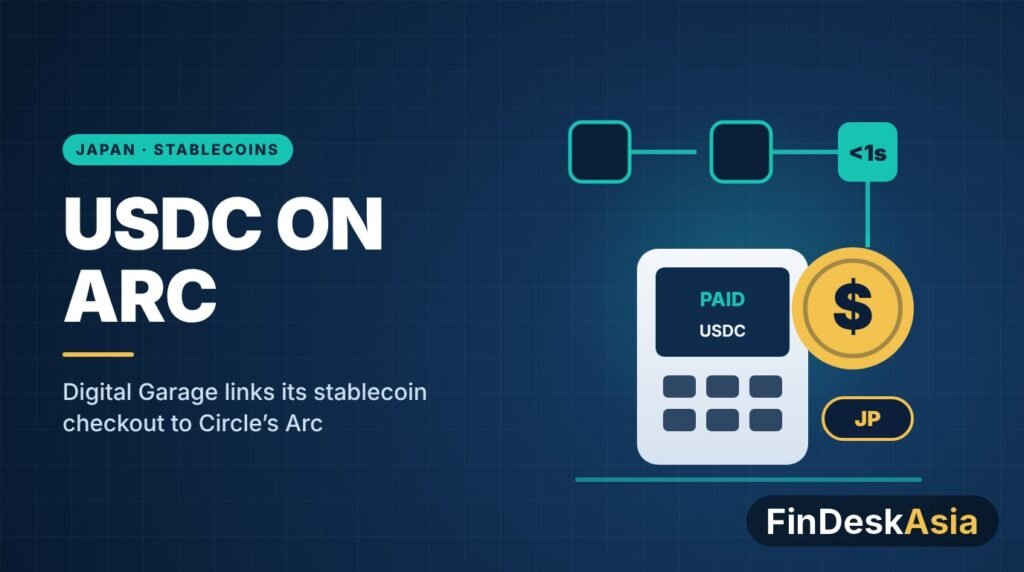
Japan: Digital Garage Adds Circle’s Arc so Payment Firms Can Offer USDC Without New Code
Japanese payments group Digital Garage has signed a basic agreement with an affiliate of Circle, the US company behind the USDC stablecoin, and has connected its stablecoin payment service to Circle’s own blockchain, Arc. The change means payment companies already using Digital Garage’s service can let shops accept USDC on Arc without building anything new.
The deal, announced on 10 November 2026, is the latest step in Digital Garage’s year-long push to turn stablecoin payments in Japan from small trials into an everyday checkout option, working closely with card network JCB.
Key facts
- The agreement: Digital Garage (listed on the Tokyo Stock Exchange Prime market) signed a memorandum of understanding with an affiliate of Circle Internet Group to grow stablecoin payments in the Japanese market.
- The upgrade: DG Stablecoin Payment Service (DG SPS), which connects to a payment provider’s existing systems, now supports USDC on Arc with no extra development needed by the provider.
- Arc’s selling points: payments become final in under one second, network fees are paid in USDC rather than a volatile crypto token, and there are optional privacy features that still allow disclosure for audits.
- Rollout: JCB is the first company receiving DG SPS, and Digital Garage’s own payments arm, DG Financial Technology (DGFT), is next.
- Track record: DG SPS went into commercial operation on 10 August 2026, first supporting USDC on Base, a network built on top of Ethereum.
What Digital Garage and Circle are building
A stablecoin is a digital token designed to keep a steady value, usually by being backed one-for-one by cash and short-term government debt. USDC is pegged to the US dollar and is issued by Circle through regulated companies. Stablecoins run on blockchains, shared digital ledgers that record who owns what. Until now DG SPS used Base; adding Arc gives payment providers a second network to choose from.
Arc is a newer blockchain that Circle has built specifically for payments, foreign exchange and capital markets. For a shop, two features matter most. First, near-instant finality: once a payment goes through in under a second, it cannot be undone by the network reorganising itself, which is important when a customer is standing at the till. Second, fees are charged in USDC, so a merchant or payment company does not need to hold a separate, price-swinging coin just to cover transaction costs, and can forecast its costs more easily.
Digital Garage describes DG SPS as plumbing for payment providers rather than an app for shoppers. Its plan is to use the merchant networks of JCB and DGFT to take USDC acceptance from physical stores into online shopping, and to sign up more partner companies over time. The two sides also plan joint technical work and to recruit partners together. No financial terms, merchant numbers or transaction targets were given.
Why it matters
Japan was one of the first major economies to write clear stablecoin rules into its payments law, and its big payment players are now testing what those rules allow in real shops. Digital Garage, JCB and Resona Holdings, one of Japan’s largest banking groups, began working together on stablecoin payments in January 2026 and followed up with an in-store trial in Tokyo in February. Digital Garage says the push is driven by demand for payment options that cut fees and speed up international payments as cashless use grows.
The most obvious early users are foreign visitors. Tourists already holding dollar stablecoins could pay at Japanese shops without first swapping cash, and in the earlier Tokyo trial the shop still received its sales in yen. Digital Garage also notes that AI agents in the United States are starting to make payments on their own, and that payment firms want to be ready to accept money from both people and software.
For the region, the deal adds to a busy few weeks for regulated stablecoin projects in Asia, from Hong Kong’s new stablecoin licensing regime to Korean fintechs building wallets. The difference in Japan is that a major card network is involved from the start, which could make stablecoins feel like just another way to pay at the till. Reporting by BigGo Finance cautions, however, that Japanese stablecoin payments have only just moved from trials into commercial use, and that real volumes will depend on how many merchants sign up.
What to watch
- When DGFT starts offering USDC on Arc to its merchants, and whether the first online stores go live.
- Whether yen-based stablecoins are added alongside USDC, letting Japanese shoppers pay in their home currency.
- Any figures from JCB or Digital Garage on merchant sign-ups and transaction volumes.
Related on FinDeskAsia: Japan: Progmat and Digital Asset sign deal to tokenise government bonds for 24/7 settlement · South Korea: Toss builds stablecoin wallet and payments
Sources: Digital Garage press release via PR TIMES (November 2026); BigGo Finance (November 2026); Nikkei (November 2026)
