
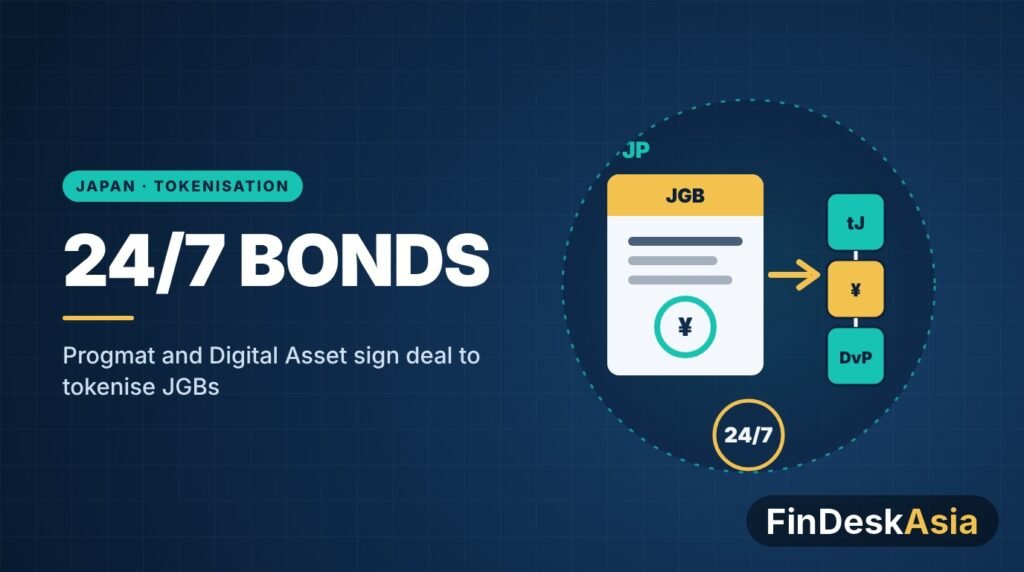
Japan: Progmat and Digital Asset Sign Deal to Tokenise Government Bonds for 24/7 Settlement
Japan’s government bond market, one of the largest in the world, has taken another step towards running on blockchain rails. Progmat, the Tokyo-based platform behind many of Japan’s security tokens, has signed a memorandum of understanding (MOU) with US firm Digital Asset, the developer of the Canton Network, to create tokenised Japanese government bonds that could settle around the clock. Live testing is planned for this month.
Key facts
- The deal: Progmat and Digital Asset signed an MOU to develop “tJGBs”, digital tokens linked to Japanese government bonds (JGBs), with the goal of 24/7 settlement.
- Two phases: first, Progmat’s issuance platform will be connected to the Canton Network and to the existing government bond transfer records; second, a live pilot in a Canton test environment will issue tJGBs, tokenised deposits and stablecoins.
- Timing: the live pilot is planned for November 2026, before a gradual link-up with repo and collateral platforms.
- Big banks involved: Mitsubishi UFJ Financial Group (MUFG) and its affiliates began testing on-chain JGB settlement and repo deals with Progmat and Digital Asset in August.
What is being built
A government bond is a loan to the government that pays interest. In Japan, these bonds are recorded in a book-entry system run through the Bank of Japan, the central bank, and trades usually settle one business day after they are agreed (known as T+1). Settlement only happens when that system is open.
The plan is not to move the bonds themselves onto a blockchain. Instead, tokens would represent the economic rights of bonds that stay in the official record, while keeping their legal status and making sure each transfer is final. Because the token is programmable, the bond and the payment for it can move at the same moment, a method called delivery-versus-payment (DvP). That removes the risk that one side delivers and the other does not.
The Canton Network is a blockchain built for regulated institutions, designed so that banks can share a ledger while keeping their transaction details private from each other.
Why it matters
The main target is the repo market, where banks and investors borrow cash for short periods by pledging bonds as collateral. Japan accounts for about 10% of the global government-bond repo market, according to figures cited by Progmat’s industry group. If tokenised bonds can be pledged and returned within hours, at any time of day, banks could free up cash and collateral that today sits idle while they wait for settlement.
The MOU builds on a wider push. In May, Progmat’s Digital Asset Co-Creation Consortium set up a working group to study tokenised JGBs and on-chain repo paid in stablecoins. Its members include Japan’s three megabanks, MUFG, Mizuho and Sumitomo Mitsui, as well as BlackRock Japan, Daiwa Securities, SBI Securities and State Street Trust and Banking. MUFG’s own proof of concept, announced in August, uses the same two partners to test DvP settlement with digital money and to automate the full life of a repo deal.
For the region, Japan’s move adds to a growing list of tokenisation trials led by regulated players rather than crypto start-ups. Hong Kong and Singapore are running similar programmes for tokenised deposits and bonds. Who sets the standards for this new plumbing, and whether the networks can talk to each other, will shape how money and collateral move across Asian markets in the coming years.
There are still hurdles. Analysts covering the project have pointed to unresolved legal, tax, operational and regulatory questions, including how 24/7 settlement fits with rules built around business-hours systems.
What to watch
- Results of the November live pilot, especially whether tJGBs, tokenised deposits and stablecoins can settle against each other smoothly.
- Whether more banks, trust banks, securities firms and money-market companies sign on as the partners push towards commercial use.
- Guidance from Japan’s Financial Services Agency (FSA) and the Bank of Japan on round-the-clock settlement and legal finality.
Related: How Malaysia’s payment system works · ASEAN’s cross-border QR record
Sources: TechFlow (Nov 2026) · KuCoin News (Nov 2026) · BigGo Finance (May 2026) · FinanceFeeds (May 2026) · Ledger Insights (Aug 2026)
