
Indonesia: Free Bank Accounts for 25 Million Low-Income Adults Due Within Two Months
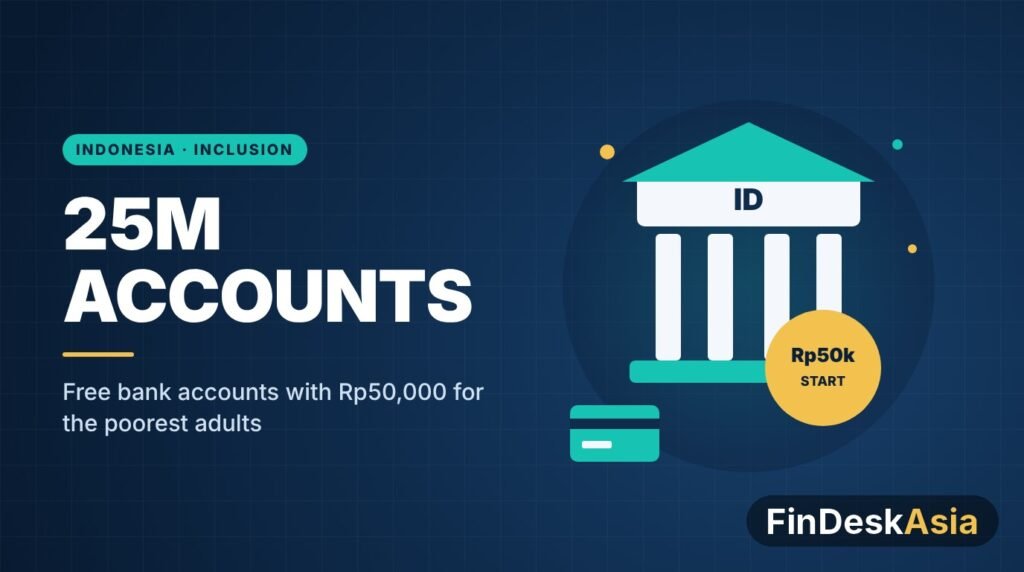
Indonesia is getting ready to open free bank accounts for about 25 million of its poorest adults, each topped up with Rp50,000 (about US$3) from the state. Coordinating Economic Affairs Minister Airlangga Hartarto said on 5 November that the “One Person, One Account” programme is being fine-tuned and should start within about two months, making it one of the region’s biggest single pushes to bring people into the banking system.
Key facts
- The programme targets roughly 25 million Indonesians aged 17 and above who have no bank account and sit in the bottom four income groups (deciles 1 to 4) of the national social and economic database, known as DTSEN.
- Each new account will start with a Rp50,000 balance, and the government has set aside about Rp1.28 trillion (around US$70 million) for the scheme.
- Two state-owned lenders, Bank Rakyat Indonesia (BRI) and Bank Syariah Indonesia (BSI), will open the accounts.
- The aim is to lift Indonesia’s financial inclusion rate from about 93.6% today to 99%, and to use the accounts to pay out social assistance.
- The plan is much smaller than first floated: in September, ministers spoke of accounts for more than 200 million people at a cost of about Rp11 trillion.
From 200 million to 25 million
The idea began in early September, when President Prabowo Subianto told his cabinet that every Indonesian citizen should have a bank account. Airlangga then said the state would need around Rp11 trillion to seed accounts for more than 200 million people with Rp50,000 each, with BRI and BSI doing the work and population records linked to the payment systems of Bank Indonesia (BI), the central bank.
By late October the plan had been cut back sharply. After matching data, the government narrowed it to people who are both unbanked and in the lowest income bands, bringing the target down to about 25 million and the budget to Rp1.28 trillion. The scheme is part of the government’s year-end economic stimulus package.
The rules are still being finished. Bank Indonesia and the Financial Services Authority (OJK), which supervises banks and fintech firms, are working on the technical and regulatory side, while the Home Ministry’s civil registry office (Dukcapil) is preparing the identity data used to check who qualifies. In October, Airlangga said the launch could come in November or December depending on when the regulations were ready; his latest guidance points to a start within two months.
Why it matters
For Indonesia, the real prize is faster and cleaner delivery of welfare money. Airlangga has stressed that the goal is “not just about opening bank accounts” but about making aid programmes work better. Paying cash aid straight into a named account can cut queues, delays and leakage compared with handing out money in person, and it leaves a digital record of who received what.
For banks and payment firms, 25 million new accounts at the bottom of the income ladder is a large new customer base, but not an easy one. Many recipients will have small balances and little experience with banking apps, so the test will be whether the accounts are actually used for saving, paying and receiving money, rather than emptied once and left dormant.
The programme also matters for the wider region. Indonesia is South-east Asia’s most populous country, and governments elsewhere are watching how state-funded account schemes can be combined with fast payment rails and QR payments to reach people who still live mainly in cash.
What to watch
- When BI and OJK publish the final rules, and whether the first accounts open before the end of 2026.
- Whether the scheme later widens towards the original goal of an account for every adult citizen.
- How many of the new accounts are still active months later, which will show whether the push changes everyday money habits.
Related on FinDeskAsia: Indonesia: Tax Office Says No New Tax on Transfers as Minister Keeps QRIS Question Open and Indonesia: Bad Loans on Online Lending Apps Hit 5.36%, Above OJK’s 5% Safety Limit.
Sources: Kompas (November 2026); Jakarta Globe (October 2026); CNBC Indonesia (October 2026); Warta Ekonomi (October 2026); ANTARA (September 2026); InvestorTrust (September 2026).
