
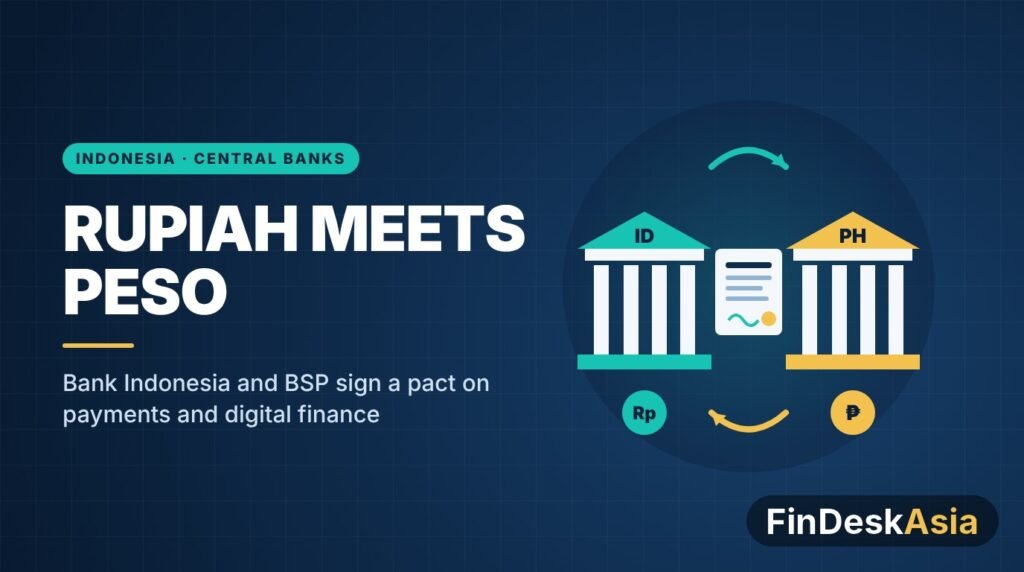
Indonesia and Philippines Central Banks Sign Pact Covering Cross-Border Payments
Indonesia’s central bank, Bank Indonesia (BI), and the Philippines’ central bank, Bangko Sentral ng Pilipinas (BSP), signed a memorandum of understanding (MoU) on Friday, 13 November, to work together more closely. Cross-border payments, local currency transactions and digital financial innovation are at the top of the list. The deal sets up a framework for cooperation; it does not yet launch a new payment service.
Key facts
- The MoU was signed by BI Governor Destry Damayanti and BSP Governor Eli M. Remolona Jr. on 13 November 2026.
- It covers payment and settlement systems, digital financial innovation, cybersecurity, monetary and macroprudential policy, and financial stability.
- It also covers sustainable and Islamic finance, financial inclusion, anti-money laundering and counter-terrorism financing, data use and staff development.
- Damayanti named local currency transactions and cross-border payments as areas for concrete joint work.
- Neither central bank announced a timeline, a target figure or a specific new payment link.
What the two central banks agreed
An MoU is a statement of intent between two institutions. It is not a law and it does not change any fees or rules on its own. What it does is give both sides an agreed list of topics, so their teams can share experience, run joint projects and respond together to common problems.
The list here is wide. Alongside the payments topics, it reaches into how each central bank manages interest rates and lending risks (monetary and macroprudential policy), how they keep the banking system stable, and how they fight money laundering. It also includes Islamic finance, which matters to Indonesia, the world’s largest Muslim-majority country, and to the Muslim community in the southern Philippines.
In comments reported by both countries’ state news agencies, Damayanti said the MoU showed both sides’ commitment to tangible and impactful collaboration. Remolona said cooperation is crucial at a time when central banks must deal with heightened uncertainty, fast technological change, cybersecurity risks and changes in how payment systems work.
Why it matters
Trade between Indonesia and the Philippines is often settled in US dollars. A business in Jakarta paying a supplier in Manila usually converts rupiah into dollars and then into pesos, and pays two currency spreads along the way. A local currency transaction (LCT) arrangement lets banks quote and settle the rupiah–peso exchange directly instead. That can cut costs and reduce exposure to swings in the dollar.
The bilateral MoU also fits a wider push in the region. In the same week, BI and BSP joined Bank Negara Malaysia and the Bank of Thailand in signing a four-country MoU on a local currency transaction framework. Both central banks were also among the five ASEAN central banks that signed the Regional Payment Connectivity MoU in 2022, which set the goal of faster, cheaper and more inclusive cross-border payments in Southeast Asia.
For consumers, the most visible form of this work so far has been cross-border QR payments, which let a traveller scan a local QR code with an app from home. Indonesia’s national QR standard is called QRIS, and the Philippines uses QR Ph. This MoU does not mention a QRIS–QR Ph link, so any such link would need its own agreement and testing.
For Malaysia, the link is real but indirect. Bank Negara Malaysia is a party to the four-country local currency pact, so closer BI–BSP work helps build the same regional network that Malaysian businesses use for ringgit trade with both countries.
What to watch
- Whether BI and BSP name concrete projects, such as a rupiah–peso local currency settlement scheme or a QRIS–QR Ph payment link, with dates.
- How this bilateral deal is used to put the new four-country local currency framework into practice.
- Joint work on cybersecurity and digital innovation, as both countries’ e-wallet and instant payment use keeps growing.
Related on FinDeskAsia: Malaysia, Indonesia, Thailand and Philippines Sign Pact to Settle Trade in Local Currencies and Cambodia and Philippines Central Banks Move to Link Their QR Payment Systems.
Sources: Philippine News Agency (November 2026); ANTARA News (November 2026); Fintech News Singapore (November 2022).
