
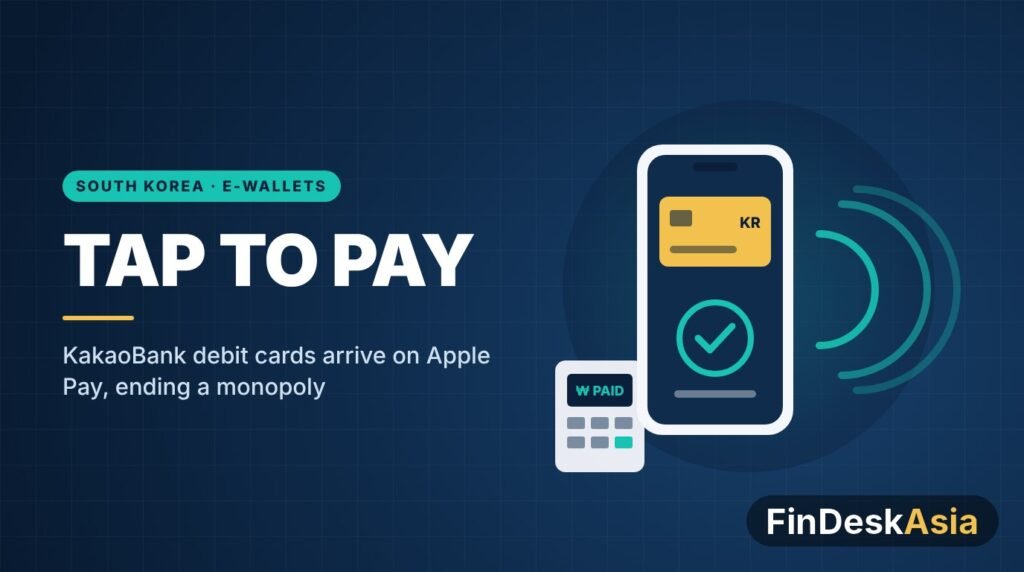
South Korea: KakaoBank Launches Apple Pay, Ending Hyundai Card’s Three-Year Monopoly
South Korean iPhone users no longer need a Hyundai Card to pay with Apple Pay. On 16 November, KakaoBank, the internet-only bank, began letting customers add its debit cards to Apple Wallet, becoming the first bank and only the second local financial firm to support the service. The launch comes a week after reports that it was getting ready.
The move ends a run of more than three and a half years in which Hyundai Card was the sole Korean issuer on Apple Pay, and it opens the service to younger users who often cannot get a credit card.
Key facts
- Launch: KakaoBank switched on Apple Pay on 16 November 2026. Customers add a KakaoBank debit card to Apple Wallet on an iPhone or Apple Watch.
- Teen cards included: The KakaoBank mini card, a card product for teenagers, can be added by users aged 14 and above.
- Where it works: At shops in Korea and overseas that take contactless payments, such as large discount stores, pharmacies, restaurants, cafes and convenience stores, and inside apps and websites on iPhone, iPad and Mac.
- End of a monopoly: Hyundai Card had been the only Korean issuer offering Apple Pay since the service arrived in the country in March 2023.
How it works
To pay in a shop, a user double-clicks the side button on the iPhone or Apple Watch, confirms with Face ID, Touch ID or the device passcode, and holds the device near the card reader. Online, buyers can check out without typing in card numbers or delivery addresses again.
As with Apple Pay elsewhere, the real card number is not stored on the phone or on Apple’s servers. Instead, the device keeps an encrypted stand-in number, called a Device Account Number, inside a dedicated security chip. This process, known as tokenisation, means a stolen phone or a breached merchant does not expose the actual card details.
Because the product is a debit card, payments come straight out of the customer’s KakaoBank account rather than running up a credit balance. Korean media point out that this suits university students and young workers who struggle to qualify for credit cards.
Why it matters
South Korea is one of Asia’s most advanced card markets, but it has been slow to embrace Apple Pay. The service only launched there in March 2023, and since then it has depended on a single issuer, so only Hyundai Card holders could use it. Apple Pay also works only on Apple devices, which limits its reach in a market where locally made Android phones are popular.
Fees are the other sticking point. Apple charges issuers a fee on each transaction, while the dominant rival, Samsung Pay, has not charged Korean card firms in the same way. Local reports say this is a key reason why major issuers such as Shinhan Card and KB Kookmin Card have prepared for Apple Pay but held back their launches. Toss Bank is reported to be reviewing a rollout with Hana Card.
By moving first among banks, KakaoBank is betting that convenience for iPhone users, especially younger ones, will bring in new accounts and more card spending, enough to justify the cost. If that bet pays off, the pressure on the larger card companies to follow will grow. Wider support would also make it easier for Korean travellers to use their phones to pay abroad, and for the country’s mobile-payment market to look more like other developed markets in the region.
For the wider region, the launch is a reminder that big-tech wallets still need local banks and card issuers to sign up one by one, and that the fee split between the wallet provider and the issuer often decides how quickly that happens.
What to watch
- Whether Shinhan Card, KB Kookmin Card and other large issuers now set launch dates for Apple Pay.
- Whether Toss Bank follows through with its own rollout, which would add a second big internet bank.
- How Samsung Pay responds, including any change to its fee-free terms for Korean card firms.
Related on FinDeskAsia: Earlier: KakaoBank and Toss Bank prepare Apple Pay
Sources: The Korea Times (Nov 2026) · Korea JoongAng Daily (Nov 2026) · Seoul Economic Daily (Nov 2026) · The Kyunghyang Shinmun (Nov 2026) · Digital Today (Nov 2026)
