
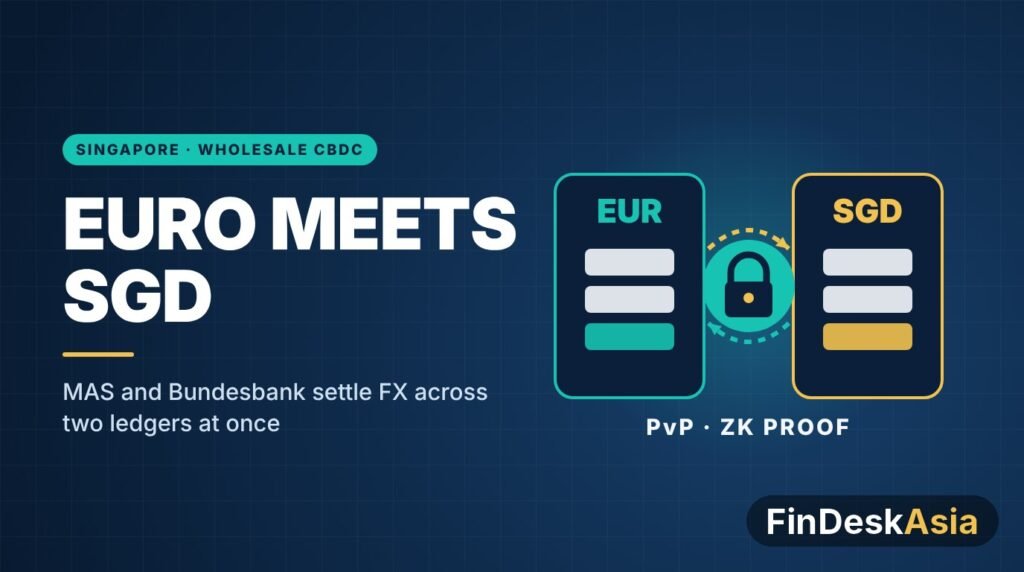
Singapore and Germany Settle Euro-SGD Trades Across Separate Ledgers in Project Simbolon
Singapore and Germany have shown that their central banks can settle a euro and Singapore dollar currency trade at the same moment, even though each currency sits on its own separate digital ledger. The trial, called Project Simbolon, was run by the Monetary Authority of Singapore (MAS) and Germany’s Deutsche Bundesbank with DBS, Deutsche Bank and the blockchain network Partior. The results were published on 16 November 2026.
Key facts
- Project Simbolon tested foreign exchange (FX) settlement between the euro and the Singapore dollar using wholesale central bank digital currencies (wCBDCs), digital central bank money used only between banks, not by the public.
- DBS and Deutsche Bank took part as the commercial banks, and Partior was the technology provider.
- Trades settled on a payment-versus-payment (PvP) basis: both currency legs complete together, or neither does.
- Zero-knowledge proofs let each side check that the other had locked up its funds, without linking the two central bank ledgers directly.
- It is the first major milestone under a memorandum of understanding that MAS and the Bundesbank signed in November 2025 on cross-border digital asset settlement.
How the trial worked
In a normal FX deal, one bank can pay out its currency before it receives the other currency in return. If the other side fails in between, the first bank loses money. This gap is called settlement risk, and it becomes harder to manage when Singapore and Frankfurt are in very different time zones and their payment systems open at different hours.
Simbolon tackled this by keeping each currency on its own test ledger: one for the euro and one for the Singapore dollar. Each bank placed its funds in escrow on its home ledger. A zero-knowledge proof, a cryptographic method that proves something is true without revealing the underlying data, then confirmed to the other side that the money was really there and ready. Once both conditions were met, both legs were released together.
The key point is that the two systems did not have to be merged, share a common ledger or rely on a trusted middleman. Each central bank kept control of its own infrastructure. Deutsche Bank described the approach as connecting different systems “without requiring them to become the same”.
Why it matters
The participants focused on two practical problems for banks that operate across Singapore and German markets. The first is faster securities settlement. As markets move to shorter settlement cycles, banks have less time to get the right foreign currency into place, and a ledger that can settle FX outside normal opening hours helps. The second is short-term funding needs during the day. Banks could use quick, two-step FX swaps to borrow a currency for a few hours, then unwind it, instead of tying up cash for longer than needed.
For Singapore, the trial adds to a long line of MAS work on tokenised money and markets, including Project Guardian, which looks at making tokenised financial markets more efficient. It also follows Project Meridian FX APAC, in which MAS, the Bank of Thailand and the Bank of England showed that FX trades can settle in sync across different systems.
Ledger Insights noted that governance, not technology, remains one of the biggest obstacles. Central banks are reluctant to hand control to a shared platform, which is why a design that leaves each ledger independent may be easier to accept than a single multi-currency hub.
The trial is still only a test. No volumes, amounts or speed results were published, and real-world use would need legal, regulatory and operational questions to be answered first.
What to watch
- A detailed report on Project Simbolon, which MAS and the Bundesbank say will be published on their websites in due course, with no date set.
- Whether the partners test other uses, settlement performance and governance rules, as both central banks have said they may.
- How this independent-ledger model compares with other cross-border projects such as Project Agorá and mBridge.
Related on FinDeskAsia: ASEAN’s cross-border QR record and Singapore and Thailand central banks show FX trades can settle in sync.
Sources: Fintech News Singapore (November 2026); Deutsche Bank (November 2026); Ledger Insights (November 2026)
