
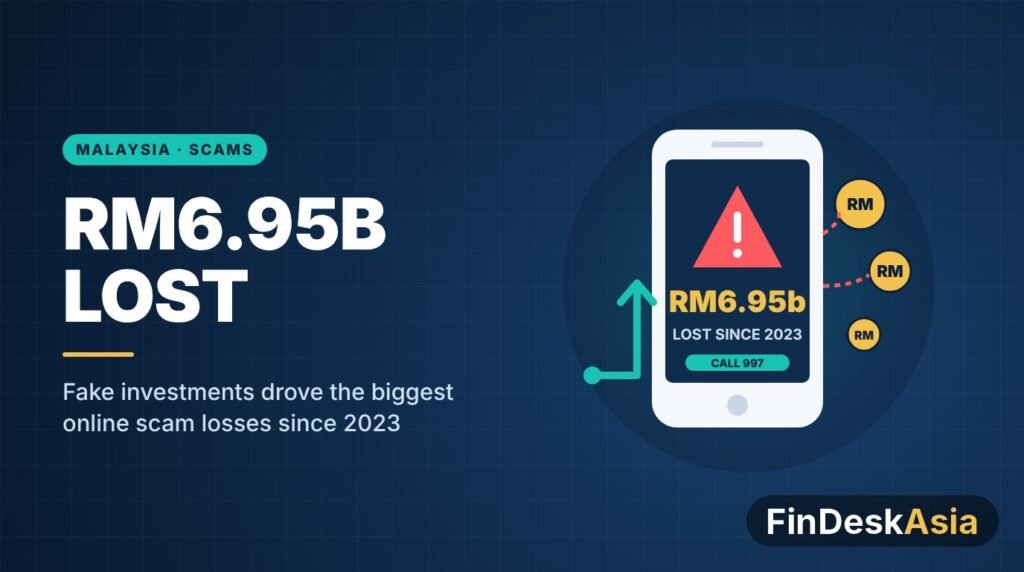
Malaysians Lost RM6.95 Billion to Online Scams Since 2023, Fake Investments Top the List
Malaysians have lost RM6.95 billion to online scams since the start of 2023, according to figures from the Home Ministry released in a written reply to Parliament this week. Fake investment schemes did the most damage, and the numbers show how little money comes back once it leaves a victim’s account.
Key facts
- Police recorded 181,750 online scam cases from January 2023 to August 2026, with total losses of RM6.95 billion.
- Yearly losses rose from RM1.22 billion in 2023 to RM1.57 billion in 2024, then jumped to RM2.97 billion in 2025. From January to August 2026, losses were RM1.18 billion across 45,683 cases.
- Non-existent investment schemes caused the biggest losses at RM3.28 billion, followed by telecommunications-related scams at RM2.03 billion. Love scams cost RM169.72 million.
- The National Scam Response Centre (NSRC) took 159,728 calls from January to August 2026, covering reported losses of RM250.35 million. It seized RM9.14 million and returned RM6.67 million to victims.
Where the money goes
The case counts and the losses tell slightly different stories. Telecommunications scams, where fraudsters call victims while pretending to be police, bank staff or other officials, were the most common type with 69,195 cases. E-commerce fraud came next with 47,221 cases. But the largest losses came from fake investment schemes, which tend to draw victims in over weeks or months and persuade them to transfer larger sums.
The ministry’s figures show 2025 was the worst year so far. Cases nearly doubled from 35,368 in 2024 to 66,204, and losses almost doubled too. Losses in the first eight months of 2026, at RM1.18 billion, are already close to the full-year total for 2023.
The ministry blamed the rise on syndicates using digital tools, fake identities, social media and psychological pressure to manipulate victims. It said commercial crime of this kind remains one of the country’s main policing challenges because of the size of the losses.
What it means for Malaysians
The NSRC figures show why speed matters. The centre, which brings together the police, Bank Negara Malaysia (BNM, the central bank), banks, e-wallet providers and telcos, can only trace and block money while it is still moving between accounts. Of the RM250.35 million reported to the NSRC this year, RM6.67 million has been returned to victims, which is less than 3% of reported losses. The ministry said that figure is 73% of the money actually seized.
- Consumers: call the NSRC hotline at 997 immediately, ideally within 24 hours, which the ministry calls the “golden hours”. Waiting to call your bank first, or hoping the scammer returns the money, reduces the chance of recovery.
- Banks and e-wallets: the pressure to stop money before it leaves is growing. In July, Prime Minister Anwar Ibrahim said e-wallet providers that fail to meet fraud safeguards must compensate scam victims within seven working days. Banks are also moving away from SMS one-time passwords towards in-app approval.
- Merchants and SMEs: e-commerce fraud is the second most common scam type. Sellers who take orders on social media should be wary of fake payment screenshots and confirm that funds have actually arrived in their account before shipping.
The questions in Parliament also asked about a shared liability framework that would split responsibility for scam losses between banks, telcos and digital platforms. The published reports did not say how the ministry answered that part.
What to watch
- Whether the government sets out a shared liability framework for banks, telcos and online platforms, similar to schemes being built in other markets.
- Full-year 2026 figures, which will show whether losses are falling from the 2025 peak or simply being reported later.
- Further steps by BNM and payment providers to slow down or flag suspicious transfers before they reach mule accounts.
Related: PayNet and the regulators: who runs Malaysia’s payments · BSN drops SMS OTPs for online card payments
Sources: The Star (November 2026) · Malay Mail (November 2026) · Sarawak Tribune (November 2026) · The Star (July 2026)
