
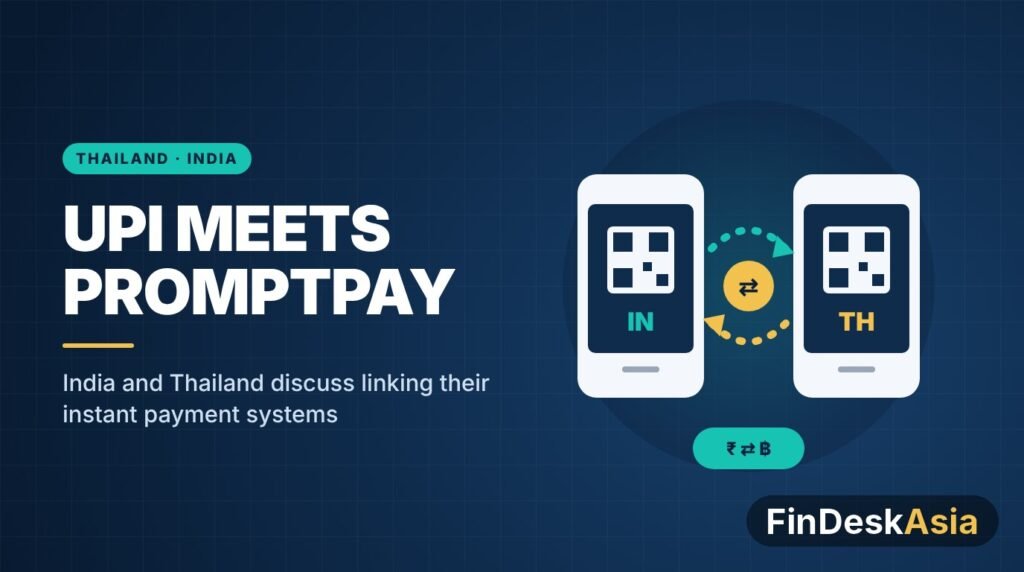
India and Thailand Discuss Linking UPI With PromptPay, Settling Trade in Local Currencies
India and Thailand are looking at connecting their national instant payment systems, India’s Unified Payments Interface (UPI) and Thailand’s PromptPay. The idea came up at a trade meeting in Thailand on 16 November, alongside talks on settling bilateral trade in the two countries’ own currencies. No timeline was announced, so this is an early-stage discussion rather than a launch.
Key facts
- The 14th India-Thailand Joint Trade Committee met on 16 November 2026 at Thailand’s Ministry of Commerce in Nonthaburi, just outside Bangkok.
- It was co-chaired by Nitin Kumar Yadav, Additional Secretary at India’s Department of Commerce, and Chotima Iemsawasdikul, Director-General of Thailand’s Department of Trade Negotiations.
- Both sides discussed a proposed UPI–PromptPay link, settling trade in local currencies, and closer fintech cooperation between the Reserve Bank of India (RBI) and the Bank of Thailand (BOT).
- Two-way trade reached US$21.49 billion in India’s 2025–26 financial year, up 12.6% from the year before.
- Thailand made up 16.7% of India’s total trade with ASEAN over the same period.
What is on the table
UPI is India’s real-time payment network. It lets people send money or pay shops instantly from a bank app using a phone number, an ID or a QR code. PromptPay plays a similar role in Thailand: Thais use it to transfer money with a mobile number or national ID and to pay at shops by scanning a Thai QR code.
A link between the two would let a customer of one system pay or send money to a user of the other, without needing a card or a money changer. In practice, that usually means an Indian tourist scanning a Thai shop’s QR code with their UPI app, or a Thai visitor doing the reverse in India, with the currency conversion handled in the background.
The second item, local currency settlement, is aimed at businesses. Instead of pricing and paying for trade in US dollars, an Indian importer could pay a Thai exporter in rupees or baht. This can cut conversion costs and reduce exposure to swings in the dollar.
The officials agreed to hold working-level talks before the next committee meeting, which India will host. They did not say when a payment link might go live or which banks or operators would run it.
Why it matters
For Thailand, letting Indian visitors pay with the app they already use at home could make it easier for hotels, restaurants and small shops to take their money. For India, a Thai link would add another destination to UPI’s growing list of overseas connections.
For the wider region, the talks fit a familiar pattern. Over the past few years, South-East Asian central banks have joined their QR and instant payment systems one country pair at a time. PromptPay already connects with several neighbours, including Malaysia’s DuitNow QR. India and Thailand are also both part of Nexus, a multilateral scheme first designed at the Bank for International Settlements (BIS) to connect domestic instant payment systems through a single shared platform, alongside Malaysia, Singapore and the Philippines.
That raises a practical question: whether a direct UPI–PromptPay link would be built on its own, or whether the two countries would wait to connect through Nexus. The meeting statement did not say.
The trade side gives the payment talks extra weight. Both sides called for an early and meaningful conclusion of the review of the ASEAN-India Trade in Goods Agreement (AITIGA), and discussed non-tariff barriers on farm, livestock and marine products. Cheaper payments and local currency settlement would support any increase in goods trade that a revised agreement brings.
What to watch
- Whether the RBI and the Bank of Thailand sign a formal agreement on the UPI–PromptPay link, and when.
- Whether the link is built bilaterally or folded into Nexus.
- Progress on local currency settlement and on the AITIGA review before the next Joint Trade Committee meeting in India.
Related on FinDeskAsia: Singapore’s Wong Proposes ASEAN-Wide Network of Cross-Border Payment Links and ASEAN cross-border QR payments.
Sources: The Tribune / ANI (November 2026); Indian Masterminds (November 2026); NewsBytes (November 2026).
