
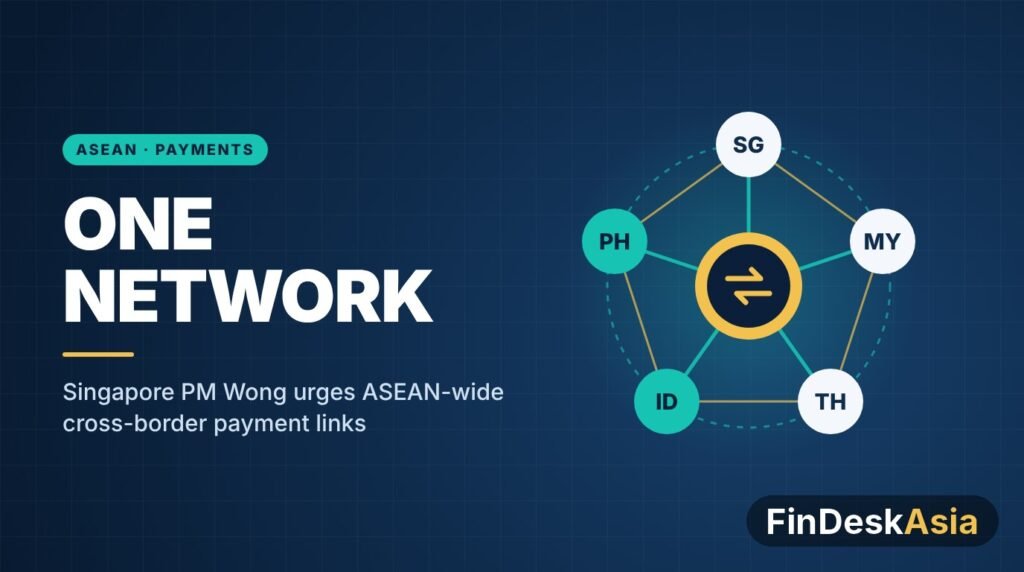
Singapore’s Wong Proposes ASEAN-Wide Network of Cross-Border Payment Links
Singapore Prime Minister Lawrence Wong has called on ASEAN to build a region-wide network of cross-border electronic payment systems. Speaking at the 49th ASEAN Summit in Manila on 15 November, he said the network could grow out of payment links Singapore already has with Malaysia and Thailand, and would make it cheaper and easier for people and businesses across the bloc to pay one another.
Key facts
- Wong made the proposal at the summit’s plenary session in Manila on 15 November 2026.
- He suggested building on Singapore’s existing payment links with Malaysia and Thailand, rather than starting from scratch.
- He said businesses, citizens, tourists and migrant workers sending money home would all gain from easier and cheaper cross-border transactions.
- The call came a day after ASEAN signed its Digital Economy Framework Agreement (DEFA), which Wong described as “just the first step”.
- He also urged closer regional coordination against cyber threats and online scams.
From one-to-one links to a network
Most cross-border payment links in South-East Asia today are bilateral: two countries connect their national systems so that a customer in one can pay or send money to someone in the other. One example is the link between Singapore’s PayNow and Malaysia’s DuitNow, the national instant-payment services run by each country’s banks. Launched in November 2023, it lets users send money across the Causeway using just the recipient’s mobile number, with daily limits of RM3,000 in Malaysia and S$1,000 in Singapore.
The weakness of the one-to-one approach is scale. Every new pair of countries needs its own technical, legal and settlement arrangements, and the number of possible pairs grows quickly as more members join. A shared network, which is what Wong is pointing to, would let a country connect once and reach all the others. That idea is already being tested through Nexus, a multilateral scheme first developed by the Bank for International Settlements (BIS), which FinDeskAsia reported is targeting a launch in the fourth quarter of 2027.
Wong did not give a timeline, a budget or a list of participating systems, so the proposal is for now a statement of direction rather than a concrete plan.
Why it matters
Across ASEAN’s member states, cheaper cross-border payments touch everyday life. Tourists who can pay with their home app avoid currency exchange counters and card fees. Small merchants can sell to buyers next door without needing a foreign bank account. And for millions of migrant workers, lower remittance costs mean more of each pay cheque reaches their families.
The timing also gives the idea weight. Wong framed the proposal as part of a wider push for practical economic integration at a time of global uncertainty, alongside calls to ratify the ASEAN Petroleum Security Agreement and to give more priority to the ASEAN Power Grid. Singapore will take over the rotating ASEAN chairmanship in 2027, which puts it in a position to keep payments connectivity on the agenda next year.
There is a direct Malaysian link. Malaysia is one of the two partners Wong named as the base for the network, through the DuitNow–PayNow connection. Any regional scheme built on that foundation would involve Bank Negara Malaysia (BNM), the central bank, and PayNet, the national payments network operator that runs DuitNow. For Malaysians who work in Singapore, travel in the region or run businesses that sell across borders, a single network could mean fewer apps, clearer fees and faster transfers to more countries.
What to watch
- Whether ASEAN leaders endorse the idea in the summit’s closing statements, and whether central banks follow with a formal work plan.
- How the proposal fits with Nexus and with the existing bilateral QR and instant-payment links, so that efforts are not duplicated.
- What Singapore puts forward on payments as ASEAN chair in 2027.
Read more: ASEAN Signs DEFA, Its First Digital Economy Pact Covering E-Payments and Digital ID · DuitNow explained
Sources: AsiaOne (November 2026) · Red Hot Singapore / The Business Times (November 2026) · EconoTimes (November 2026) · BusinessToday Malaysia (November 2023)
