
Bank Negara Sets 2028 Start for Open Finance, Biggest Banks to Share Customer Data First
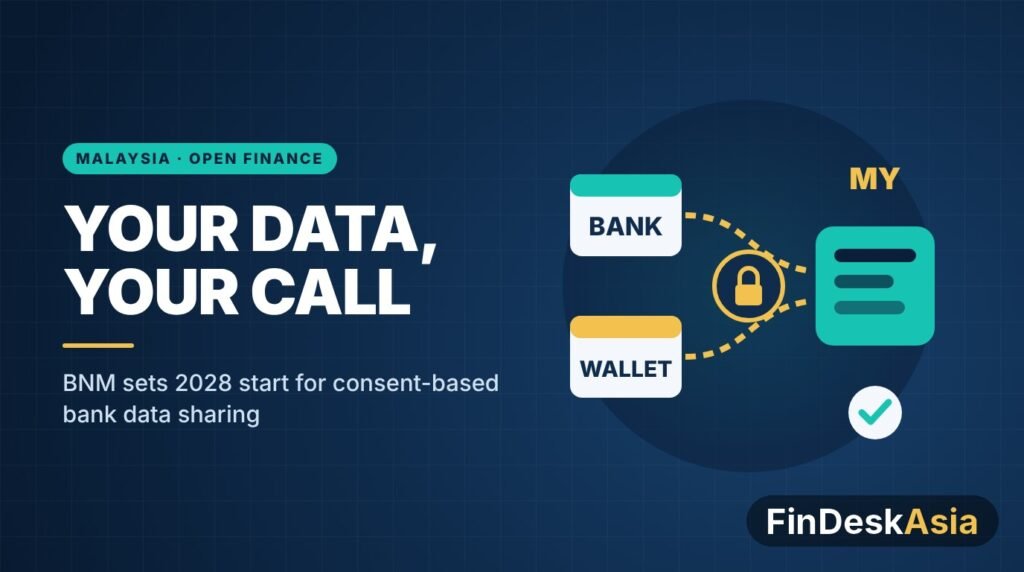
Bank Negara Malaysia (BNM), the country’s central bank, has issued its final policy on open finance, a system that lets customers tell their bank or e-wallet to share their account data with another financial provider. The policy took effect on 17 November 2026, and the largest banks must be ready to share individual customers’ data, with their consent, from 1 January 2028.
Key facts
- BNM issued the open finance policy document on 17 November 2026, setting rules for consent-based sharing of customer information across the financial sector.
- Licensed and Islamic banks with more than one million active individual and SME customers combined must share individual customers’ data from 1 January 2028.
- The data covers current balances and the past 12 months of transactions for deposit accounts, e-money accounts, credit cards and charge cards.
- Data will move through the Open Finance Malaysia platform, run by Payments Network Malaysia (PayNet), the national payments operator.
- Customers must opt in actively, and recurring access lasts up to six months before it has to be renewed.
How the rollout works
The mandate grows in three stages, according to the policy as reported by Fintech News Malaysia. The first wave, from 1 January 2028, covers only the biggest banks, and only the sharing of individual customers’ data.
From 1 January 2029, the duty extends to banks and Islamic banks with more than 250,000 active individual and SME customers combined, and to e-money issuers (e-wallet operators) with more than five million active users. By the same date, covered banks and e-wallets must also be able to receive data when a customer asks for it, not just send it.
The final stage arrives on 1 January 2030. Prescribed development financial institutions, the government-backed lenders such as those serving SMEs and rural borrowers, must join if they pass the 250,000-customer mark. SME account data also becomes part of the mandate on that date for providers with more than 30,000 active SME customers or users.
Investment banks, insurers and takaful (Islamic insurance) operators are not required to take part. Smaller banks and e-wallets below the thresholds may join voluntarily if they meet the rules.
What it means for Malaysians
For consumers, the most visible change is likely to be convenience. A customer could see accounts held at different banks and e-wallets in one app, or let a lender pull their transaction history directly instead of downloading and uploading bank statements for a loan or credit card application.
Control stays with the customer. Providers may not use pre-ticked boxes or bury consent inside unrelated terms and conditions. A consent dashboard will show what data a person has agreed to share, with whom, why and for how long, and lets them withdraw permission. A one-time permission ends as soon as the data is retrieved; recurring access must be renewed at least every six months.
For SMEs, the 2030 stage matters most. Small firms often struggle to prove their cash flow to lenders, and direct access to verified transaction data could make credit checks faster and fairer for businesses with thin paperwork.
For banks and e-wallets, the work starts now. They need the technology to connect to PayNet’s platform, a plan for handling data breaches, and arrangements to cooperate when a complaint involves more than one provider. Each provider is liable for what is within its own control, and data must be deleted once consent ends unless the law requires it to be kept.
The policy follows an exposure draft BNM released for consultation in November 2025, and it comes as the central bank pushes scam controls hard. Strict consent rules are meant to make sure data sharing does not open a new door for fraudsters.
What to watch
- Which banks fall into the first 2028 group, and when PayNet starts live testing of the Open Finance Malaysia platform.
- Whether large e-wallets prepare early for the 2029 deadline, and which smaller fintechs opt in voluntarily.
- The first consumer products built on shared data, such as account dashboards and faster loan approvals.
Related: PayNet and the regulators · How Malaysia’s payment system works
Sources: Fintech News Malaysia (Nov 2026) · Bernama via Media Selangor (Nov 2026) · Newswav (Nov 2026) · BNM exposure draft (Nov 2025)
