
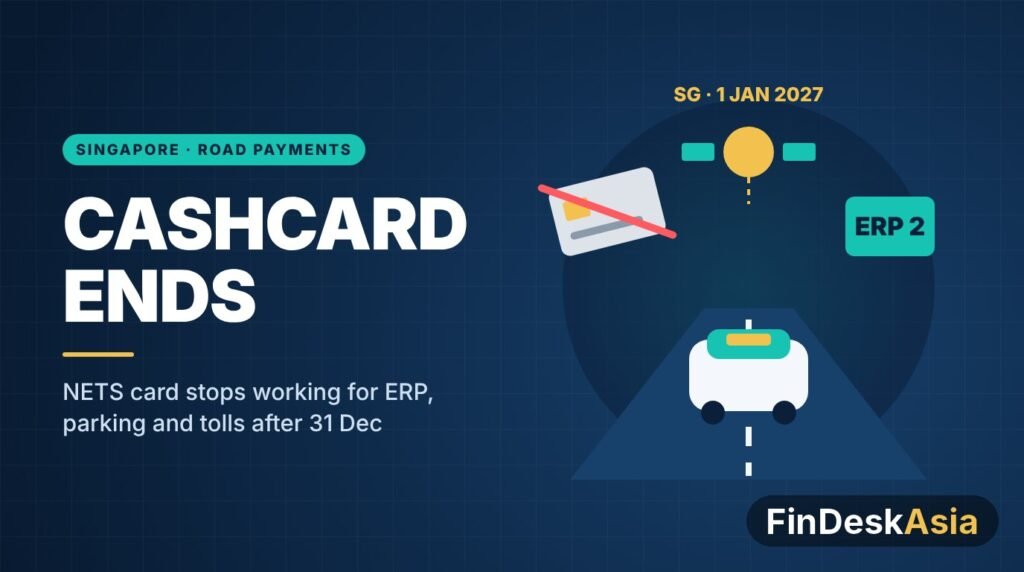
Singapore: NETS CashCard Stops Working for ERP, Parking and Tolls After 31 December
Singapore drivers who still keep a NETS CashCard in their car have about six weeks left to use it. NETS, the payments network owned by the city’s three local banks, says the stored-value card will no longer be accepted for road charges, car parks, checkpoint tolls or shop purchases after 31 December 2026. The change comes as the Land Transport Authority (LTA) switches to ERP 2, a satellite-based road charging system, on 1 January 2027.
Key facts
- The CashCard stops working for Electronic Road Pricing (ERP), car park payments, checkpoint tolls and retail after 31 December 2026.
- NETS is pointing users to two replacements: the NETS Motoring Card and the NETS FlashPay Card.
- Leftover balances can be refunded at DBS/POSB, OCBC and UOB branches, and at OCBC and UOB ATMs, until 31 March 2027. The DBS/POSB ATM option closed on 15 November.
- Card balances are refunded in full within two years of the card’s expiry date. After that, a S$1 monthly charge is deducted until the money is refunded or used up, or until four years have passed.
Why a 30-year-old card is being retired
The CashCard was launched in 1995 and began paying ERP and car park charges in 1997. For most of that time it sat in an in-vehicle unit on the dashboard, which deducted road charges each time a car passed under an ERP gantry.
ERP 2 changes how that works. Instead of overhead gantries, cars carry an on-board unit (OBU) that uses satellite positioning to work out where charges apply. Every Singapore-registered vehicle must have an OBU fitted by 1 January to use public roads, and LTA said in September that more than 98% of eligible vehicles already had one. Up to one million motorists get a free NETS Motoring Card when they install the unit, so many drivers have already been handed the replacement.
The physical side of the old system is also being taken down. LTA contractors are removing 62 gantries that are no longer in use first, then 33 operational gantries once gantry-based charging ends on 31 December. Some frames may stay up, fitted with roadside units that support the satellite system. New blue “ERP” road markings and “ERP Charge Zone” signs have been appearing since October.
Why it matters
For drivers, the practical message is simple: move any balance off the CashCard and make sure a Motoring Card or FlashPay Card, or another accepted payment option, is ready before New Year’s Day. Anyone who leaves an old card in a drawer can still get the money back, but waiting more than two years after expiry means the S$1 monthly charge starts eating into it. From 1 April 2027, only the NETS Customer Service Centre will handle refund requests.
For the wider payments market, the CashCard’s exit is another step in Singapore’s slow retirement of older stored-value cards built for a single purpose. Public transport has already moved towards account-based fare payments, and road charging is now moving to a system built around the OBU. Fewer card types means less legacy hardware for banks, NETS and car park operators to maintain, and fewer small balances stranded in forgotten cards.
The shift also shows how payments are becoming part of transport infrastructure itself. With ERP 2, the vehicle’s own unit decides when and where a charge applies, while the card or linked payment method simply settles the bill.
What to watch
- How smoothly car parks and checkpoints handle the 1 January cut-over, especially for drivers who have not switched cards.
- Whether NETS or the banks extend refund channels if many CashCard balances are still unclaimed by 31 March 2027.
- Further moves by LTA to retire the remaining gantry hardware and expand ERP 2 features in 2027.
Related on FinDeskAsia: Singapore: Samsung Wallet Users Can Now Pay at QR Shops With Visa Cards via Scan to Pay · Singapore’s Wong Proposes ASEAN-Wide Network of Cross-Border Payment Links
Sources: Fintech News Singapore (Nov 2026) · AsiaOne (Nov 2026) · Tabla (Nov 2026)
