
YouApp Trials Stablecoin Payments at DuitNow QR Shops, Merchants Still Paid in Ringgit
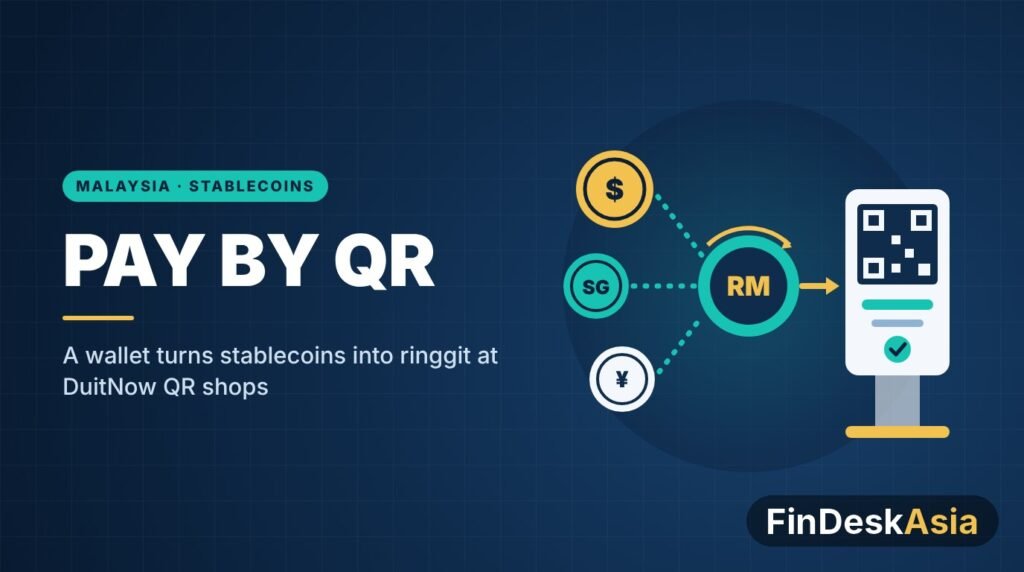
A wallet app called YouApp is testing a way for people holding digital dollars and other stablecoins to pay at ordinary Malaysian shops. Customers scan a standard DuitNow QR code, and the shop receives ringgit as usual, while a conversion step in the background turns the customer’s tokens into a ringgit-linked balance.
Key facts
- YouApp began a retail payment trial linked to DuitNow QR, Malaysia’s national QR payment standard run by PayNet, in October 2026, according to KoreaTechDesk.
- Users top up with stablecoins on the Ethereum network, including US dollar tokens, XSGD (Singapore dollar), JPYC (Japanese yen) and IDRT (Indonesian rupiah).
- Sera, a settlement provider at sera.cx, converts those tokens into MYRT, a token that YouApp says is minted and redeemed one-for-one with ringgit.
- Licensed payment partners redeem the MYRT and pay the merchant in ringgit, so shops do not handle crypto or change their checkout.
- YouApp’s site lists a scan-to-pay fee from 1.5% to 1.7% depending on the page, with limits of RM5,000 per transaction and RM150,000 a year.
How the payment works
A stablecoin is a digital token designed to hold a steady value by tracking a normal currency, such as the US dollar. Travellers, freelancers and crypto users often hold them, but most Malaysian shops cannot accept them directly.
YouApp tries to bridge that gap. The user funds a non-custodial wallet, meaning the user, not the app, controls the keys to the funds. The wallet infrastructure comes from Privy, a company owned by Stripe. When money arrives, Sera converts it into MYRT, which becomes the spending balance shown in the app.
At the till, the customer scans the shop’s DuitNow QR code and approves the payment. Behind the scenes, licensed partners swap the MYRT back into ringgit and send it to the merchant through the DuitNow network. From the shop’s side, it looks like any other QR payment.
YouApp describes MYRT as a limited-purpose ringgit payment token rather than a currency of its own. It says the token’s reserves are held one-for-one at a licensed Shariah-compliant fund. The app also states plainly that it is not a bank and not an e-money issuer. Neither the company’s site nor the KoreaTechDesk report says the trial is running inside a Bank Negara Malaysia (BNM) sandbox.
What it means for Malaysians
For merchants and SMEs, the appeal is that nothing changes. More than 3 million DuitNow QR points already exist across the country, and any of them can in principle receive these payments without new hardware or a crypto account.
For consumers and visitors, the trial points to another route for foreign money to reach local shops. Malaysians already have several cross-border QR options. On 28 October, PayNet let Maybank, CIMB and Hong Leong Bank customers pay by DuitNow QR in China, Hong Kong, South Korea, the Philippines and Laos through Ant International’s Alipay+. YouApp’s model works in the other direction: it lets holders of digital tokens spend in ringgit here.
For banks and regulators, the test sits at the edge of the formal system. The shopper-facing part runs on public blockchains, while the final payout relies on licensed partners and the PayNet network. That mix raises questions about oversight, consumer protection and who is responsible if a payout fails.
The costs matter too. A fee of 1.5% to 1.7% on each payment is a noticeable cost for small purchases. KoreaTechDesk also notes that any cost advantage over existing payment options has not yet been shown. So the main users are likely to be people who already hold stablecoins, rather than everyday Malaysian shoppers.
What to watch
- Whether YouApp or its partners name the licensed firms that handle redemption and payouts, and whether the scheme seeks formal BNM approval or sandbox status.
- How many merchants and users the trial reaches beyond its early stage, and whether payouts stay reliable at scale.
- Whether banks or licensed e-money issuers launch their own ringgit tokens, which could compete with privately run models like this one.
Read more: DuitNow explained and ASEAN’s cross-border QR record.
Sources: KoreaTechDesk (November 2026), YouApp: What is MYRT (November 2026), Lowyat.NET (October 2026).
