
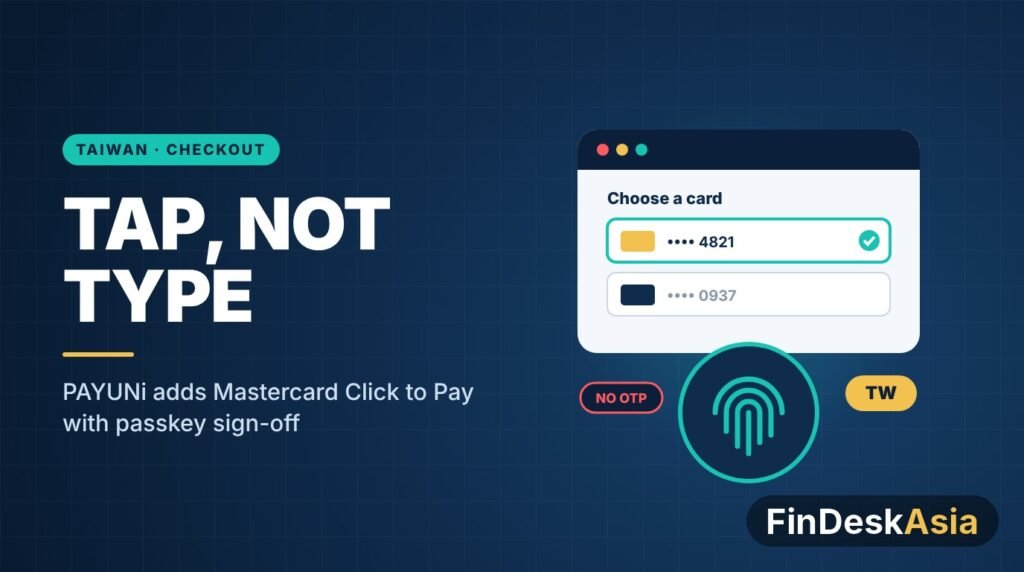
Taiwan: PAYUNi Adds Mastercard Click to Pay, Swapping SMS Codes for Fingerprint Checks
Online shoppers in Taiwan who are tired of typing in their card number at every checkout have a new option. PAYUNi, the third-party payment brand of the Uni-President group, has added Mastercard’s Click to Pay service and paired it with Mastercard Payment Passkeys, so buyers can pick a saved card and confirm with a fingerprint or face scan instead of waiting for an SMS code.
The move makes PAYUNi the first third-party payment service provider in Taiwan to work with Mastercard on Click to Pay, and it pushes the card network’s password-free checkout plan beyond a handful of early partners.
Key facts
- Who: PAYUNi, the online payment brand of Taiwan’s Uni-President group, and Mastercard. The launch was announced on 17 November 2026.
- What: Click to Pay lets shoppers choose a card they have already registered at checkout, without re-entering the card number, expiry date or security code.
- Verification: Payment Passkeys let eligible cardholders approve payments with facial or fingerprint recognition instead of an SMS one-time password (OTP).
- First of its kind: PAYUNi is the first payment service provider in Taiwan to partner Mastercard on Click to Pay.
- Not yet known: the first participating merchants and supported banks have not been named.
How the new checkout works
Click to Pay is built on a standard from EMVCo, the industry body owned by the major card networks that sets common rules for card payments. Because it is a shared standard, it is not tied to one phone brand or one e-wallet. Shoppers do not need to download an app; it runs in mainstream web browsers on supported devices. Several eligible cards can be stored in one profile, and at a participating shop the buyer simply picks which card to use.
The second piece is security. Payment Passkeys follow the FIDO standard, the same technology that lets people log in to websites with a fingerprint instead of a password. Rather than receiving a one-time code by text message, or being bounced to a separate bank page, the cardholder confirms the payment on their own device. Behind the scenes, the real card number is replaced with a token, a stand-in number that is useless if stolen.
PAYUNi says this split of roles is the point: Click to Pay handles choosing the card, while passkeys handle proving who you are. In its words, security and convenience should not be an either-or choice.
Why it matters
SMS codes are one of the weakest links in online card payments. They can arrive late, which leads shoppers to give up on a purchase, and they are a favourite target for phishing and social-engineering scams in which fraudsters trick victims into reading out the code. Replacing them with on-device biometrics removes a step for honest shoppers and closes a common door for scammers, although it does not make every transaction risk-free.
For merchants, the attraction is fewer abandoned carts. Mastercard’s own research, cited when it first announced Click to Pay for Taiwan in December 2025, found that 83% of online shoppers had abandoned a cart at checkout, and 49% of those blamed a clumsy payment process. Taiwan’s online market is large enough for that to matter: e-commerce sales reached a record NT$383.5 billion (New Taiwan dollars) in the first ten months of 2025, according to the Ministry of Economic Affairs.
Until now, Mastercard’s Taiwan rollout had relied on a bank partner, Union Bank of Taiwan, and a few merchants such as ChargeSPOT. A payment service provider like PAYUNi can switch the feature on for many online shops at once, which is usually how a new checkout method reaches scale. Mastercard has set a goal for online shopping across Asia Pacific to need no passwords or typed card numbers by 2030, and Taiwan is one of its first test markets.
What to watch
- Which PAYUNi merchants switch on Click to Pay first, and which Taiwanese card issuers support Payment Passkeys.
- Whether rival networks and local payment providers follow with similar card-on-file and passkey checkouts.
- Any data from PAYUNi or Mastercard on checkout completion rates and fraud after launch.
Related on FinDeskAsia: How payment gateways work · How a payment system fits together
Sources: CIO Taiwan (November 2026) · Storm Media (November 2026) · Mastercard Taiwan (December 2025)
