
Singapore: MAS Maps PayNow Upgrade Letting Any App Pay Any QR Merchant From 2027
Singapore has set a timetable for the next big upgrade to PayNow, its national instant payment service. The Monetary Authority of Singapore (MAS), the country’s central bank and financial regulator, and the Association of Banks in Singapore (ABS) published a roadmap on 18 November that will let shoppers pay any merchant with the app they prefer, starting with a limited rollout in 2027.
The plan, known as PayNow Generation 2 (Gen2), also adds clearer refund and scam rules for shop payments, richer payment data for businesses, and early work on payments made by AI agents.
Key facts
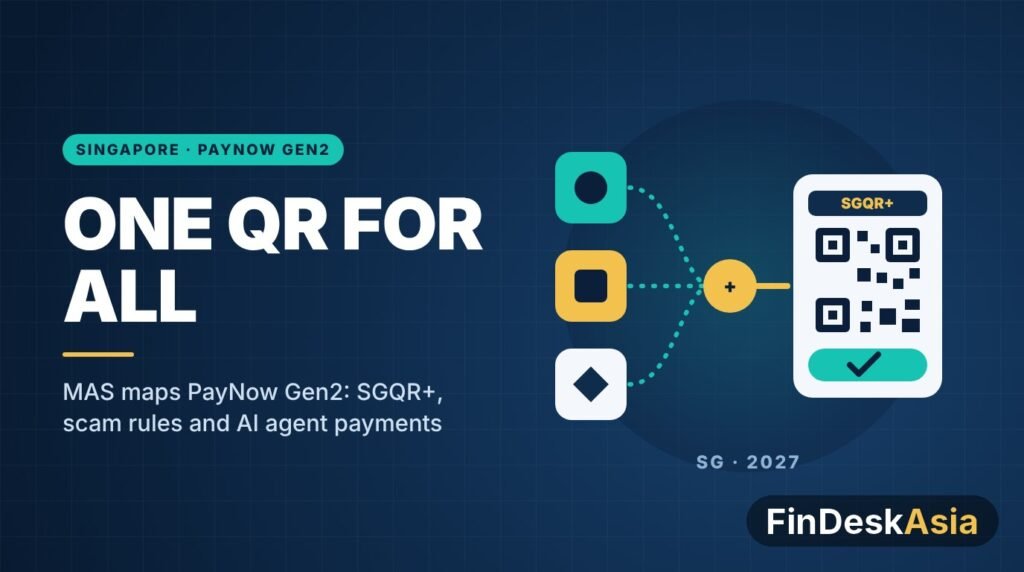
- One QR for every app: a new switch called SGQR+ will let users pay at any merchant without checking which QR schemes it accepts. Work has started, with a limited rollout in 2027 and wider scope in 2028.
- Smoother online checkout: common standards and a central facility for “deep-linking”, which jumps shoppers straight from a checkout page to their payment app, are due by end-2027.
- Consumer protection: the Singapore Payments Network (SPaN) will set rules for disputes, refunds, fraud and scams on person-to-merchant payments, introduced in stages over 2028.
- Higher-value government payments: higher PayNow limits will be tried with one government agency in late 2027, with other agencies targeted from 2028.
- Next step: MAS will draw up a Future Payment Rails Blueprint in 2027 to plan Singapore’s payment systems beyond Gen2.
What changes for shoppers and merchants
Today, Singapore already has a common QR label, SGQR, that puts many payment schemes on one sticker. But customers and tourists can still find that their app is not one of the schemes a shop accepts. SGQR+ is meant to fix this behind the scenes: the switch routes the payment so that any participating app can pay any participating merchant. MAS says the change will also help tourists, as Singapore plans to link SGQR+ to more regional QR networks.
Online shoppers should notice the deep-linking work first. Instead of saving a screenshot of a QR code and scanning it with a banking app, the shopper taps a button and the payment app opens with the details filled in. Some checkouts already do this, such as Lazada with the OCBC app, but the roadmap aims to make it a common standard.
For businesses, richer payment data is the quieter but useful change. From end-2027, payments can carry structured details such as merchant identifiers, merchant category codes, invoice references and payment-purpose codes. That helps finance teams and government agencies match payments to invoices automatically, a job that is often still done by hand.
Why it matters
PayNow made instant transfers between people easy, but paying shops has been more fragmented. Clear rules on refunds and scams matter as much as the technology: shoppers are more willing to pay merchants by bank transfer when they know how disputes will be handled. SPaN, the industry body that will set these rules, will also oversee the scheme.
The roadmap looks further ahead too. MAS will bring together SPaN, Banking Computer Services (BCS, which operates key payment infrastructure) and other partners to build capabilities for payments made through AI agents. Banks and payment firms will test whether very small, frequent payments, worth less than a cent in some cases, can be processed cheaply enough to make sense. Work will also look at tokenised payment credentials for recurring and contactless payments.
There is a regional angle. Singapore’s NETS QR and Malaysia’s DuitNow QR have been linked since 2023, so travellers can already pay across the Causeway with their home apps. A wider SGQR+ network that plugs into more regional QR systems could make those links easier to use, and fits ASEAN’s wider push to connect national payment systems.
What to watch
- Which apps, banks and merchants join the first, limited SGQR+ rollout in 2027.
- The detail of SPaN’s refund, dispute and scam rules for shop payments, due in stages over 2028.
- Whether the Future Payment Rails Blueprint in 2027 adds new rails, such as a low-cost system for micropayments.
Related: ASEAN’s cross-border QR record · DuitNow explained
Sources: Monetary Authority of Singapore (November 2026) · TNGlobal (November 2026) · Fintech News Singapore (November 2026) · Tech Wire Asia (April 2023)
