
Bank Negara Wants DuitNow QR Payments Funded by Credit Cards, Closed QR Codes Gone by 2028
Bank Negara Malaysia (BNM), the country’s central bank, wants paying by phone to get cheaper, easier and more connected in 2027. Speaking at PayNet’s Malaysian E-Payments Excellence Awards in Kuala Lumpur on 19 November, Deputy Governor Aznan Abdul Aziz said digital payments are now “an essential service” and that lower costs must reach shoppers and merchants, not just the payment firms.
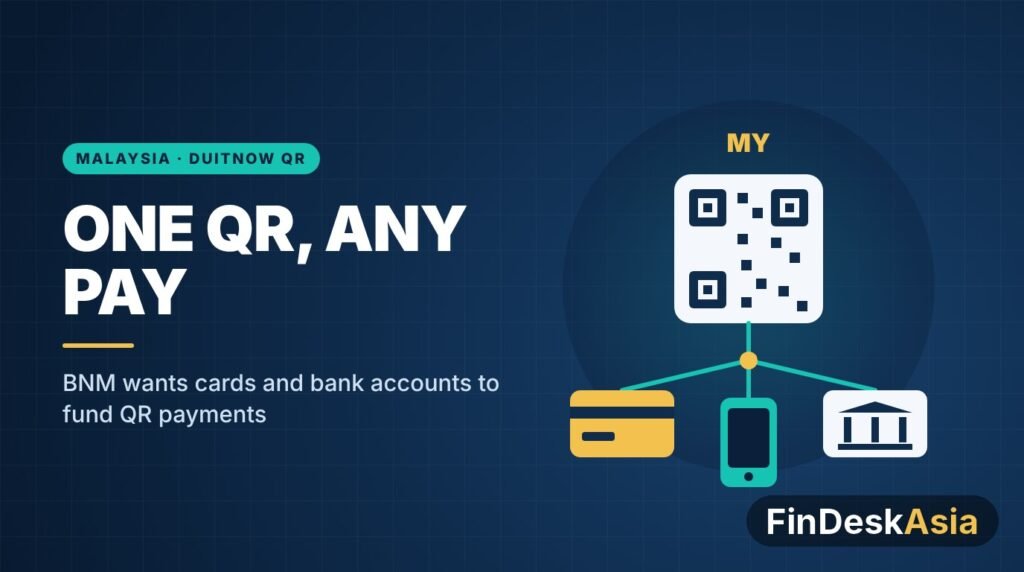
His most practical point: a DuitNow QR merchant should one day be able to accept money drawn from a credit card or an online bank account, so that a visiting tourist can pay at a hawker stall without a Malaysian e-wallet.
Key facts
- BNM wants digital payments to become more accessible, affordable and interoperable (able to work across different providers) in 2027.
- Under BNM’s Interoperable Fund Transfer Framework, banks and e-wallets must move off their own closed QR networks and onto the shared DuitNow QR system by 30 June 2028.
- PayNet, the national payments network, processed 8.4 billion digital payment transactions in 2025, up 37% from a year earlier.
- Cross-border QR payments grew 2.5 times to 29.7 million transactions in 2025.
- Aznan said Malaysians now make about two electronic payments a day, and DuitNow QR is accepted at more than four million points nationwide.
From closed QR codes to one shared network
DuitNow QR is Malaysia’s national QR code standard, run by Payments Network Malaysia (PayNet) on its Real-time Retail Payments Platform. Most shops already show a DuitNow QR that any banking or e-wallet app can scan. But some merchants still display “closed” QR codes that work with only one app, which forces customers to check which wallet a stall accepts before they queue.
BNM’s framework, issued on 30 June 2026, gives providers two years to end this. They cannot sign up new merchants to private QR systems during the changeover, and by June 2028 the national QR should link the different networks and operators. Wallets can still run their own cashback and reward schemes on top of the shared rails.
Aznan’s speech pushes the idea one step further. Today, a DuitNow QR payment is usually funded from a bank or e-wallet balance. He said BNM wants to “give people more choice in how they fund a payment”, naming online bank accounts and credit cards as examples for tourists. He also linked the plan to open finance, the policy that lets licensed firms share customer data with permission, saying it could help trade and tourism across ASEAN.
What it means for Malaysians
- Shoppers: fewer “sorry, we only take this wallet” moments. By mid-2028, any banking or e-wallet app should work at any QR counter, with no new sign-up needed.
- Merchants and SMEs: one QR code instead of a stack of stickers at the till. Aznan said the cost of accepting payments “should stay affordable” and that savings from rising volumes must reach merchants. Small businesses should hear from their bank or payment provider about moving their QR code.
- Banks and e-wallets: less room to lock merchants into closed networks, so competition shifts to rewards, app features and fees. Allowing card-funded QR payments would also open new roles for card issuers in the QR world.
- Tourism: with Visit Malaysia 2026–2027 approaching, letting visitors pay DuitNow QR merchants with cards or foreign bank accounts could widen spending well beyond hotels and malls.
The bigger picture
The numbers explain the urgency. PayNet’s 8.4 billion transactions in 2025 make e-payments a daily habit, and the 2.5-fold jump in cross-border QR payments shows how quickly Malaysian apps are being used abroad and foreign apps here. At the same awards, RHB Bank and ShopeePay won the top e-payment awards in the bank and non-bank categories, while Maybank and TNG Digital, the operator of Touch ‘n Go eWallet, were named top acquirers (firms that sign up merchants to accept payments).
BNM has not yet said how or when card-funded DuitNow QR payments would work, or what fees would apply. Card payments usually carry higher merchant charges than account-to-account QR transfers, so pricing will matter for small traders.
What to watch
- Whether BNM or PayNet publishes a timeline and fee rules for paying DuitNow QR merchants with credit cards or foreign accounts.
- How quickly closed-loop QR codes disappear from counters ahead of the 30 June 2028 deadline.
- Progress on open finance and ASEAN payment links, which Aznan tied to cross-border trade and tourism.
Related on FinDeskAsia: DuitNow explained · PayNet and the regulators
Sources: BernamaBiz (November 2026) · Fintech News Malaysia (November 2026) · BusinessToday Malaysia (November 2026) · RinggitPlus (July 2026)
