
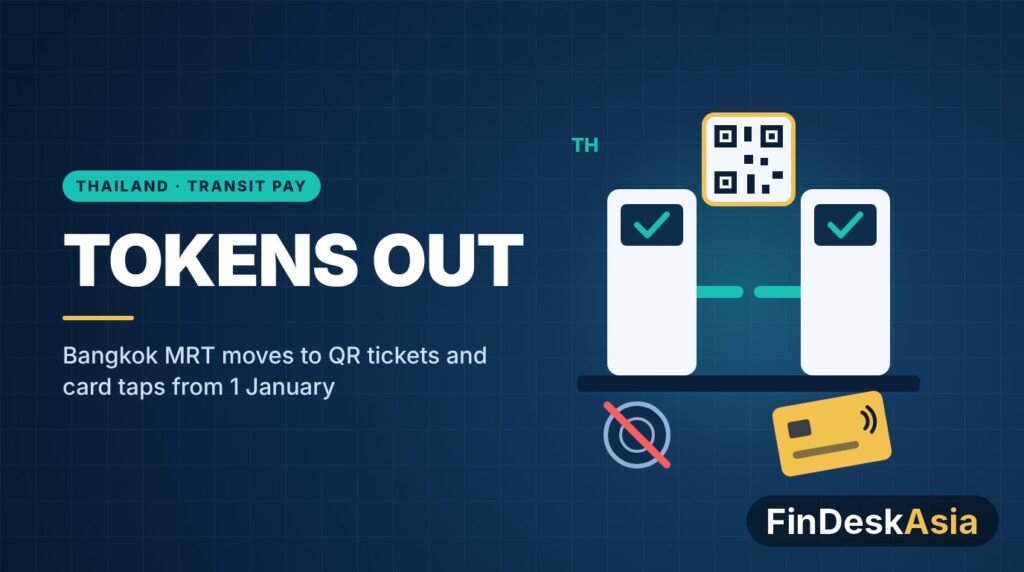
Thailand: Bangkok MRT Swaps Tokens for QR Tickets From 1 January, Cards Get Fare Cap
Bangkok’s MRT Blue and Purple lines will stop taking plastic single-journey tokens on 1 January 2027 and switch to QR code tickets, with public trials expected in December. The change also draws a clear line for Thai riders: only people who pay by contactless bank card or the Mangmoom stored-value card will get the government’s new 17–45 baht fare cap.
Key facts
- Bangkok Expressway and Metro (BEM), which runs the Blue and Purple lines, has fitted QR readers at its fare gates and is testing them now. If tests go smoothly, QR tickets will run alongside tokens from December.
- Tokens will no longer be accepted from 1 January 2027. From then, riders on both lines can pay only with EMV contactless cards, Mangmoom EMV cards or QR tickets.
- About 40% of passengers on the two lines still use tokens, so a large share of riders will have to change how they pay.
- QR tickets will not qualify for the 17–45 baht fare cap, which starts on 1 January 2027 for Thai nationals; the cabinet set aside about 5.8 billion baht to fund it for the first year.
How riders will pay from January
The new set-up gives Bangkok three ways through the gates. EMV contactless is the global chip standard used by Visa, Mastercard and UnionPay cards, so a rider can tap the same card they use in shops. Mangmoom is a dedicated EMV prepaid card for people who don’t want to use a bank card, and BEM is swapping old MRT cards for Mangmoom cards free of charge until 31 December, one per passenger. QR tickets replace the round plastic tokens for one-off trips, which suits tourists and occasional riders.
According to the Bangkok Post, credit cards from all banks will work at the gates, but debit card support is limited to cards from Krungthai Bank, UOB, Krungsri (Bank of Ayudhya), Kasikornbank and Siam Commercial Bank.
The fare cap works as a refund rather than a discount at the gate. Thai riders pay the full fare first, then get the difference back through Pao Tang, the Krungthai Bank app that Thailand uses for government payment schemes. To join, they register their national ID card and a payment card in the app, and the Transport Ministry has said sign-ups will open in December. Because a QR ticket isn’t tied to a person or a card, it can’t be matched to a refund, which explains why it is left out.
Why it matters
The switch is a step towards account-based ticketing, where the gate reads a card or code and the fare is worked out in the back office, instead of loading money onto a transit-only card. Thailand already dropped the old MRT stored-value cards on the two lines in June 2026, and the QR switch completes that clean-up.
It is also part of a bigger plan. Thailand’s Common Ticket Management Act 2025 is in force, and the first phase of a national common ticket, using EMV cards and a Thai QR ticket standard, is aimed at rail in 2027. Buses, boats, expressways and intercity coaches are meant to follow between 2028 and 2030.
For banks and card networks, the fare cap is a strong push: Thai commuters who want cheaper trips now have a reason to carry an EMV card and link it to a government app. Singapore made a similar move with SimplyGo, and Bangkok is another sign that the transit-only card is fading across the region.
What to watch
- Whether the December QR trials run without glitches, and how BEM tells the 40% of token users how to buy QR tickets.
- How quickly Thai riders register on Pao Tang, and how fast refunds land once the fare cap starts.
- Whether more banks add debit card support at the gates, which would widen access for people without credit cards.
Related on FinDeskAsia: ASEAN’s cross-border QR payments hit a record · How Malaysia’s payment system works
Sources: Bangkok Post (November 2026) · BangkokScoop (November 2026) · Thai PBS World (November 2026) · The Nation Thailand (October 2026)
