
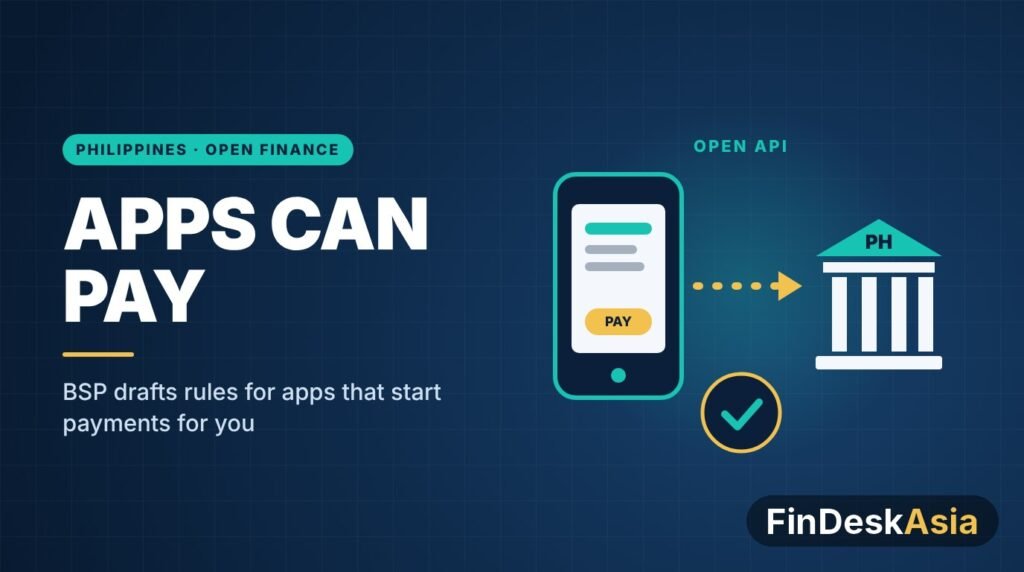
Philippines: BSP Drafts Rules Letting Licensed Apps Start Payments From Bank Accounts
The Philippines’ central bank wants to let licensed third-party apps start payments straight from a customer’s bank or e-wallet account, without ever touching the money. A draft circular from the Bangko Sentral ng Pilipinas (BSP) sets rules for these “payment initiation” providers and, at the same time, formalises a way for smaller institutions to plug into the country’s retail payment rails through a bigger sponsor.
Key facts
- The BSP has published a draft circular creating a framework for payment initiation services (PIS), where an authorised provider triggers a payment from a customer’s account with the customer’s consent.
- PIS providers could not receive or hold customer funds, and would need a minimum capital of ₱5 million, which the BSP may raise for riskier or higher-volume players.
- Banks and electronic money issuers (EMIs) would apply for a certificate of authority by filing a report; other firms would need approval and must file at least 30 business days before they start operating.
- PIS could not be used for gambling, virtual asset service providers or money service businesses such as remittance firms and money changers.
- The draft also recognises clearing sponsorship, letting a BSP-supervised institution clear payments through another participant that is a direct member of an automated clearing house.
What the BSP is proposing
The Philippines runs its everyday digital payments through the National Retail Payment System (NRPS), the BSP’s framework for retail payment “streams” such as InstaPay for real-time transfers and PESONet for batch transfers. Each stream is governed by an automated clearing house (ACH), a binding multilateral agreement that sets who can take part and on what terms.
The first part of the draft deals with access. Under the proposed amendments to the BSP’s Manual of Regulations for Payment Systems, any supervised financial institution could appoint a clearing sponsor institution to clear its transactions through an ACH. The smaller player becomes an indirect clearing participant. According to BusinessWorld, the two sides would need a written agreement covering service levels, liability, customer redress, business continuity and exit terms. The sponsor would have to carry out due diligence, manage liquidity risk and keep each participant’s transactions separately traceable, while the indirect participant stays responsible for its own customers, disputes and anti-money laundering checks.
The second part creates rules for payment initiation. A licensed provider could show the payer the payment details, run the authentication step and send the payment order to the customer’s bank or e-wallet through standardised open APIs and the ACH networks. The provider never takes custody of the funds, and it must get the customer’s explicit consent and disclose fees. BusinessWorld reports that PIS would sit within the BSP’s open finance framework, that exclusive one-to-one deals between a provider and a bank would be banned, and that a provider wanting to exit would need BSP approval three months ahead.
Why it matters
For consumers, payment initiation could mean paying a merchant or a bill directly from a bank account inside a third-party app, without typing in account numbers or first loading money into a wallet. For merchants and fintechs, it opens a regulated route to account-to-account payments, which often cost less than cards. The ban on exclusive bank tie-ups is meant to keep the market open rather than letting a few partnerships lock it up.
Clearing sponsorship matters for rural banks, cooperative banks and smaller EMIs that may find full, direct membership of InstaPay or PESONet too costly or complex. A sponsor model, common in other markets, lets them offer the same instant transfers to their customers while a larger institution handles the connection.
The move also fits a regional trend. Singapore, Thailand, Malaysia and Indonesia are all working on open finance and wider access to their fast-payment systems, and the BSP recently agreed with Bank Negara Malaysia to deepen cooperation on payment links. Clear rules for who can initiate payments make future cross-border connections easier to plug in.
What to watch
- Industry feedback: Philstar reports that stakeholders can comment until 11 December, and the rules would take effect 15 calendar days after the final version is published.
- Whether big e-wallets such as GCash and Maya, or fintech start-ups, apply to become payment initiation providers once the rules are final.
- How many smaller banks and EMIs use clearing sponsors to reach InstaPay and PESONet.
Related on FinDeskAsia: Bank Negara and Philippines’ BSP sign pact on payment links and GCash readies ‘No Signal Pay’ for tap payments without mobile data.
Sources: BusinessWorld (November 2026); The Philippine Star (November 2026).
