
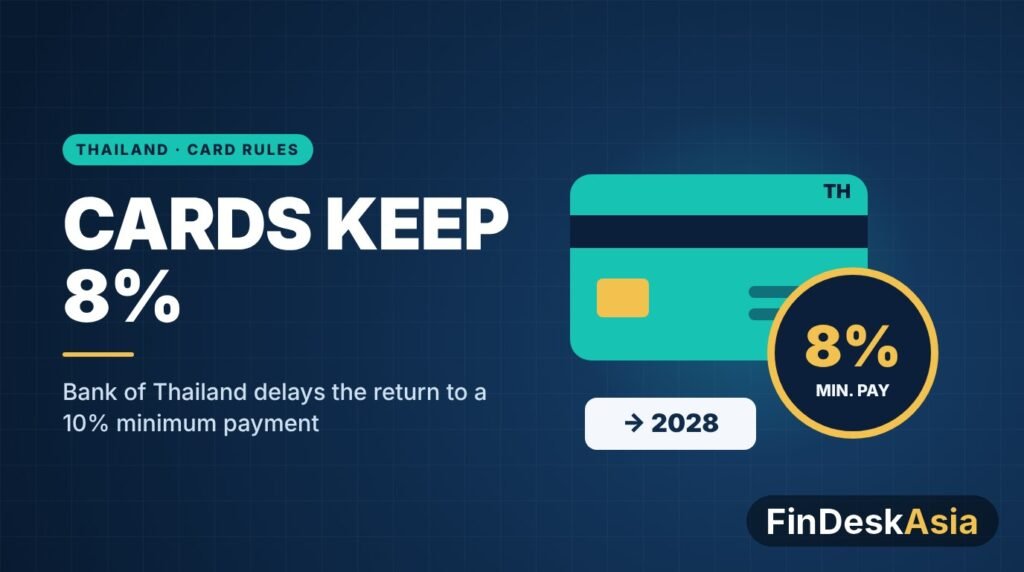
Thailand: Central Bank Keeps 8% Credit Card Minimum Payment Until End-2028
Thailand’s central bank is giving credit card holders two more years of breathing room. The Bank of Thailand (BOT) said on 23 November 2026 that card issuers may keep the minimum monthly repayment at 8% of the outstanding balance until the end of 2028, instead of letting it climb back to 10% when the current relief expires at the end of this year.
The decision matters for millions of Thai borrowers who only pay the minimum each month, and for the banks and card companies that lend to them.
Key facts
- The 8% minimum monthly payment on credit cards now runs to 31 December 2028. It had been due to end on 31 December 2026.
- Without the extension, the minimum would have gone back to 10% from 1 January 2027.
- BOT Governor Vithai Rattanakorn said incomes are recovering overall, but some borrowers’ earnings have not fully bounced back, so a jump to 10% could squeeze their cash flow.
- The BOT says it will keep monitoring the measure before deciding what the right long-term rate should be.
How Thailand got here
A “minimum payment” is the smallest amount a cardholder must pay each month to stay current; the rest of the balance rolls over and keeps collecting interest. Before the pandemic, Thai cardholders had to pay at least 10%. In 2020 the BOT cut this to 5% to help people through COVID-19 lockdowns.
The plan was then to step back up in stages: 8% from January 2024 and 10% from January 2025. The first step went ahead, but the second has been postponed repeatedly. In December 2025 the BOT pushed the 10% return to 2027. Monday’s move pushes it out again, beyond 2028.
Under the 2025 package, borrowers who paid at least 8% received a quarterly cashback equal to a 0.25% interest cut on their balance. Those who could not manage 8% were allowed to turn their card debt into an instalment term loan before it went bad, while keeping the rest of their card limit. The latest announcements focus on the 8% rate and do not spell out whether these extras continue.
Why it matters
Household debt is a long-running worry in Thailand, and the central bank has spent several years trying to bring it down without tipping struggling families into default. Raising the minimum payment speeds up debt repayment, but it also takes a bigger bite out of monthly income. The BOT’s choice signals that it sees the second risk as the bigger one for now.
For cardholders, an 8% minimum means smaller monthly bills than 10% would bring, but it also means balances, and interest costs, stay on the books for longer. Paying only the minimum remains an expensive way to borrow.
For lenders, the extension removes a source of stress. Analysts quoted by Thai business outlet Kaohoon said listed card issuers such as Krungthai Card (KTC) and AEON Thana Sinsap could benefit, because a sudden jump in required payments could have pushed more customers into arrears. Kaohoon also cited a brokerage report saying both firms saw higher credit costs after the minimum rose from 5% to 8% in 2024.
Across the region, the move is a reminder that card and consumer-credit rules are being used as tools to manage household debt, not just to protect consumers. Other central banks watching rising consumer borrowing, including through buy now, pay later (BNPL), face similar trade-offs between faster repayment and short-term pain for borrowers.
What to watch
- Whether the BOT confirms that the cashback and term-loan conversion options also run to 2028.
- Card issuers’ asset quality and credit costs in their next quarterly results.
- Any BOT signal on when, or whether, the minimum will finally return to 10%.
Related on FinDeskAsia: How Malaysia’s payment system works · Malaysia’s e-wallet war
Sources: Kaohoon International (Nov 2026); Kaohoon International, KTC and AEONTS (Nov 2026); Thansettakij (Nov 2026); Posttoday (Nov 2026); Daily News (Nov 2026); Bank of Thailand (Dec 2025); The Nation (Nov 2023)
