
ShopeePay Raises Money+ Limit to RM30,000, Above Touch ’n Go’s GO+ Cap
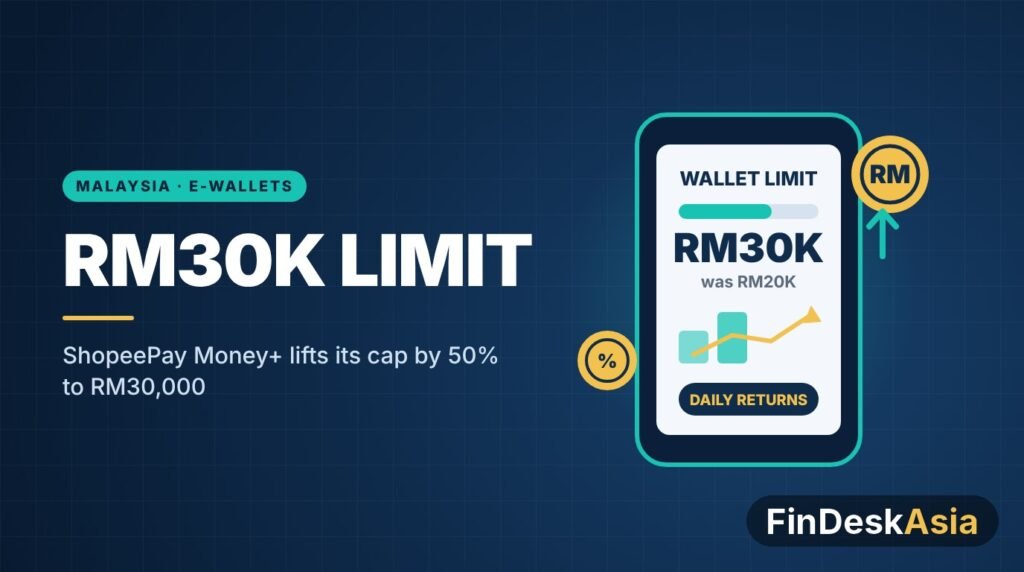
ShopeePay has raised the maximum balance Malaysians can keep in Money+, its in-app savings and investment feature, from RM20,000 to RM30,000. The higher cap costs users nothing and lifts the product above the RM20,000 ceiling on Touch ’n Go’s rival GO+ feature, sharpening the fight over where Malaysians park their spare cash inside e-wallets.
Key facts
- The Money+ holding limit rises by 50%, from RM20,000 to RM30,000, matching the RM30,000 limit ShopeePay set for its main e-wallet in January 2026.
- Money+ balances go into the Eastspring Investments Islamic E-Duit Fund, a Shariah-compliant money market fund, distributed through iFAST Capital. The base return is about 3% a year and changes daily.
- A promotion running until 30 November 2026 adds a ShopeePay-funded bonus of up to 2% a year on the first RM10,000, for an indicative total of up to 5%. Users must keep at least RM200 in Money+.
- The bonus comes from a RM1.7 million budget given out first come, first served, so it can end before the deadline.
- Money+ is an investment, not a bank deposit or e-money. Returns are not guaranteed and balances are not protected by PIDM, Malaysia’s deposit insurance agency.
How Money+ works
Money+ launched in January 2026. Instead of sitting idle in the e-wallet, money moved into Money+ is invested in units of a money market fund, which holds short-term, Shariah-compliant instruments. Returns are credited daily, and there is no lock-in period, so users can take money out whenever they want.
The key selling point is convenience. Users can scan DuitNow QR codes at shops, pay for Shopee orders or send money to friends and family straight from the Money+ balance, without first moving the money back into the main wallet. DuitNow QR is Malaysia’s national QR payment standard, run by PayNet, so the balance can be spent at the many merchants that accept DuitNow QR.
To sign up, users must be Malaysian citizens aged 18 or above, finish eKYC (electronic identity checks done in the app) and have no US tax ties. Because the underlying fund is a unit trust product, it falls under the Securities Commission Malaysia rather than Bank Negara Malaysia’s e-money rules.
What it means for Malaysians
For savers: RM30,000 is a meaningful amount for many households, so Money+ can now act as a full emergency fund that also earns a return. But users should read the fine print. The headline 5% applies only to the first RM10,000, only during the promotion, and only while the RM1.7 million bonus pool lasts. Money above RM10,000 earns the base fund rate, roughly 3%, which can go up or down. Top-ups made after 2pm on a business day start earning the next business day, and bonuses for weekends and public holidays are paid on the next working day.
For risk: because Money+ is not a deposit, it does not carry PIDM protection. Money market funds are low risk, but they are not risk-free. Keeping more than a modest sum in any single app also raises the stakes if a phone or account is compromised, so strong passwords and app security settings matter more as limits rise.
For merchants and the market: the move continues a race between e-wallets to become the place where users hold money, not just spend it. Touch ’n Go raised its GO+ limit to RM20,000 in November 2024. Higher balances inside wallets mean more spending flows through DuitNow QR at shops, which supports merchant acceptance. For banks, it is another sign that fintech apps are competing for everyday savings that once sat in current and savings accounts.
What to watch
- Whether Touch ’n Go and other wallets respond by raising their own limits or adding bonus returns.
- How fast the RM1.7 million bonus pool is used up, and whether ShopeePay extends the promotion beyond 30 November.
- Any guidance from regulators on how app-based investment features should explain risks to retail users.
Read more: Inside Malaysia’s e-wallet war and DuitNow explained.
Sources: Fintech News Malaysia (Oct 2026), Business Today (Oct 2026), SoyaCincau (Oct 2026), RinggitPlus (Nov 2024).
